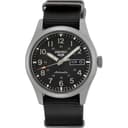
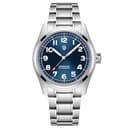
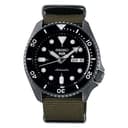
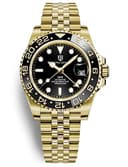
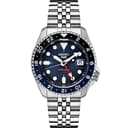
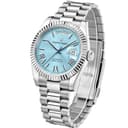
Where Pagani Design genuinely wins
The crystal
Every Pagani reference on this page states a sapphire crystal. Every Seiko on this page states Hardlex, which is Seiko’s own mineral glass. Sapphire sits at 9 on the Mohs scale against mineral’s 5.5 or so, and the practical consequence is simple: sapphire resists the everyday scratches that mineral picks up from doorframes and desk edges. This is not a close call and it is not marketing. Our sapphire versus mineral comparison works through what the hardness difference does and does not buy you.
The water rating
The Pagani NH35A Pilot states 200m. The Seiko 5 Sports references here state 100m. Both are more than most lives require — 100m covers swimming and water sports — but 200m is the figure that stops you thinking about it, and the cheaper watch has it. Note what Seiko reserves for Prospex rather than 5 Sports: an actual ISO 6425 diver’s marking with a screw-down crown, which neither brand on this page offers at these prices.
The movement, on one specific reference
The PD1759 and the PD-1651 both state a Seiko NH35 or NH35A. That caliber is made by Seiko Instruments and sold to other manufacturers — it is the workhorse that the entire affordable-automatic industry runs on, it hacks, it hand-winds, and any competent watchmaker can service it. Buying a Pagani with an NH35 means buying a Japanese movement in a Chinese case. Our NH35 roundup covers the caliber and the watches built around it.
Where Seiko wins, and why it is worth the money anyway
Published figures instead of a parts list
Seiko publishes an accuracy band for the 4R35/4R36 — +45 to −35 seconds a day, measured worn on the wrist — along with 24 jewels, 21,600 vibrations an hour and roughly 41 hours of reserve. Pagani publishes none of that for any reference here. Worse, its disclosure is inconsistent: where Pagani has a Seiko caliber it names it, and where it does not, the listing drops to “automatic mechanical” with no name at all — which is the case on both GMT references on this page. The DD36 names an ST16. A brand that names the movement when the movement is impressive and goes quiet when it is not has told you something.
Service, and the ten-year question
A mechanical watch is a machine that will eventually need an overhaul. Seiko runs its own repair and overhaul channel; a Seiko bought today can be sent to Seiko in a decade. Pagani Design has no equivalent, and a watch with an NH35 in it is serviceable by an independent watchmaker — which is a genuine mitigation, and also means the service will likely cost more than a replacement Pagani. Our service cost guide covers what that bill looks like.
Resale, and the thing nobody admits
A Seiko 5 Sports holds a reasonable second-hand price. A Pagani Design does not, and there is no mystery to it: the brand has no secondary market. If you buy a Seiko and fall out of love with it, you recover much of the money. If you buy a Pagani, you own it.
The GMT case, which is the clearest version of this choice
Both brands sell a mechanical GMT, and the gap is the whole comparison in one row. Seiko’s 5 Sports GMT runs the 4R34 — a true 24-hour second-time-zone caliber Seiko documents, in a 42.5mm case with 100m and Hardlex. Pagani’s GMT is about a third of the price with a sapphire crystal and 100m, and names no caliber. If a mechanical GMT is the goal and the budget is $150, there is no Seiko answer at all, which makes the Pagani the only option rather than the compromise. If the budget reaches the Seiko, take the Seiko. Our GMT roundup has the full field, and the Seiko 5 GMT review covers the 4R34 references in detail.
How to decide in one question
Ask whether this is the watch or a watch. If you are buying one automatic to wear for the next decade, buy the Seiko: the published figures, the service route and the resale all matter over that horizon, and none of them show up on a spec sheet. If you are buying a third pilot watch, or a case shape you want to try, or a mechanical GMT for $150, buy the Pagani — the specification is real, the NH35 references are honestly good, and nobody needs a service plan for a watch that cost less than a bracelet.
And if neither answer feels right, the brand that splits the difference is Orient: in-house calibers with published figures, Japanese, and priced between the two. Our Orient roundup and Seiko vs Orient vs Citizen cover that route.