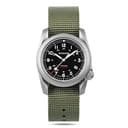
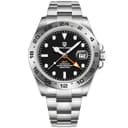
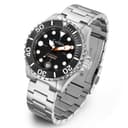
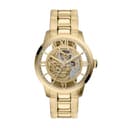
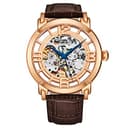
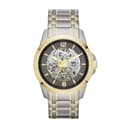
How we picked
1. A named, serviceable movement
The single biggest thing that changes at this price is that you can buy a watch with a caliber you can look up. The Seiko NH35 — the unbranded cousin of Seiko’s own 4R35 — is the workhorse here: hacking, hand-winding, documented, and serviceable by any watchmaker anywhere. A $130 watch with an NH35 in it has a longer realistic service life than a $170 watch with an unnamed caliber, and that is the ranking logic on this page. Our guide to automatic watch movements explains what the names mean and which ones actually matter.
2. Sapphire, or a good reason not to have it
Sapphire crystals become genuinely common in this band, which is significant because a scratched crystal is the thing that makes an old watch look old. Two picks here have it. Where a watch doesn’t — the Fossil and Relic skeletons, both mineral-class — the trade is a design or a brand you wanted, and we have said so rather than glossing over it.
3. Case material and honest ratings
Titanium at $145 is the headline spec of this whole page. It is lighter than steel, does not provoke nickel reactions, and it feels different on the wrist in a way people notice immediately. It also scratches more visibly than steel, which is the trade. Alongside that, we have preferred watches whose water resistance is stated as a real figure rather than implied by a diver’s bezel — what those markings actually permit is covered in our dive watch guide.
4. Design that isn’t borrowed — or that admits it is
This band is full of homages: watches that copy a famous design without faking a brand. That is legal and extremely common, and for a lot of buyers it is exactly the appeal. Our position is that it should be stated rather than implied, so the Pagani Design GMT is described on its card as what it is. The Boderry and the Fossil are on this list partly because they aren’t copying anything.
Micro-brand or high street?
This is the real decision in this band, and it is not a spec question.
Micro-brands — Boderry, Pagani Design, CADISEN — give you more watch per dollar than anyone else, because you are not paying for retail markup, marketing or a service network. You are also not getting any of those things. If the watch arrives faulty you are dealing with a marketplace returns process, and in five years there may be nobody to send it to. For a $145 watch with a documented movement, that is a rational trade; a watchmaker can service an NH35 without the brand’s help.
High-street brands — Fossil, Relic — reverse it. You get a warranty, a returns path and a company that will exist next year, and in exchange the movement is undocumented and the money buys design rather than specification. That is a legitimate purchase; it just isn’t a spec argument, and the marketing at this level tends to imply otherwise.
There is no universally correct answer. If the watch is a gift or a first mechanical, the high-street option is easier to live with. If you already know you like watches and you want the most watch for the money, the micro-brands win comfortably.
What $200 doesn’t buy yet
Two things stay out of reach in this band, and it is worth knowing which.
An in-house movement from a major brand. Seiko’s 4R36 and Orient’s own calibers start at roughly $180–$250 and are the backbone of our under-$300 picks. The difference is not raw accuracy so much as documentation, parts availability and the fact that the company that made the movement also made the watch.
Finishing you notice. Applied indices, sharply brushed case flanks, a bracelet whose links don’t rattle — these are the things that separate a $175 watch from a $400 one when you hold both. Specs won’t show you the difference; hands will.
Neither is a reason to skip this band. They are the reason our under-$500 page exists, and the honest framing is that under $200 you buy specification, and above it you start buying execution.
If you specifically want a diver at this price
Dive watches are where the sub-$200 market is strongest, because a Seiko NH35 and a sapphire crystal leave room in the budget for a properly sealed case. Our best automatic dive watches under $200 applies a single entry rule — a published water-resistance figure of 100m or more — and explains which dive-styled watches at this price cannot meet it.