The four things that decide a box for an expensive watch
1. Pillow fit, which is sized by bracelet circumference
This is the one people get wrong, because boxes are sold by slot count and not by fit. A watch on a steel bracelet needs a pillow that fills the bracelet without stretching it; too small and the watch rolls and the clasp knocks the case, too large and you are putting constant tension on the links. The winder industry is further ahead on stating this than the box industry is — Barrington, for instance, sizes its winder cushions by strap circumference, offering one for 16.5–22cm and a smaller one for 12.5–16.5cm, and says the larger suits about 85% of customers. Box makers rarely publish an equivalent figure, which is why “pillows suit medium wrists best” appears in the cons on more than one pick above. If your bracelet is sized for a large wrist, expect to have to squeeze or swap a pillow.
2. The liner material
Hairlines on a polished case do not come from one dramatic event; they come from thousands of small contacts with something slightly harder than the clear coat on your patience. A microsuede or ultra-soft velour liner is the difference between a case that still looks sharp in five years and one that has acquired a fine haze where it sat. Everyday grit is largely quartz, which sits at 7 on the Mohs hardness scale, and a dusty liner is therefore an abrasive liner — which is also the argument for a closed lid over an open tray.
3. What a lock is for
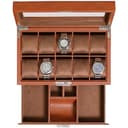
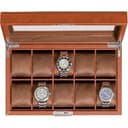
A lock on a watch box is a deterrent and a privacy device. It stops a guest, a cleaner, a curious teenager or a contractor from opening it on impulse, and that is a real and useful function. It does not stop anybody who wants the contents — a leather-covered board box with a glass lid comes apart in seconds. Both Rothwell picks above are honest about this in their own cons, and so are we: if the collection is genuinely valuable, the same logic applies to lockable winders, and the real answer is a safe plus the right insurance rider.
4. Glass lid versus closed box
A glass display lid is the reason most people buy this kind of box, and it has one cost: display means light. Sustained direct sunlight is hard on strap leather and on dial finishes over years, so a glass-topped box belongs out of a window’s direct path. If the box is going to sit in a bright room, a closed box or a drawer insert protects better — and how to store automatic watches covers the rest of the environment, including the magnetic fields that are a far more common problem than light.
Capacity: buy for the collection you have
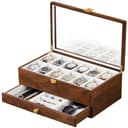
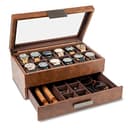
The classic overspend in this category is capacity. Twenty-four slots for six watches looks worse than six slots for six watches, and the empty pillows are dead weight until you grow into them. If you own one expensive watch and two others, a six- or ten-slot box is the right object; our small watch box roundup covers the 2–6 range and the large boxes pick up at ten and above. A valet drawer is usually more useful than four more watch slots, because the clutter around a watch collection is rarely more watches — it is straps, a spring-bar tool, cufflinks and a bracelet’s worth of removed links.
Does a Rolex need a winder instead?
Only under one condition: you rotate it but do not wear it often enough to keep it running, and it has a complication you would rather not reset. A date-only automatic takes ten seconds to set, so for most owners of one watch the box is the correct purchase and the winder is an optional convenience. If you do want one, winders for this class of watch are the one place where published turns-per-day and direction control genuinely matter — our winder page for Rolex and Omega is built around exactly that, and winder versus box is the decision itself, argued honestly.
A note on magnetism while we are here, because a storage decision is where it bites: ISO 764 defines a magnetic-resistant watch as one that survives a 4,800 A/m field and still keeps its previous rate to within ±30 seconds a day. Most watches are not rated to it. The practical rule is simply not to store a watch on or beside a speaker, a tablet cover, a laptop or a magnetic catch — and if the rate suddenly goes strange, demagnetising is a five-minute fix rather than a service.
What about travel?
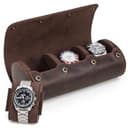
A box is not a travel case, and a watch worth real money should not go in checked luggage in either. The pick above is a full-grain leather roll with removable pillows that fits a carry-on pocket; it protects against scratching and tangling rather than crushing. If you want hard-shell protection instead, the travel case roundup covers both formats.