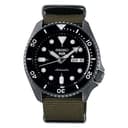
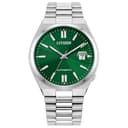
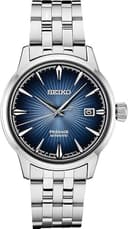
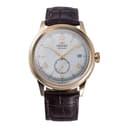
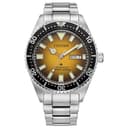
The three houses, and what each is actually good at
Seiko: the documentation and the service network
Seiko is the only one of the three that publishes an accuracy band you can hold it to at this price. Its own specification for the 4R35/4R36 states automatic plus hand-winding, 24 jewels, 21,600 vibrations an hour, about 41 hours of reserve and a rate of +45 to −35 seconds a day worn on the wrist. That last figure is wide, and publishing it is the point: it is a promise rather than a boast, and it is why we can tell someone whose watch gains 20 seconds a day that their watch is behaving exactly as specified. Seiko also runs its own repair and overhaul channel, which almost nothing else at this money does. The trade is the crystal: Hardlex mineral on most of the affordable range, not sapphire.
Orient: the most watch per dollar, and the fullest spec sheets
Orient is the value house, and it is less of an underdog than it looks. By its own account the company started in 1950 and merged with Seiko Epson in 2017, which now operates both Orient and Orient Star from planning through manufacturing. The practical consequence is that an Orient diver at $250 is built inside one of the two Japanese groups that make calibers at scale, not bought in from a catalogue. Orient also publishes more dimensional detail than anyone: diameter, lug-to-lug, thickness and lug width for every reference, which is the data you need to buy a watch unseen. Its F6922 hacks and hand-winds, and the Kamasu gets sapphire where the Mako II has mineral — the only real difference between those two.
Citizen: the movement arm nobody credits
Citizen is the quiet giant of this category because of Miyota. Per Miyota’s own account, Citizen Watch built a movement factory in the town of Miyota, Nagano in 1959, launched the MIYOTA brand in 1980, and its movements now run in millions of watches — many of them wearing other companies’ names. Under Citizen’s own dial the automatic to know is the 8210: the Tsuyosa publishes a 42-hour reserve, a hack feature, a sapphire crystal and WR50, which is a genuinely strong sheet for the money. Citizen publishes no daily accuracy figure, and one quirk is worth knowing — the earliest Tsuyosa units did not hack, while current production does.
How to choose between them
In practice the decision is made by what you want the watch to do, because all three houses are reliable:
- First automatic, want it to last and be serviceable: Seiko 5 Sports. The published rate, the day-date, the see-through caseback and the service channel are the whole argument, and the Seiko 5 roundup covers the line.
- Swimming, snorkelling, a watch you will knock about: Orient Kamasu or the Citizen Promaster diver — a stated 200m, a screw-down crown and a unidirectional bezel. The dive roundup has the full field.
- A jacket, a cuff, a wedding: Seiko Presage or an Orient Bambino. Both are 40mm or under with a domed or box-shaped crystal, and both read as considerably more expensive watches than they are. Best dress automatics is the category page.
- One watch for everything, on a bracelet: Citizen Tsuyosa at 40mm with sapphire, or the Seiko 5 if you want the day-date and the higher water rating. Everyday automatics compares the two cases directly.
What a Japanese automatic will not do
Keep chronometer time. None of these movements is a certified chronometer and none claims to be: COSC certification requires an average rate of −4 to +6 seconds a day across fifteen days in five positions and three temperatures, and nothing in this price band is submitted for it. A Japanese workhorse caliber will typically sit somewhere inside its published band and drift as you change how you wear it and how it rests overnight. If that bothers you, the honest fix is positional experimentation rather than a service — automatic watch accuracy explains what is normal and what is a fault.
They also will not hold their value, with narrow exceptions. These are production watches made in large numbers; buy them to wear. And they will all eventually want servicing, which on a $250 watch is a real economic question rather than an obvious yes — what a service costs is worth reading before the watch is ten years old, not after.
Where Swiss and Chinese watches fit around this
Below Japanese prices, the market is Chinese: Seagull’s ST1901 hand-wound chronograph is a genuine piece of engineering with its own history, and the NH35 homage brands deliver specifications Japanese makers will not match at the money — sapphire and 200m for $150 — without the design, documentation or service. Above, Swiss mechanicals start around where the Japanese range ends and buy you finishing, provenance and, in some cases, a certified rate. Our Seiko vs Orient vs Citizen comparison is the head-to-head inside Japan, and best automatic watch brands is the map of the whole market, including who makes their own movements and who does not.