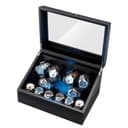
How we picked
Five criteria, in this order. The first two are specific to this format; the rest are the standard winder questions applied to a bigger box.
1. The powered-to-static ratio
This is the spec that decides whether a cabinet fits your collection or fights it. A 2+3 suits someone with two daily automatics and a few kept watches. A 6+6 suits a genuinely large collection with a real rotation. Buying an 8+6 for four watches is the same mistake as buying an eight-position winder for four watches, with a larger footprint attached. Count your fortnightly wearers first; that number is how many powered positions you need, and everything else should be static.
2. Whether the storage half is actually good
Storage slots cost a maker almost nothing to add, which is why they appear on cheap cabinets so readily. What separates a real storage half from a marketing number is padding and pillow sizing: slots that don’t hold a watch snugly let cases slide and rub, which marks a bracelet faster than any winder motor ever will. Where a listing states removable pillows and a lined interior we have said so; where it doesn’t, we haven’t assumed.
3. Independent control on the powered positions
The same rule as every other winder page: different calibers want different turn counts and sometimes different directions, so a cabinet that applies one mode to every powered slot forces a compromise. This is less painful here than on a pure multi-winder, because you have fewer powered positions to compromise — but it is still the first thing to check. Bring your movement’s figure from our TPD settings guide rather than trusting that a preset lands close.
4. A lock, and what a lock is worth
Two picks here lock. It is worth being precise about what that buys, because the listings are not: a lock on a wooden cabinet is a deterrent, not security. It keeps children, house guests and cleaners out of a watch collection, which is a genuinely useful thing. It will not slow down anyone who came to steal, and no cabinet on this page should be treated as a substitute for a safe or for insurance.
5. Footprint and where it will live
A 6+6 cabinet is a piece of furniture with a mains cable. Measure the shelf before you order, and check there is a socket in reach — none of these picks runs on batteries for long. The 2+3 Liliaafar is here specifically because it is the one option that fits on a normal dresser without dominating it, and for a lot of households that is the deciding spec rather than a footnote.
Winder plus storage, or a winder and a box?
Two separate objects give you more flexibility and often better quality per dollar: a well-chosen single winder for the watch that needs it, and a good watch box for everything else, will usually beat a budget combined cabinet on both halves. They also let you put the winder on a nightstand and the box in a drawer.
The combined cabinet wins on three things: one power cable, one footprint, and a lower total price at the same capacity. It also wins on the thing nobody puts in a spec table — you are far more likely to actually use a storage slot that is eighteen inches from the watch you just took off than a box in another room. If your watches currently live in their boxes on a shelf, or loose in a drawer, the combined cabinet is the format most likely to change that.
What the money buys
The spread on this page is roughly five to one, and almost none of it is winding competence. In ascending order the money buys: more storage slots, a jewelry drawer, a lock, a quieter and better-documented motor, a real cuff mechanism rather than a foam pillow, wood instead of veneered board, and a brand with a service history. WOLF sits at the top of this list because it delivers the last four; it is also several times the price of the 6+6 cabinets, and if the watches going into it cost less than the cabinet does, that is a signal worth heeding.
At the other end, the $85 Mcbazel gives you twelve positions — six powered, six static — for less than a single premium winder. Nothing about it is refined, and its turns-per-day figures are not published. But if the alternative is watches stacked in a drawer, it is a real improvement for very little money, and we would rather say that plainly than pretend the expensive option is the only defensible one.
Setting one up
Hand-wind each watch 20 to 40 crown turns before seating it in a powered position — a winder maintains a running watch and is slow at starting a dead one. Set direction before turn count; a winder running the wrong way for a given movement spins the rotor without winding anything, which is the most common reason a new winder gets returned as faulty. Our guide to winding an automatic watch covers the mechanics, including why overwinding is not something you can do.
For the storage half, the useful habit is to store watches wound down rather than fully wound, and to keep them out of direct sunlight — UV fades dials and dries out leather straps far faster than age does. Snug the bracelet or strap on each pillow so nothing shifts when the cabinet is opened and closed. And switch off any powered position you aren’t using, where the design allows it.
If the cabinet also has to keep people out of it, our lockable winder and box picks cover the cabinets here that take a key or a fingerprint reader — and say plainly what a lock fitted to a wooden case is actually worth.