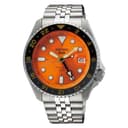
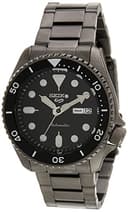
What the SSK001 actually is
A stainless steel automatic with a 24-hour hand, a date, and a rotating bezel marked in 24 hours rather than 60 minutes. Seiko’s own product page describes the case and dial as drawing on the Seiko SKX series — the shape most people picture when they picture a Seiko — and states the specification as caliber 4R34, automatic with manual winding, 24 jewels, approximately 41 hours of power reserve, 42.5mm in diameter, 13.6mm thick, 46.0mm lug to lug, 22mm between the lugs, a Hardlex crystal with a magnifier over the date, LumiBrite on the hands and indexes, 10 bar water resistance, magnetic resistance of 4,800 A/m, and a see-through screw case back. It weighs 161 grams on its bracelet.
Seiko lists it at $495 on its own US store. Amazon is normally the cheaper route and what it charges moves from week to week, which is exactly why the figure in the buy row above comes from a live check instead of from this paragraph.
The functions Seiko names are worth reading precisely, because they are the whole argument: 24-hour hand (dual time display function), stop second hand function, and date display. The second of those is hacking — the seconds hand stops when you pull the crown, so the watch can be set to the second. Our guide to what hacking means on a watch explains why that matters more than it sounds.
The 4R34, in Seiko’s own numbers
The 4R34 is the GMT member of the 4R family that powers most of the rest of the Seiko 5 line. Seiko’s instruction sheet for the caliber states 24 jewels, 21,600 vibrations per hour — six per second — four hands plus a date, and a factory-adjusted accuracy of +45 to −35 seconds per day at normal temperature range. Seiko prints the caveat itself: the actual daily rate of any mechanical watch may fall outside that window depending on how it is worn and stored.
Note that the spec table above reads “Not published” against accuracy. That is deliberate and it is accurate: Seiko states the figure for the caliber, not for the SSK001 as a finished reference, and we do not move a number from one document into a field it was not written for.
Caller, not traveler — and why that is the whole decision
There are two ways to build a GMT. A traveler GMT lets you jump the local hour hand forward or back in one-hour steps without stopping the watch, so you land, pull the crown one click, and you are on local time with home time still showing on the 24-hour hand. A caller GMT works the other way round: the 24-hour hand is the one you set, and the local hands stay where they are.
The 4R34 is a caller. Seiko’s instructions for the caliber walk you through setting the 24-hour hand to a different time zone; there is no independent local-hour adjustment to walk you through. In practice the SSK001 is excellent at tracking a second zone you care about from home — a colleague in London, family in Manila, a market that opens while you are asleep — and mildly annoying to re-set on arrival if you genuinely fly with it, because you reset the main time and then re-check the 24-hour hand.
That is a category, not a defect. Nothing at this price is a traveler GMT, and most people who buy one never leave their own time zone with it. But if you are buying specifically to make landing easier, buy something else — and be clear that the something else costs several times more. Our roundup of automatic GMT watches covers the rest of the affordable field on exactly this distinction.
The accuracy figure, read correctly
A window of +45 to −35 seconds a day looks alarming beside a quartz watch that loses seconds a month. Two things make it less so. The first is that it is a tolerance, not a typical result — it is the band Seiko guarantees, and well-behaved 4R movements commonly settle inside a much narrower range. The second is that a mechanical watch’s error is consistent in a way that makes it correctable: if yours runs +8 seconds a day, that is +56 a week, and you reset it on a Sunday.
What you should not do is buy a mechanical watch for accuracy. If chronometer numbers matter to you, the honest answer is quartz, and our guide to automatic watch accuracy makes that case in full.
The two dimensions that decide whether it fits
Diameter is the number everyone quotes and the less useful of the two. 42.5mm is large but not extreme. The number that actually decides fit is the 46.0mm lug-to-lug, because that is the measurement which has to sit between the two edges of your wrist — and Seiko, to its credit, publishes it, which most brands at this price do not.
As a rough guide, 46mm lug-to-lug sits comfortably on a wrist of about 6.75 inches and up, is wearable but visually large from roughly 6.5 inches, and will overhang below that. Add 13.6mm of thickness and this is a watch with presence: it catches a shirt cuff, and it is not the watch to buy if you wanted something that disappears. If any of that sounds like a problem, our watch size guide explains how to measure your own wrist properly before you spend, and our small-wrist roundup lists the automatics that solve it.
The three honest complaints
1. Hardlex, not sapphire
Seiko fits its own Hardlex mineral glass rather than sapphire, and at this price that is the most contested decision on the watch. Hardlex resists shattering well and scratches far more easily; sapphire is the reverse. Homage brands fit sapphire for a third of the money, which makes the omission look worse than it is — but it is still an omission, and it is why a well-worn SSK001 often carries a visible hairline or two across the crystal. Our sapphire versus mineral comparison covers what each one actually survives.
2. It is a thick watch
13.6mm is not unusual for an automatic with a rotating bezel, but combined with the 46mm lug-to-lug it makes the SSK001 wear like a tool watch rather than a travel watch. The Japan-market SBSC011 field GMT in the list above is the same movement in a bezel-free 39.4mm field case, for anyone who wants the function without the bulk.
3. The bezel does not do what a diver’s bezel does
The bezel rotates and is marked in 24 hours, which lets you read a third time zone by offsetting it against the GMT hand. It is not a unidirectional elapsed-time bezel and it does not lock. That is the correct design for a GMT and the wrong one for diving — which brings us to the complaint we do not think is fair.
The complaint that is not fair: “it is not a real diver”
It is not, and it never claimed to be. Seiko rates the SSK001 at 10 bar and does not mark it “Diver’s 200m”, which is the marking reserved for watches meeting ISO 6425. 10 bar is comfortably enough for swimming, showering and being caught in weather; it is not a scuba rating, and Seiko does not pretend otherwise. Our explainer on what water resistance ratings mean covers where the line sits, and if a genuine ISO-rated diver is what you actually want, the automatic dive watch roundup is the page you want instead of this one.
One more published figure worth knowing: Seiko states magnetic resistance of 4,800 A/m, which is ordinary for a mechanical watch and means the usual suspects — laptop speakers, magnetic phone mounts, handbag clasps — can still upset its rate. If a watch suddenly starts gaining minutes a day, magnetism is the first thing to rule out, and our guide on how to demagnetize a watch explains the fix.
Living with it: winding, wearing, storing
The 4R34 hand-winds, so there is no need to shake the watch to start it — wind the crown in its neutral position until it resists, then set the time. Approximately 41 hours of reserve means a watch taken off on Friday evening is usually stopped by Sunday morning, which is the normal rhythm for a 4R and the reason owners start looking at winders. Whether you need one is a real question rather than a foregone conclusion, and our guide on whether automatic watches need a winder answers it honestly for a single-watch collection.
The bracelet uses a three-fold clasp with a push-button release, and the lugs are 22mm — the most common strap width there is, so replacements are plentiful and cheap if the bracelet does not suit you. Sizing the bracelet is a ten-minute job with the right tool; our bracelet resizing guide walks through it.
Who should buy the SSK001
Buy it if you want a mechanical second time zone from a company that builds its own movements and publishes their specifications, you have a wrist that carries 46mm lug-to-lug, and you are tracking a zone from home rather than flying between them. On those terms it is close to unbeatable, and nothing else running a Seiko caliber comes near the money.
Do not buy it if your wrist is under about 6.5 inches, if a scratch-free crystal in five years matters more to you than the badge on the dial, or if you are buying a GMT specifically to make landing in a new country easier. Each of those has a better answer in the list above — and one of them is simply not buying a GMT at all. The SRPD65 is the same family, the same in-house pedigree and materially less money for the many buyers who will never move the 24-hour hand after the first week. The rest of the line is covered in our guide to the best Seiko 5 automatics.