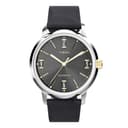
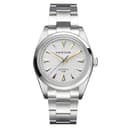
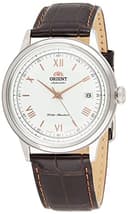
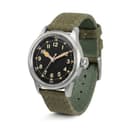
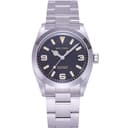
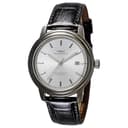
The four things that make a watch look vintage
1. Case diameter, and it is smaller than you think
The single biggest tell. Mid-century watches were mostly 34 to 37mm; the 42 to 45mm case is a 2000s invention. A vintage-styled watch at 44mm is a costume, not a design. Every pick here is 40mm or under, and two are 36mm.
If you are used to large watches, a 36mm case will feel small for about a week and then stop feeling like anything. If you genuinely have a large wrist and it looks wrong, the 40mm options here are the honest answer rather than pretending proportion does not exist. Our watch size guide covers what actually decides fit, which is not diameter alone.
2. A domed crystal
Old watches had domed acrylic, and the way it bends light at the dial edge is a large part of why they look the way they do. Modern watches replicate it with domed mineral glass, domed sapphire, or — in the Timex Marlin’s case — actual acrylic, which is the most authentic answer and the softest one. Acrylic scratches easily and polishes out easily; sapphire does neither. Our crystal comparison sets out the trade honestly.
3. Applied markers and printed minute tracks
Applied markers — small metal indices fixed to the dial rather than printed on it — catch light in a way printing cannot, and they are the detail that makes a $250 watch look considerably more expensive in person than in photographs. A printed railroad-style minute track around the outside is the other era-correct detail worth looking for.
4. Warm lume, not white
Genuine vintage lume ages to a cream or amber color. Modern watches imitate that with tinted luminous compound, and done tastefully it works. Done heavily it looks like a watch pretending to have a history, which is the failure mode of the whole genre. Our guide to what lume actually is covers the materials involved.
How we picked
1. Design that references a period rather than a specific watch
There is a difference between a watch styled after the 1960s and a watch copying one famous reference. The first is design; the second is homage, which is a legitimate but separate category — see our Pagani Design guide for that end of the market. The picks here lean toward the first.
2. A movement you can live with
The whole argument for vintage-style over vintage is that the mechanics are modern and supportable. Miyota publishes the 9015 in full — 28,800 vibrations per hour, 24 jewels, roughly 42 hours of reserve, hacking and hand-winding — and Orient publishes its own caliber data. Timex does not name the caliber in the Marlin beyond a 21-jewel automatic, and its entry says so rather than filling the gap.
3. Honest about water resistance
Vintage-styled watches frequently carry low water resistance ratings, and that is era-correct rather than a defect. What matters is knowing it: several watches in this style are 30m, which means splashes and handwashing only, not swimming. The spec tables below print what each maker states and “Not published” where they state nothing.
4. What we left out
Anything artificially distressed, any dial printed to look faded, and any listing using the word “vintage” to mean second-hand. Deliberate fake patina is the one thing in this category that reliably looks worse in five years than it did on day one.
Vintage style versus actual vintage
The honest comparison, because plenty of people reading this are weighing a $250 new watch against a $250 old one.
Real vintage gives you the genuine article, a design nobody is making any more, and the possibility that it holds value. It also gives you unknown service history, a case that has probably been polished at least once, water resistance you should treat as zero, and a servicing bill that can exceed what you paid — our service cost guide covers why.
Vintage style gives you none of the romance and none of the risk: a warranty, a movement in current production, gaskets that are new, and a watch you can wear in the rain. For a first mechanical watch that is close to unarguable. Buy the real thing later, once you know what you like and have a watchmaker you trust.
There is a third category worth knowing about: a maker reissuing its own old design, which gives you the period look and a brand-new watch at once. The clearest example on this site is the Sea-Gull 1963 chronograph, a hand-wound reissue of an aviation chronograph the same factory developed in the 1960s — no rotor, so it is outside the picks above, but it is the most genuinely period watch we cover.