How we picked
1. The lining, because it touches your watches
The single criterion that matters most in any watch box, small or large. A microsuede or soft velour interior is what keeps a polished case free of hairline marks over years of being taken in and out. A rough, hard-backed lining does the opposite. Where a maker states the lining we have recorded it; where it does not, our spec table says “Not published” rather than assuming the best case.
2. Removable pillows
Small boxes are more likely than large ones to hold a mixed collection — a diver, a dress watch, something on a leather strap. Removable pillows are what makes that work. A fixed pillow that is too fat holds a bracelet stretched open for months, which strains the clasp and the links; one that is too thin lets a heavy watch roll.
3. Glass, not acrylic
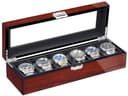
A transparent lid is most of the appeal of a display box, and acrylic ruins it quickly — it scratches from dusting alone and hazes over. Every pick here states a glass lid. Glass is also heavier, which is part of why the wooden boxes here feel more substantial than their price suggests.
4. Wood or wrap?
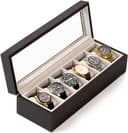
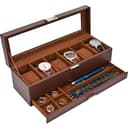
The main structural distinction at this size. Genuine wooden boxes — the Case Elegance, KAMIER and BEWISHOME picks here — feel and age like furniture. Wrapped board boxes, which is what almost everything under $25 is, protect watches identically and simply look less good doing it. Neither choice is wrong; the price difference is real and so is the difference in how they age.
How many slots do you actually need?
A useful rule: count your watches, add one, and buy that. The spare slot absorbs the next purchase without leaving the box looking sparse, and it gives you somewhere to put a watch that has come off its bracelet.
For two or three watches specifically, consider a travel case or roll instead of a box. A three-slot roll costs less, takes up almost no space, and comes with you when you travel — which a display box never does. The trade-off is that you cannot see the watches without opening it, which for some people is the entire point of a box.
Above six watches, the economics flip and the larger formats become better value per slot. Our large watch box picks cover ten slots and up, and our main watch box guide covers the twelve-slot middle ground most collections eventually land on.
What a small box does not solve
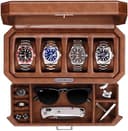
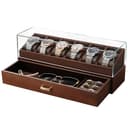
Two honest limitations. First, a small box has no room for the things that accumulate around a watch collection — spare straps, a spring bar tool, a loose bracelet, a watch that is away being serviced. If that clutter is the actual problem, a box with a drawer is the answer, and our valet drawer picks cover that format.
Second, a box is storage, not power. If you own an automatic with a complicated calendar that is genuinely annoying to reset, a box will not help with that — though for most watches it is still the right purchase, and our winder versus box comparison explains exactly where that line falls.
Two small boxes or one large one?
An underrated option. If your collection is genuinely mixed — say four dress watches and four tool watches — two six-slot boxes let you separate them, keep each box full, and put one in a drawer and one on the dresser. It also costs about the same as one twelve-slot box.
The counter-argument is simply aesthetic: one good box is a nicer object than two adequate ones. Both positions are defensible, which is why we are laying them out rather than choosing for you.