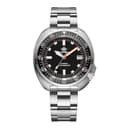
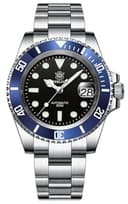
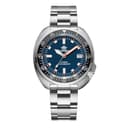
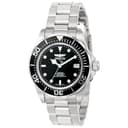
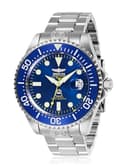
“200m water resistant” is not “Diver’s 200m”
These two phrases look identical on a listing and mean different things. The words Diver’s 200m are regulated by ISO 6425, which requires a minimum 100m rating, a unidirectional or lockable elapsed-time bezel, legibility in total darkness at 25cm, resistance to salt water, thermal shock and magnetism, and testing of every individual watch rather than of a sample from the line. A plain “200m water resistant” figure is a pressure specification, usually sample-tested, and nothing more.
That is not a scandal and it is not a reason to avoid these watches. It is the honest description of what $160 buys: a watch sealed to a real depth, with a movement you can service, that will handle swimming, snorkelling and a shower without complaint. If you are going to strap a tank on your back, buy a watch that prints the certified marking — Seiko’s Prospex line states 200m / 660ft diver’s with a screw-down crown, and it costs roughly two and a half times what the watches here do. Our full dive-watch roundup covers that side of the market, and water resistance explained unpacks every marking.
What the money actually buys between $80 and $195
The movement
Three of the five run the Seiko NH35, the caliber that made this entire price bracket possible: an automatic with hand-winding and hacking, sold to anyone who wants to buy one, in the same architecture family as the 4R35 Seiko fits to its own watches. It is the reason a $160 watch can be repaired rather than binned. Our NH35 roundup covers the caliber and the watches built around it, and NH35 vs 4R36 settles the question of how it relates to the movement inside a Seiko 5.
The two Invictas do not name a caliber at all. Invicta’s own specification page for the 47mm 27611 labels the movement only as “IM-A-005” and publishes no case thickness, no power reserve and no accuracy figure. That is the trade at $80 to $110: a watch that works, from a brand that will not tell you what is inside it.
The crystal
Sapphire on the three micro-brands, mineral on both Invictas. Sapphire sits at 9 on the Mohs hardness scale, ordinary mineral glass at about 5.5, and the grit in everyday dust is largely quartz at roughly 7 — which is precisely why a mineral crystal hazes over a couple of years of wear and a sapphire one does not. On a watch you intend to swim in and knock about, this is the specification that decides how it looks in 2029. The crystal comparison covers when mineral is genuinely the better answer.
The lume
The BGW9 reference here names its luminous material, which is unusual at this price and worth paying attention to. BGW9 is a Super-LumiNova color code from RC Tritec: a non-radioactive strontium-aluminate pigment that glows blue-green and appears white in daylight, with emission at 485nm. Naming the pigment is a small proof that a maker knows what it bought. Our lume roundup ranks the wider field on exactly that basis, and what is lume on a watch explains why it fades by morning.
The bezel
Bezel quality is where these watches differ most visibly, and it is also where listings say least. An aluminium insert scratches and fades; a ceramic one does not, and it is the most obvious upgrade in this bracket — but only some references at this price state which they use, so read the listing rather than the photograph. ADDIESDIVE also sells a ceramic-bezel NH35 diver, which is priced at the $200 line rather than under it today and sits on our NH35 roundup instead.
What you give up under $200
Published dimensions. Most micro-brand listings state a diameter and stop. Lug-to-lug distance, thickness and weight — the numbers that decide whether a watch fits — are frequently missing, and we will not estimate them from a photograph. If fit is your main worry, buy from a maker that publishes a full sheet: our 40mm roundup and the size guide both work from published figures only.
A service network. Seiko and Orient will repair their own watches for decades. A micro-brand assembling bought-in calibers is selling you a specification, and the practical repair route in five years is movement replacement rather than overhaul. That is a legitimate way to buy a watch — an NH35 costs a fraction of an overhaul — but it is a different purchase, and our service cost guide puts numbers on both routes.
Resale, and the benefit of the doubt. An Orient Mako II or a Seiko 5 Sports holds value and is understood by everybody; a micro-brand diver is worth what the next buyer feels like paying. If that matters, the step up is small: the Kamasu and the Mako II both run an in-house Orient caliber with a published sheet, and both sit within about a hundred dollars of the top of this page.