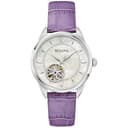
The four things that decide a Bulova automatic
1. Crystal, because Bulova is inconsistent about it
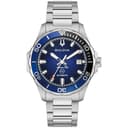
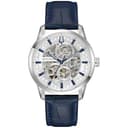
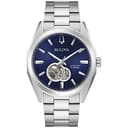
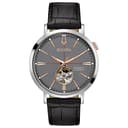
This is the first spec to check and the one that varies most inside the range. The Marine Star 98B466 and the 40mm Sutton 96A330 both publish sapphire— anti-reflective on the Marine Star, an anti-reflective dome on the Sutton. The Surveyor 96A275 publishes mineral. The Aerojet 98A187 publishes a double-curved mineral box crystal, which is the shape most exposed to a knock on a desk edge. And the 43mm Sutton 96A208 — the one most people land on first, and the one we card on our skeleton automatics roundup — publishes a domed mineral crystal, not sapphire.
The hardness argument is short. Sapphire is corundum, which sits at 9 on the Mohs scale; quartz sits at 7, and most environmental grit is quartz. So mineral glass accumulates fine scratches from ordinary life and sapphire mostly does not. Sapphire’s own weakness is brittleness — it chips where mineral would scuff. Our sapphire vs mineral comparison has that trade in full, and the sapphire-crystal roundup is the whole registry sorted on it. Within Bulova, the shortcut is: 98B466 or 96A330 if you want sapphire, and accept mineral on everything cheaper.
2. Water resistance, which is weaker than the styling suggests
Three of the five picks here carry no usable water-resistance figure at all. Bulova’s details panel for the Surveyor 96A275 and the Sutton 96A330 reads “WR [Splash Resistant]”with no meter number printed, which is why those rows say “Not published” above rather than carrying a number we assumed. The Aerojet states 30 meters in its description — hand-washing and rain, not swimming. Only the Marine Star publishes a figure you can actually plan around: WR200, which Bulova itself describes as suitable for swimming, showering and snorkeling.
Two notes on that. First, WR200 is a water-resistance rating, not an ISO 6425dive certification — no Bulova in this registry carries one, and nor does most of what we cover. Second, a 30m rating on a dress watch is normal and not a defect; it becomes a problem only when the watch looks sporty enough that you forget. Our water-resistance guide is the five minutes that saves a movement, and whether you can swim with an automatic answers the narrower version of the question.
3. The movement you are not told about
Here is the oddity at the center of the brand. Bulova names a caliber on somereferences and not others, with no visible logic to it. Its page for the gold-tone Sutton 97A162 states, verbatim, that the exhibition case back “offers a glimpse of the Miyota 8N24 21-jewel automatic skeletonized movement”. That is a real, lookup-able caliber: Miyota publishes -20 to +40 sec/day, 21 jewels, 21,600 vibrations per hour, about 42 hours of running time, hand winding and a stop-second device for the 8N24.
Now look at the two Suttons on this page. The 96A330 publishes “21-jewel skeletonized automatic movement” and “42-hours of power reserve”; the 96A208 publishes a “self-winding 21-jewel movement”. Those figures are consistent with the 8N24 sheet — but Bulova does not name the caliber on either page, so we do not record one, and we do not move Miyota’s accuracy figure onto a reference Bulova left unnamed. That is the same rule that leaves Seiko’s per-reference accuracy fields empty when Seiko publishes a number for the caliber and not the watch. If you want a named, documented caliber for certain, the NH35 roundup and the NH35 vs Miyota 9015 comparison are where that lives.
4. Size, which Bulova only half publishes
Bulova prints a case width for every reference and almost never a thickness or a lug-to-lug. That is a real limitation when the range runs from 40mm to 43mm and the cases are visually chunky. The 40mm Sutton 96A330 is the safest buy for an average wrist; the 42mm Surveyor and the 43mm 96A208 wear like what they are. Measure first with our watch size guide, and if you already know you are at the smaller end, the small-wrist roundup and the 38mm list are better starting points than this brand.
What each price bracket buys you inside Bulova
Around $290, the bottom of the range
The Aerojet 98A187. You get a 41mm steel case, an exhibition case back, a published 40-hour reserve, a box crystal in mineral and a leather strap. It is a competent, pleasant dress automatic and the cheapest route to the brand. At the same money you could have a Orient Bambino with a published Orient caliber, a stated reserve and a full dimension set, or a Seiko 5 Sports with a published accuracy figure and 100m. That is the trade: Bulova’s design and name against the Japanese makers’ paperwork.
Around $310 to $390, the middle
The Surveyor 96A275 on a bracelet, or the 40mm Sutton 96A330 on leather. These two are the clearest illustration of Bulova’s internal inconsistency: the cheaper one is a bracelet watch with mineral glass and nothing published about the movement, the dearer one is a strap watch with sapphire, 21 jewels and 42 hours published. If you only ever wear bracelets, take the Surveyor and accept the glass. Otherwise the Sutton is the better watch and the better spec sheet.
Around $410 and up, the only one we would call a bargain
The Marine Star 98B466. Sapphire, WR200, a unidirectional bezel, a 42-hour reserve and a crystal case back, at a price where Seiko’s nearest diver still ships Hardlex mineral. It is the one place in the range where Bulova is not merely competitive on specification but ahead on the spec that matters most over ten years. Where it still loses is information: no caliber, no thickness, no accuracy figure. That whole argument, with the figures side by side, is our Bulova vs Seiko page.
What we deliberately left out, and why
Two exclusions are worth naming, because both are watches people will expect to see here.
The Oceanographer “Devil Diver” GMT, 98B407, is Bulova’s most interesting automatic and the one the enthusiast forums actually talk about. It is not on this page because Bulova’s own US product page for the reference returns a 404, its UK and Irish stores list it sold out, and its regional sites disagree about the watch’s name and even its strap color. There is a live Amazon listing at a much higher price than anything above. We will not build a pick on a reference whose maker will not currently show us a specification sheet.
The gold-tone Sutton 97A162 is excluded for a different and more interesting reason: it is the one Bulova reference with a namedcaliber, which should make it a natural pick — but Amazon sells it as a “Sutton Chronograph” and the word “chronograph” appears nowhere on Bulova’s own page for it. The 8N24 Bulova names there is a three-hand open-dial caliber, not a chronograph caliber. We are not going to card a watch under a complication its maker does not claim. If a self-winding chronograph is what you want, read our mechanical chronograph roundup first — the short version is that almost everything affordable in that category is hand-wound, not automatic.
We also excluded every Lunar Pilot and every Precisionist: they are quartz, and this is an automatic site. If you are not yet sure which you want, automatic vs smartwatch and automatic vs quartz are the two comparisons that settle it.
Is a Bulova automatic worth buying?
Yes, with one condition: buy it because you like the watch, not because you read the specification sheet and concluded it was the best value. On pure published specification, the Japanese brands win at every price point on this page except one — and that exception, the Marine Star’s sapphire crystal at around $410, is a genuine win worth having.
What Bulova gives you that a Pagani Design or an ADDIESDIVE cannot is a company with a US presence, a warranty you can claim, and 150 years of name on the dial. What it gives you that Seiko and Orient do not is a design language that is neither Japanese-sporty nor vintage-homage. Those are real reasons to buy. They are just not spec-sheet reasons, and a page that pretended otherwise would be lying to you. For the full market view rather than one brand, start at the best automatic watch brands roundup.