Beat rate: 28,800 vs 21,600
The most cited difference and the most visible one. The Miyota 9015 runs at 28,800 vibrations per hour— eight beats a second. The NH35 runs at 21,600, or six beats a second, per Seiko’s published figures for the 4R family it shares its architecture with.
What that means practically: the 9015’s seconds hand moves in smaller, more frequent steps, producing a sweep that looks smoother. It is genuinely noticeable if you look for it, and completely invisible if you do not.
Does a higher beat rate mean better accuracy? In theory a faster oscillator is less disturbed by shocks and position changes, so it can be more stable. In practice, at this price, regulation matters far more than beat rate, and neither manufacturer publishes an accuracy specification for these calibers as fitted to third-party watches. Any specific claim otherwise is speculation.
Thickness: the 9015’s real advantage
Less discussed and arguably more important. The 9015 is a notably thin movement, which is why it appears in slimmer watches. The NH35 is a taller caliber, and a watch built around one starts from a thicker baseline.
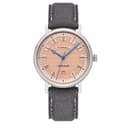
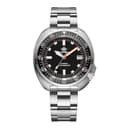
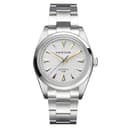
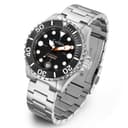
On a dive watch, where the case is thick anyway, this changes nothing. On a dress watch or anything intended to slip under a cuff, it changes a great deal — and it is a large part of why the 9015 dominates slim micro-brand watches while the NH35 dominates divers. If you are shopping for a dress automatic, this is the difference that matters most.
The rotor noise question
The 9015’s best-known quirk. Its rotor is unidirectional and, in many watches, audibly spins — a soft whirring you can hear in a quiet room when you move your arm. Some owners find it charming and mechanical; others find it maddening.
It varies by watch, because case construction affects how much of the sound escapes, and it is not a fault. But it is real and it is well documented across many 9015-powered watches, so it is worth knowing before you buy rather than after.
The NH35’s rotor is bidirectional and generally quieter, though NH35 rotors have their own reputation for a slight wobble that some owners can feel.
Serviceability: the NH35’s decisive win
This is the argument that matters most over a long ownership, and it is not close.
NH35 movements are inexpensive and stocked everywhere. When one fails, the standard repair is often not a repair at all — it is a complete movement swap, which frequently costs less than the labor of servicing the original. That gives an NH35 watch a cheap second life that most watches do not have, as our service cost guide explains.
The 9015 is also a widely available bought-in caliber and any competent watchmaker can work on one, but replacement movements cost more, and the calculation is less overwhelmingly in favor of swapping. For a watch you intend to keep for decades, the NH35 is the lower-risk heart.
Power reserve and hand-winding
Both movements hack — the seconds hand stops when you pull the crown — and both hand-wind, so a stopped watch can be started properly at the crown rather than by shaking it. Those two features together are what separate this generation of affordable automatics from the previous one, and their presence in both calibers is why neither feels like a compromise.
Seiko publishes roughly 41 hours of reserve for the 4R family the NH35 shares its design with. Citizen does not publish an equivalent figure for the 9015 in a form we could verify, so we have not quoted one — the reserves of the two are broadly comparable in practice, and neither will survive a full weekend off the wrist.
Who makes them
Worth knowing, because it explains the market. Seiko Instruments makes the NH series — the same corporate family that builds the movements in Seiko’s own 5 Sports line. The NH35 is functionally the 4R35 sold through a different channel, usually unregulated.
Miyota is a subsidiary of Citizen, and the 9015 is one of its higher-specification offerings — a step above the workhorse 8200-series that appears in cheaper watches. Citizen also fits Miyota-derived calibers to its own watches, which our brand comparison covers.
So both movements come from major Japanese manufacturers with real engineering behind them. Neither is a no-name part, and that is precisely why these two dominate.
How to decide
Choose the Miyota 9015 if the watch is slim, dressy or something you will look at closely — where the smoother sweep and the thinner case earn their place. Accept the rotor noise.
Choose the Seiko NH35 if the watch is a tool — a diver, a field watch, a pilot watch — or if you intend to own it for a very long time. The cheap-replacement path is the most valuable property either caliber has, and the NH35 has it more strongly. Our NH35 watch guide covers the watches built around it.
And a final honest note: for most buyers, the movement is not the deciding factor. The case, the crystal, the bracelet and whether you like looking at the watch matter more in daily ownership than six beats a second versus eight. Our guide to what a caliber name actually tells you makes that argument at length.