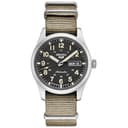
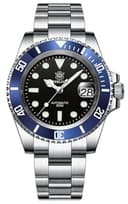
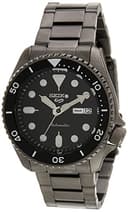
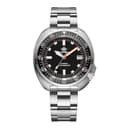
What is genuinely the same
The mechanical core. Both calibers share the same architecture, the same 21,600 vibrations per hour, the same 24 jewels, the same roughly 41-hour power reserve, and the same functional set: hacking seconds (the seconds hand stops when the crown is pulled, so you can set the time precisely) and hand winding (the crown winds the mainspring directly, so a stopped watch starts without shaking).
Both wind bidirectionally, which matters if you are choosing a winder — any rotation direction does useful work, so the setting is not critical. Our TPD settings guide covers what to set anyway.
Parts interchange across the family in practice, which is why a watchmaker with an NH35 on the bench treats it as familiar territory. That commonality is the entire reason both calibers are cheap to keep running.
What is genuinely different
1. The complication — day-date against date
The 4R36 drives a day wheel as well as a date wheel; the NH35 drives date only. If you want a day display on a micro-brand watch, the caliber you are looking for is the NH36, not the NH35. Whether that is an advantage depends entirely on taste — a lot of people prefer the cleaner date-only dial, and there is one fewer thing to reset after the watch has stopped.
2. Regulation before it reaches you
This is the difference that shows up in daily wear. Seiko regulates the movements it fits to its own watches. A bought-in NH35 arrives at a micro-brand however that brand chose to receive it, and most receive them unregulated, because regulating movements requires a watchmaker and a timegrapher and adds cost to a $150 watch.
The practical consequence: a new NH35 watch is noticeably more likely to run at the outer edges of Seiko’s −35 to +45 seconds-per-day window than a Seiko 5 is. Both are within specification. One has had someone look at it. Our accuracy guide explains how to test yours and what to do about a result you do not like.
3. Finishing you can see through the caseback
Where a watch has an exhibition caseback, the difference is visible. Seiko applies more decoration to the movements in its own watches than a bare NH35 receives. Neither is finished to a level anyone would call haute horlogerie; the 4R is a workhorse caliber and Seiko has never pretended otherwise.
4. What backs the watch
A 4R36 comes inside a Seiko, with Seiko’s warranty, Seiko’s service network and published documentation for the caliber. An NH35 comes inside whatever the micro-brand built around it, usually with neither. The movement is equally repairable either way — a replacement NH35 costs less than a service — but everything around the movement is not. Our micro-brand roundup sets out what that trade actually costs.
The comparison that actually matters
Because the calibers are so close, the movement is almost never the reason to choose between two watches that use them. The decision comes down to what is built around the movement: the case, the crystal, the bracelet, the dial finishing and the company.
That is genuinely useful, because it removes a variable. An NH35 diver at $150 with a sapphire crystal and a 300m case is not mechanically inferior to a Seiko 5 at $250 — it is differently finished, unregulated, and unsupported. You can weigh those things honestly instead of worrying about the engine.
If you want the fuller version of that argument, our Seiko 5 versus Invicta Pro Diver comparison works through the same trade at the budget end, and NH35 versus Miyota 9015 covers the genuinely different caliber choice you might make instead.
Which should you buy?
A 4R36 watch — meaning a Seiko — if you want a regulated movement, a warranty, a service path and a day display. It is the safer purchase and it is why the Seiko 5 gets recommended as a first automatic more than anything else.
An NH35 watch if you want a specification combination Seiko does not sell at the price — sapphire, 200m or 300m, a ceramic bezel — and you are comfortable that the movement may need regulating and the brand may not be there in five years.
Neither, on movement grounds alone. If the two watches you are weighing use these calibers, the caliber is not the tiebreaker. Buy the watch you would rather look at. Our guide to choosing an automatic watch covers the decisions that actually do separate them.