What the second hundred dollars actually buys
1. Numbers instead of modes
The most valuable upgrade in this band is information. Versa publishes four turns-per-day settings on its Elite winders — 650, 950, 1,250 and 1,850 — along with clockwise, counter-clockwise and bidirectional operation. Rothwell publishes five speeds from 650 to 1,950. Below $100 you get “four rotation modes” with no statement of what any of them does.
That matters because turns per day is the only specification a winder really has. If you own a movement with a stated winding requirement, a published TPD range lets you hit it. Our TPD settings guide covers what different movements ask for, and there is no ISO standard here — maker guidance is the authority.
2. Per-position independence
On multi-watch winders, the question is whether each position has its own motor and its own settings. A shared-program four-position box gives all four watches the same treatment; an independent one lets each watch have the direction and turns it actually wants. Under $200 this is available but not universal, and it is the first thing we check on any multi-position pick. It is also the whole organizing spec of our best double watch winders roundup, where the picks that state per-position control rank above the ones that apply a single setting to both slots.
3. Cuffs that fit properly
The unglamorous upgrade. Budget winders use a fixed foam pillow that is often too fat, holding a bracelet under tension for months. Better winders use a spring-loaded or adjustable cuff that grips the watch without stretching the bracelet. This is the single most common reason people replace a cheap winder, and it is worth the money.
4. What it still does not buy
Honesty about the ceiling: $200 does not buy WOLF or Barrington build quality, a genuinely premium case material, or a service network. The lacquered wood and leather-lined cases in our Rolex winder guide sit well above this band. What you get under $200 is the functionality, not the object.
Under $100 or under $200?
If you own one straightforward automatic — a Seiko 5, an Orient Bambino, an Invicta Pro Diver — the honest answer is that a sub-$100 winder does the job and our under-$100 picks are where to look. Those movements wind bidirectionally and are not fussy, so unlabeled modes cost you nothing in practice.
Move up to this band when one of three things is true: you own a movement with a specific winding requirement and want to hit it; you have more than one watch and want them wound differently; or you want the winder to also store watches you are not rotating. Those are the three problems the extra money genuinely solves.
Capacity: buy for the collection you have
The temptation under $200 is to buy positions, because four-watch boxes are suddenly affordable. Resist it slightly. A winder only earns its keep on watches you actually rotate and that are annoying to reset — and most collections have fewer of those than their owners think. Four spinning positions holding two watches and two empty cuffs is a worse outcome than two well-chosen positions.
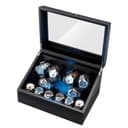
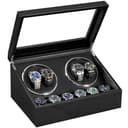
The winder-plus-storage format is the sensible middle ground and the reason it appears on this list: powered positions for the watches in rotation, static storage for the rest. Our winders with storage page covers that format properly.