Where WOLF genuinely wins
1. The cuff — the real engineering difference
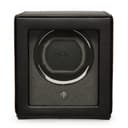
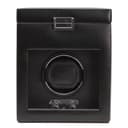
This is WOLF’s strongest argument and it is not marketing. WOLF uses a patented spring-loaded cuff that expands to grip a watch and holds it without stretching the bracelet open. Budget winders, including Versa’s, use a compressible foam pillow that you push the watch onto.
The consequence matters more than it sounds. A pillow that is too fat for a given bracelet holds the clasp and end links under tension continuously, for months on end — and that sustained strain is, as our guide on winder damage explains, the most genuine risk a winder poses to a watch. The cuff is the one place WOLF is solving a real problem rather than a cosmetic one.
2. Materials and finish
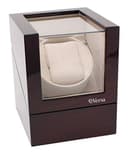
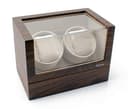
WOLF builds in vegan leather, real wood veneers and properly weighted cases with glass covers that close on a soft action. Versa builds in PU over board with an acrylic or glass window. On a dresser, in a bedroom you look at every day, that difference is visible and it is what the money is actually buying.
Whether an object you look at daily is worth several hundred dollars is a personal question, not a technical one, and we are not going to pretend it has an objectively correct answer.
3. Longevity and support
WOLF has been building winders for decades and stands behind them. If a motor fails in year four, there is a company to contact and a warranty position to argue. Versa is a value brand; a failure generally means buying another one.
That said, another Versa costs a fraction of a WOLF repair, so the economics are less lopsided than the warranty comparison suggests.
Where Versa genuinely wins
1. Published turns-per-day figures
The most important and least expected point in this comparison. Versa publishes real numbers for its Elite winders — 650, 950, 1,250 and 1,850 TPD — along with all three rotation directions, and states that positions on its multi-watch models can be set independently.
Turns per day is the only specification a winder really has. There is no ISO standard for it, so maker guidance is the authority, and a winder that tells you its numbers is a winder you can match to a movement. WOLF states one for the Heritage single — 900 TPD, 1,800 bi-directional — but it is fixed, where Versa’s is selectable, and selectable is the part that lets you match a caliber rather than hope it suits. If you own something with a specific winding requirement — the scenario our Rolex winder guide addresses — that is not a small advantage.
2. Cost per position
A Versa quad costs less than a WOLF single. If your problem is four watches rather than one special one, the arithmetic is brutal and it is not in WOLF’s favor. Our multi-watch winder guide covers that end of the market.
3. Power flexibility
Versa’s Elite winders run from the supplied adapter or from batteries, which makes them viable inside a safe or a drawer where no cable can reach. That is a genuine functional capability, and our battery-powered winder guide covers what it costs in practice.
Where neither wins: noise
Versa states a quiet Japanese motor. WOLF makes no published noise claim at all — not on its product pages, not on its winder technology page — which is why the spec table on its picks reads “Not published” for a quiet motor. Neither publishes a measured decibel figure, so we are not going to quote one or claim a winner. What we would say is that motor noise at this level is generally a function of the motor and the case construction together, and that a missing claim is not evidence of a loud winder — only of a maker that does not make the claim.
If silence is your top priority, our quiet winder guide is the more focused place to start than either brand page.
The decision
Buy WOLF if you own one watch you genuinely care about, the winder will live somewhere you look at it every day, and the bracelet on that watch is the kind of thing you would rather not have stretched for a year. The cuff is a real engineering advantage and the object is a nicer object.
Buy Versa if you want the function, you have more than one watch, or you want to set an exact turns-per-day figure. It is the better technical purchase and it is not close on value.
Buy neither if you have not yet worked out whether you need a winder at all. That is genuinely the most common right answer, and our guide on whether automatics need winders makes the case honestly. A stopped watch is not being harmed, and for most collections a good watch box is the better purchase — a comparison we take head-on in winder versus box.
The other brands worth knowing
Two names sit between these poles and deserve mention. Barrington is the enthusiast-forum favorite: a silent Japanese motor, a full TPD range with direction choice, and a modular design so you can add units as a collection grows. It costs meaningfully less than WOLF and offers more control.
Rothwell is the other transparent brand, publishing five TPD speeds from 650 to 1,950 with three rotation modes and per-position settings on its multi-watch models. Both appear throughout our winder guides, and both are worth a look before you settle on either brand in this comparison.
WOLF against Barrington is the other half of this question: two premium singles with opposite philosophies, one selling a fixed program and a cuff rated to 52mm, the other five published turns-per-day steps. And if your real question is how long any of this lasts, how long watch winders last works through the warranties and what actually fails.