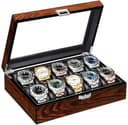
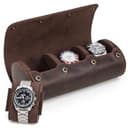
Leather, PU or bonded: what the words mean
Genuine leather
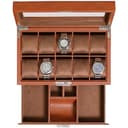
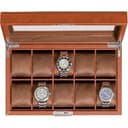
A real hide. It develops a patina rather than degrading, it can be conditioned, and it will outlast the box’s hinges. “Genuine leather” as a marketing term is actually one of the lower grades of real leather, below full-grain and top-grain — but it is still leather, and it still behaves like it.
PU / synthetic / vegan leather
A polyurethane surface bonded to a fabric backing. It is uniform, it takes any color and grain pattern, and it is what almost every box under about $60 uses. Its failure mode is characteristic: after a few years the coating cracks at corners and edges and begins to flake. It does not fail suddenly, and it does not harm watches when it does.
Bonded leather
Leather scraps ground up and reconstituted onto a backing, then coated. It carries the word “leather” legitimately and behaves like PU. If a listing says bonded, price it as synthetic.
The practical conclusion: a well-made PU box with a microsuede interior will protect watches better than a real-leather box with a rough lining. Buy the interior, and treat the exterior as an aesthetic choice.
How we picked
1. The lining, first
Microsuede or soft velour, ideally stated by the maker. This is the surface your watches actually rest against every day. Where a listing does not describe the lining, our spec table records the material as published rather than assuming, and we have ranked those picks below the ones that do state it.
2. Removable pillows, not fixed ones
The most consistently under-appreciated feature in watch storage. A fixed pillow that is too fat holds a bracelet stretched open for months at a time, which is genuinely bad for the clasp and the links. Removable pillows let you match the padding to the watch — and let a 44mm diver and a 36mm dress watch share one box.
3. Real glass, not acrylic
Most boxes at this level have a transparent lid, and the difference between glass and acrylic shows quickly. Acrylic scratches from dusting alone and goes cloudy. Every pick here states a glass top. It is also heavier, which is part of why the better boxes feel more substantial.
4. Locks, and what they are worth
Several picks have a lock. Be realistic about it: these are small cam locks in a wooden or board carcass, and they will deter a curious houseguest or a child. They are not security. Anything genuinely valuable belongs in a safe — and if that safe has no socket, our battery-powered winder picks cover the keeping-it-running problem.
Sizing: buy for the collection you have
The most common watch-box mistake is buying capacity for an imagined future collection. A twelve-slot box holding five watches looks worse than a six-slot box holding five, and the empty pillows collect dust. Our small watch box picks cover the four-to-six-slot end properly, and our large box picks handle ten and above.
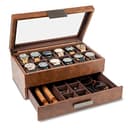
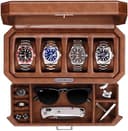
If a drawer is what you actually need — for straps, a spring bar tool, cufflinks, a spare bracelet — our valet drawer box picks are the more focused list.
Looking after a leather box
Real leather benefits from an occasional wipe with a barely damp cloth and, once a year or so, a light leather conditioner. Keep it out of direct sunlight, which fades and dries any hide. PU needs nothing beyond dusting — conditioners do not penetrate a polyurethane coating and will simply sit on the surface.
One thing that applies to both, and to the watches inside: humidity. A box in a damp room is a worse environment for a mechanical watch than a dry one, and a cheap silica-gel pack in the corner of the box costs almost nothing. Our guide on how long automatic watches last covers the storage conditions that actually matter.