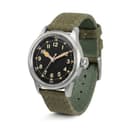
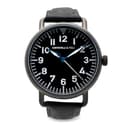
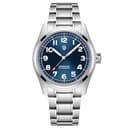
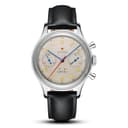
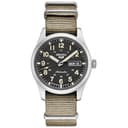
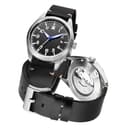
Type A vs Type B: the layout that defines a flieger
Worth understanding properly, because it is the one piece of knowledge that lets you read this category at a glance.
Type A (Baumuster A) has a single ring of hour numerals, one to twelve, with an isosceles triangle flanked by two dots at the top. It is clean, instantly readable and the layout most modern pilot watches borrow.
Type B (Baumuster B) inverts the priority. The outer ring carries minutes in five-minute increments — 5, 10, 15 and so on all the way round — and the hours shrink to a small inner ring. It looks stranger and reads differently, and it exists because a navigator timing a leg cares about minutes far more than hours. If you want the historically correct observation-watch dial, Type B is what you are looking for.
Neither is better. Type A is easier to live with for telling the time; Type B is the more interesting object and the more faithful reference. Most people buy Type A without ever knowing there was a choice.
How we picked
1. Legibility above everything
The entire premise of a pilot watch is being readable instantly under bad conditions. That means high contrast — white on matte black, in practice — generous numerals, and lume that actually works. A pilot watch with a busy dial, applied polished markers or a date window cut through a numeral has abandoned the brief. We have ranked accordingly.
2. A movement you can name
The Seiko NH35 appears twice on this list, and it is the specification we weight most heavily at the budget end. It is documented, it hacks, it hand-winds, and any competent watchmaker can service it. “Japan movement” with no caliber number is not a checkable claim, and where a pick says that, its card says so too. Our NH35 watch guide covers what that caliber actually is.
3. Size, because originals were 55mm
The historical B-Uhren were 55mm across and worn over a flight jacket on a long strap. Nobody wants that now, but the DNA lingers: pilot watches tend to run large, and a “faithful” flieger is often a 44mm watch. The sub-40mm picks here are deliberately included, because a legible dial on a wearable case beats an accurate reproduction you leave in a drawer.
4. Strap, which matters more here than usual
The pilot watch look is inseparable from the strap: a thick riveted leather band, or the long strap with a second buckle designed to go over a jacket sleeve. It is also the cheapest thing to change. If a watch here is right in every respect except the band, that is a $20 problem, not a reason to skip it.
Where the Hamilton and Laco tier sits
Two names come up constantly in pilot-watch discussion and neither is on this list, so it is worth explaining why. Laco is one of the original B-Uhr manufacturers and still builds fliegers to the historical pattern; Hamilton’s Khaki Aviation line is the best-known mid-priced Swiss pilot watch. Both are genuinely excellent and both sit several times above the price band this page covers.
We have not featured either with a buy link because their availability through the retailer we link to is inconsistent — listings appear and vanish, and some are gray-market rather than authorized. We would rather name them here as the obvious step up, and let you buy them from a dealer, than attach a link we cannot stand behind. That policy is set out in our methodology.
Pilot, field, or both?
The two categories overlap heavily and the distinction is mostly historical. A field watch descends from infantry issue: smaller, tougher, usually 36–40mm, with a 24-hour inner track. A pilot watch descends from aviation issue: larger, with the triangle at twelve and often a longer strap.
In practice, if you want one legible automatic for daily wear, a field watch is usually the easier object to live with, and our field watch picks cover that ground. Buy a pilot watch when you want the presence and the reference — the triangle, the oversized numerals, the sense of an instrument.