Dial & Lume

Best Multi-Watch Winders (4, 6 and 8 Watches)

Four-, six- and eight-position winders compared on positions per dollar, footprint and what each maker actually publishes — plus the question nobody selling them will ask you: how many of your watches genuinely need to be spinning?

By Stephen V.Last updated How we pick

Once you pass two watches, a winder stops being an accessory and starts being furniture. A four-position box is roughly the size of a shoebox; a six or eight is closer to a small jewelry cabinet, and it needs a permanent home with a socket near it. That physical reality decides more of these purchases than any spec does, so it is where this page starts and where every pick is judged from.

The second thing worth saying out loud: most people buying a six-position winder do not rotate six automatics. They rotate two or three and store the rest. If that describes you, the honest recommendation is a smaller winder and a proper box — or one of the winder-plus-storage cabinets on our winders with storage page, which are built for exactly that split. Nothing bad happens to a stopped automatic; it just needs winding and setting before you wear it again.

If you genuinely do rotate four or more, the picks below run from about $65 to just under $400. We have not handled any of them. Specs come from each maker’s published data and retail listing, dated on every card, and prices come from a live daily check rather than a number typed into this page. Where a maker doesn’t publish a turns-per-day figure — and at this end of the market most don’t — the spec table prints “Not published” instead of a plausible-looking guess.

How this is funded: we earn a commission if you buy through our links, at no extra cost to you. As an Amazon Associate we earn from qualifying purchases. It never changes which watch or winder we recommend, and we’ll tell you plainly when to skip one. Full disclosure.

Quick picks

Ranked on movement, specs and buyer fit. Select a row to jump to the full write-up. We have not tested these — here is exactly what we do instead.

#ProductBest forPrice
1
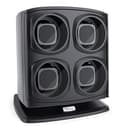
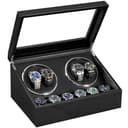
Versa Quad Watch Winder

Versa Quad Watch Winder

Four positions, each independently controlled, for the price of one premium single. If you rotate three or four automatics this is the sensible box — no need to compromise settings across the collection.

Best overall four-watch
$149.99 · View on Amazon

Price as of September 4, 2026. #ad How we’re funded

2
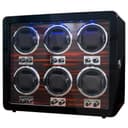
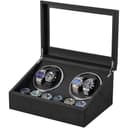
Heiden Quad Watch Winder

Heiden Quad Watch Winder

The four-position winder to buy when the watches in it are worth protecting. Heiden's listing states a quiet Japanese motor and a no-magnets construction — the second of which matters more than most product pages admit, because a magnetized hairspring is a repair bill, not a setting.

Best built four-watch
$329.99 · View on Amazon

Price as of September 4, 2026. #ad How we’re funded

3
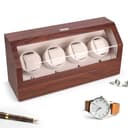
Oryx 6-Watch Winder (Wooden Case)

Oryx 6-Watch Winder (Wooden Case)

Six positions in a real wooden case — the point at which a winder stops being a gadget on a dresser and becomes a piece of furniture you have to find a home for. Buy it because you rotate six automatics, not because six looks impressive.

Best six-watch
$275.49 · View on Amazon

$289.995% off

Price as of September 4, 2026. #ad How we’re funded

4
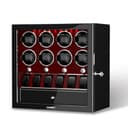
DUKWIN 8-Watch Winder with 6-Watch Storage (Lockable)

DUKWIN 8-Watch Winder with 6-Watch Storage (Lockable)

The top of this format: eight powered positions plus six static storage slots and a lock, in one cabinet. It is the answer for a collection large enough that a second winder and a separate box would cost more and look worse.

Best for eight or more
$419.00 · View on Amazon

Price as of September 4, 2026. #ad How we’re funded

5
ANWBROAD 4-Watch Winder

ANWBROAD 4-Watch Winder

Four positions for roughly what one decent single costs. That is the whole argument, and it is a strong one if your collection is four honest workhorses rather than four heirlooms. Expect the finish and the settings menu to reflect the price.

Best budget four-watch
$67.99 · View on Amazon

Price as of September 4, 2026. #ad How we’re funded

6
BEWISHOME 4-Watch Winder

BEWISHOME 4-Watch Winder

A straight alternative to the ANWBROAD at roughly the same money — worth checking on the day you buy, because these two trade places on price constantly. Same caveats apply: positions first, published settings a distant second.

Cheapest four-watch
$67.99 · View on Amazon

Price as of September 4, 2026. #ad How we’re funded

The picks in full

#1Best overall four-watch

Versa Quad Watch Winder

Four positions, each independently controlled, for the price of one premium single. If you rotate three or four automatics this is the sensible box — no need to compromise settings across the collection.

Strengths

  • Four independently controlled winding positions
  • Big value versus buying multiple singles
  • Established Versa design with a long sales history

Trade-offs

  • Large footprint — this is furniture, not a trinket
  • No storage-only slots for watches you're resting
Watches held4
Rotation settingsIndependent settings per position
DirectionCW, CCW, both
PowerAC adapter
Quiet motorNot published
Includes storageNo

Why this one. A four-position winder only makes sense if you actually rotate four automatics; if two sit unworn for weeks, a winder-plus-storage box suits them better than a spinning position.

Specs read from the product listing and the maker’s published data, on July 21, 2026. “Not published” means the maker does not state that figure.

#2Best built four-watch

Heiden Quad Watch Winder

The four-position winder to buy when the watches in it are worth protecting. Heiden's listing states a quiet Japanese motor and a no-magnets construction — the second of which matters more than most product pages admit, because a magnetized hairspring is a repair bill, not a setting.

Strengths

  • Four positions with a quiet Japanese motor
  • Listed as magnet-free — relevant when the watches are mechanical
  • Established winder brand rather than an anonymous marketplace listing

Trade-offs

  • Costs more than twice what a budget quad does
  • Per-position turns-per-day figures are not published
Watches held4
Rotation settingsMultiple settings
DirectionNot published
PowerNot published
Quiet motorYes
Includes storageNo

Why this one. Magnet exposure is the one genuine mechanical risk in a winder, and it comes from the motor, not the rotation. A maker that states 'no magnets' is answering a real question.

Specs read from the product listing and the maker’s published data, on August 11, 2026. “Not published” means the maker does not state that figure.

#3Best six-watch

Oryx 6-Watch Winder (Wooden Case)

Six positions in a real wooden case — the point at which a winder stops being a gadget on a dresser and becomes a piece of furniture you have to find a home for. Buy it because you rotate six automatics, not because six looks impressive.

Strengths

  • Six winding positions in one cabinet
  • Wooden case rather than molded board
  • Cheaper per position than any premium quad

Trade-offs

  • Large footprint — measure the shelf first
  • Per-position settings are not documented in the listing
Watches held6
Rotation settingsMultiple rotation modes
DirectionNot published
PowerNot published
Quiet motorNot published
Includes storageNo

Why this one. Six positions is where the honest question becomes 'do I actually wear six automatics in rotation?' If two of them sit for months, storage plus a smaller winder is the better spend.

Specs read from the product listing and the maker’s published data, on August 11, 2026. “Not published” means the maker does not state that figure.

#4Best for eight or more

DUKWIN 8-Watch Winder with 6-Watch Storage (Lockable)

The top of this format: eight powered positions plus six static storage slots and a lock, in one cabinet. It is the answer for a collection large enough that a second winder and a separate box would cost more and look worse.

Strengths

  • Eight winding positions plus six storage slots
  • Lockable case — the only pick here that addresses security
  • One power cable for what would otherwise be two or three boxes

Trade-offs

  • The most expensive winder on the site by some distance
  • Genuine furniture-sized footprint
Watches held8
Rotation settingsMultiple rotation modes
DirectionNot published
PowerNot published
Quiet motorYes
Includes storageYes

Why this one. A lock on a wooden cabinet deters opportunists, not burglars. Treat it as a lid that stays shut around visitors and children, not as a safe.

Specs read from the product listing and the maker’s published data, on August 11, 2026. “Not published” means the maker does not state that figure.

#5Best budget four-watch

ANWBROAD 4-Watch Winder

Four positions for roughly what one decent single costs. That is the whole argument, and it is a strong one if your collection is four honest workhorses rather than four heirlooms. Expect the finish and the settings menu to reflect the price.

Strengths

  • Four winding positions at a budget-single price
  • Same maker as our budget double pick, so the format is familiar
  • Compact for a four-position box

Trade-offs

  • No published turns-per-day figure
  • Cabinet materials are molded board, not wood
Watches held4
Rotation settingsMultiple rotation modes
DirectionNot published
PowerNot published
Quiet motorNot published
Includes storageNo

Why this one. Below about $80 a four-position winder is buying you positions, not precision. If any single watch in the box has a specific TPD requirement, check it against the mode list before you commit.

Specs read from the product listing and the maker’s published data, on August 11, 2026. “Not published” means the maker does not state that figure.

#6Cheapest four-watch

BEWISHOME 4-Watch Winder

A straight alternative to the ANWBROAD at roughly the same money — worth checking on the day you buy, because these two trade places on price constantly. Same caveats apply: positions first, published settings a distant second.

Strengths

  • Four positions at the bottom of the four-watch market
  • Direct price competitor to the other budget quads

Trade-offs

  • No published TPD ladder or per-position control
  • Brand has no winder track record to speak of
Watches held4
Rotation settingsMultiple rotation modes
DirectionNot published
PowerNot published
Quiet motorNot published
Includes storageNo

Why this one. When two budget winders are functionally identical, buy whichever is cheaper the day you order. There is no loyalty to earn here.

Specs read from the product listing and the maker’s published data, on August 11, 2026. “Not published” means the maker does not state that figure.

How we picked

Four criteria, applied in this order. They are deliberately different from the criteria on our single-winder pages, because the questions change once several watches share one box.

1. Independent control per position

This is the whole reason to scrutinize a multi-watch winder rather than buying on capacity alone. Four automatics almost never want the same setting: a Seiko 4R36, a Rolex caliber and an ETA-based movement have different turn requirements and sometimes different preferred directions. A winder that applies one mode to every position forces a compromise on at least three of your four watches. The Versa Quad states independently controlled positions; several of the budget boxes do not, and we have marked that as a trade-off on the card rather than burying it.

2. Positions per dollar — and whether you need them

Capacity is the cheapest thing a winder maker can add, which is why the price gap between a four and a six is usually smaller than the gap between a good motor and a bad one. That makes “more positions” a weak reason to spend more. Buy the number of positions you will actually use within a year, and treat anything beyond that as dead weight you are paying to power. A four-position box running two watches looks like a mistake every time you open it.

3. Motor count and noise

A winder cycles on and off around the clock, so noise compounds with capacity: an eight-position box has more opportunities per day to make a sound than a single does. Two related questions matter. First, does the maker describe the motor as quiet — near-universal now, and near-meaningless as a differentiator. Second, and more useful, does the box use one shared drive or several? Where a maker doesn’t say, assume shared, because a shared drive is also a reason every position ends up on the same schedule. If noise is your binding constraint rather than capacity, our quiet watch winder picks go deeper on it.

4. Magnets, which almost nobody mentions

Rotation is not a risk to a healthy automatic. Magnetism is. A magnetized hairspring will run wildly fast and needs a demagnetizer or a watchmaker to fix — it is the one genuine mechanical hazard in this category, and it comes from the motor, not the winding. Heiden is the only maker in this list that states a magnet-free construction on its listing, which is why it takes the “best built” slot despite costing several times what the budget quads do. That is not a claim we have verified with instruments; it is a maker’s published statement that its competitors do not make.

Four positions, six, or eight?

Start from the watches, not the box. Count the automatics you wear at least once a fortnight — that is your real number. Everything else is storage, and storage is a different product with a different price.

Four is the sweet spot for the overwhelming majority of collections, and it is where the value is: the Versa Quad gives four independently controlled positions for roughly the price of one premium single winder. If your collection grows past four, a second four is often cheaper and always more flexible than replacing everything with a six.

Six makes sense when six watches are genuinely in rotation and all live in one room. The Oryx six-position box is a real wooden cabinet rather than molded board, which matters at this size because a large box in a cheap finish looks cheap in a way a small one doesn’t.

Eight is a collection-management decision, not a winding one. The DUKWIN eight-position cabinet earns its place because it pairs the powered positions with six static storage slots and a lock — so it replaces a winder and a box rather than adding to one. That is also the only pick here that addresses security at all, and it is worth being precise about what that means: a lock on a wooden cabinet keeps casual hands and children out. It is not a safe, and no product on this page should be treated as one.

What the money actually buys

The gap between the $65 pick and the $389 pick is not winding competence. All six will turn a rotor and keep a mainspring topped up. In ascending order, the money buys: independent per-position control, a published turns-per-day ladder, a magnet-free motor design, a real wooden cabinet instead of veneered board, integrated storage, a lock, and a company that answers email in five years’ time. That is a genuine list of differences — it just isn’t the list the product photography implies.

If budget is the binding constraint, buy the cheapest box on this page with the settings your watches actually need and put the difference toward the watches. The same logic runs through our winders under $100 list: past a quiet motor and the right turn count, you are buying an object rather than a function.

Setting up a multi-watch winder

Wind each watch by hand, 20 to 40 turns of the crown, before you seat it. A winder maintains a running watch and is slow at starting a fully unwound one, because it turns for only a few minutes per cycle. Our guide to winding an automatic watch covers this properly, including why you cannot overwind one.

Set direction first, turn count second. A winder running the wrong way for a given movement spins the rotor without winding anything, and that single mistake is the most common reason someone concludes a new winder is faulty. Our TPD settings guide has a reference table by brand and movement — bring your watch’s number to this page rather than hoping a preset lands near it.

Finally, switch off any position you aren’t using, where the box allows it. An empty cuff spinning for a year is motor hours spent on nothing, and on a shared-drive box it may not be possible at all — which is one more small argument for buying the number of positions you need rather than the number you might.

Frequently asked questions

How many watches should a winder actually hold?

Count the automatics you wear at least once a fortnight — that is the number of powered positions you need. Watches worn less often than that are better off wound and set by hand when you want them, or kept in a box. Buying a six-position winder for two rotated watches is the single most common overspend in this category.

Is one multi-watch winder better than several single winders?

For four watches or more, one multi almost always wins on cost, cable count and shelf space. Several singles win on independence — separate boxes, separate motors, and the freedom to move one watch to another room. If only one of your watches is genuinely valuable, the strongest setup is often one good single for that watch plus a storage box for the rest.

Do all the positions in a multi-watch winder need the same settings?

No, and that is exactly why independent control matters. Different calibers want different turns per day and sometimes different directions. A box that applies one mode to every position puts most of your watches on a compromise setting. Check the listing for the phrase 'independently controlled' before you buy — the cheaper boxes here do not have it.

Can a watch winder damage my watch?

Rotation itself won't — the mainspring's slipping bridle makes overwinding mechanically impossible on an automatic. The two real risks are magnetism from the motor, which can make a watch run wildly fast until it is demagnetized, and a loose fit on the pillow letting the case shift and rub. Seat every watch snugly and prefer makers that state a magnet-free design.

Are multi-watch winders loud?

They shouldn't be, but capacity multiplies the opportunities to hear one. Every pick here uses a motor its maker describes as quiet, and each cycle lasts only a few minutes. On a multi, ask whether the positions share one drive or use several: either can be quiet, but several motors cycling on different schedules is several chances to notice. Standing the box on a soft surface rather than a hard shelf helps more than most people expect.

Should I buy a winder with storage instead?

If more than half your collection sits unworn for weeks at a time, yes. A winder-plus-storage cabinet matches how most collections actually work — a few watches in rotation, the rest kept safely — and costs less than a large winder plus a separate box. Our winders with storage page covers that format in full.

Sources

  • Barrington Watch Winders — How to set optimal winding parametersA winder maker's guidance on turns per day (TPD) and rotation direction, and why the wrong direction winds nothing — there is no ISO standard for TPD, so maker guidance is the authority (accessed July 21, 2026)
  • Automatic watch — WikipediaReference on self-winding watches: most automatics can also be wound by hand at the crown, and a slipping bridle on the mainspring barrel makes overwinding by a rotor or a winder mechanically impossible (accessed August 11, 2026)
  • Versa Watch Winders — Elite Double Watch Winder specificationVersa's own spec for the Elite Double: four turns-per-day settings (650/950/1250/1850), clockwise, counter-clockwise and bi-directional operation, and 'set each winder independently' (accessed July 23, 2026)

Keep reading