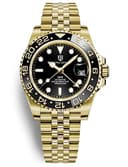
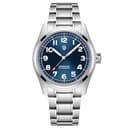
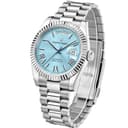
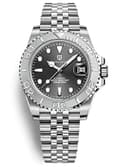
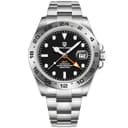
What you are actually getting
The movement, where the model uses an NH35
Several Pagani Design models run Seiko’s NH35, and that is a real Seiko product rather than a clone: it shares its architecture with the 4R35 Seiko fits to its own watches — automatic with hand winding, 24 jewels, 21,600 vibrations per hour, roughly 41 hours of power reserve, hacking seconds. Seiko publishes that specification openly, which is why it can be quoted here without qualification. Our head-to-head on Pagani Design versus Seiko works through what that shared movement does and does not settle — the cheaper watch wins on crystal and water rating, and loses on everything that is not printed on a spec sheet.
Not every model uses it. The 36mm DD36 in this list runs an ST16-type movement, which is a Chinese caliber family with far less published documentation behind it. The spec table on each pick names what the listing states, and prints “Not published” where nothing is stated. That distinction is worth checking before you buy any Pagani model, not just these.
The sapphire is real sapphire
The listings state sapphire rather than sapphire-coated mineral glass, which is the more meaningful claim — a coating is a thin hardened layer on soft glass and wears through. Sapphire sits at 9 on the Mohs hardness scale against 5.5 for ordinary glass, and everyday grit is largely quartz at 7. In practice that is the difference between a watch that looks new after three years and one that does not.
It remains slightly absurd that a $150 Pagani has sapphire and a $400 Seiko does not. The explanation is not that Pagani is better engineered — it is that sapphire is now cheap to source and it is the single most effective line on a spec sheet for a brand with nothing else to trade on. Our sapphire crystal roundup goes through that inversion in detail.
The three arguments against, stated plainly
1. You are wearing a copy, and people notice
The strongest objection is not legal or mechanical, it is social. These designs are recognizable specifically because the originals are famous, and anyone who knows watches will identify what a Pagani is referencing at a glance. Some owners find that entirely comfortable; others discover after a month that they do not. Only you know which you are, and it is worth asking before you spend.
2. No service path and no resale
Where the watch has an NH35 the practical repair route is movement replacement, and that works — the caliber is cheap and universally available. Everything else (bracelet links, bezel inserts, a cracked crystal) has no supply chain to speak of. Resale value is close to zero.
3. Quality control varies
Bezel alignment, hand alignment and bracelet finishing are the three areas where units differ. This is normal at this price and across the micro-brand market generally — see our micro-brand roundup for the wider picture — but it is more visible on a watch styled after something whose whole reputation rests on precision.
How we picked
1. Models where the caliber is named
Prioritized heavily. A watch listing that names Seiko NH35 is telling you the watch can be repaired for the cost of a movement. A listing that says only “automatic mechanical” is not, and the DD36 entry below says so rather than papering over it.
2. Size range, because Pagani makes usable sizes
One genuinely good thing about this brand: it offers the same design in 36mm, 40mm and 42mm, which mainstream makers frequently do not. The 36mm and 40mm options are the reason this page is worth writing — see our small-wrist roundup if that is your constraint.
3. Function that survives the styling
The GMT models actually have an independently settable 24-hour hand rather than a decorative 24-hour scale, which is the difference between a GMT watch and a watch with a GMT-looking bezel. Our GMT roundup explains the caller-versus-traveler distinction that applies to all of them.
4. What we left out
Any model whose listing quotes an accuracy figure Seiko does not publish for the NH35, and any model claiming a complication at a price that complication has never cost. Those listings exist in this corner of the market and they are the clearest signal to walk away.
Should you buy one?
Yes, if this is a second or third watch, you want a specification combination the mainstream will not sell you at the price, and you are genuinely relaxed about wearing a design that belongs to someone else. As a $150 experiment in whether you like a particular case shape before spending real money, it is hard to fault.
No, if it is your first mechanical watch. Buy something with its own design and a service network — a Seiko 5, an Orient Bambino or a Mako II — and buy it because you like the watch rather than because it resembles one. Our entry-level roundup covers those, and our guide on whether cheap automatics are worth it works through where the money goes at every level.
The other brand on this shortlist for most people is Invicta, which spends the same money in the opposite place: mineral crystal instead of sapphire, but a published 200m to 300m rating, cases up to 48mm and a three-year warranty with a US service line. We compared them reference by reference in Pagani Design vs Invicta, and the Invicta side of that argument is laid out in full in the Invicta automatic roundup.