Dial & Lume

Best Watch Winders Under $50

Six winders that cost less than a decent strap, ranked on the one thing that separates them - whether the maker publishes any winding figure at all. At this price you are buying positions, not settings.

By Stephen V.Last updated How we pick

The short answer

The pick is the ANWBROAD Wooden 3-Watch Winder, for a reason that only applies in this price band: it is three winding positions for under fifty dollars, and almost nothing else at any price gives you that. If you own one automatic, take the SONGMICS single instead — four settings, a quiet motor and USB-C power, for about the price of a takeaway. And if you care about knowing what your winder does rather than guessing, the Mcbazel double is the only pick here whose maker publishes a turns-per-day range at all (970–2,430 TPD). That is the honest shape of this category: under $50 you are buying rotation, not control.

Almost every “cheap watch winder” search is really one of two questions. Either you own an inexpensive automatic and resent paying more for the winder than you did for the watch, or you own several and want to know how many positions fifty dollars buys. Both are reasonable, and both have good answers — as long as you know what you are giving up.

Here is what you are giving up. Of the six picks below, exactly one publishes a turns-per-day figure: the Mcbazel double, at 970 to 2,430 TPD. The other five publish “rotation modes” — unlabelled programs you select with a button, with no number behind them. That is not a flaw we are calling out on one bad unit; it is how the entire sub-$50 band works, and it is the single clearest difference between this page and our winders under $100 list, where MOZSLY and Versa both publish real settings menus.

The second thing to know is that money below fifty dollars buys positions faster than it buys quality. A three-position winder here costs less than a one-position winder from Versa, and less than a tenth of what WOLF charges for a single. If the job is keeping three $150 automatics running, that trade is obviously correct. If the watch is a Seiko Prospex you saved for, spend the extra fifty dollars.

We have not handled any of these units. Every specification below was read from the maker or the retail listing on the date printed in its spec table, and every price comes from a live daily check with the date stamped on it.

How this is funded: we earn a commission if you buy through our links, at no extra cost to you. As an Amazon Associate we earn from qualifying purchases. It never changes which watch or winder we recommend, and we’ll tell you plainly when to skip one. Full disclosure.

Quick picks

Ranked on movement, specs and buyer fit. Select a row to jump to the full write-up. We have not tested these — here is exactly what we do instead.

#ProductBest forPriceTurns per dayRotation settingsPower
1
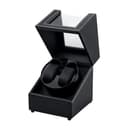
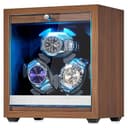
ANWBROAD Wooden 3-Watch Winder

ANWBROAD Wooden 3-Watch Winder

Three positions for less than the price of one premium single. It is a budget winder and behaves like one, but if the job is simply keeping three inexpensive automatics running it does that job.

Best overall under $50
$49.98 · View on Amazon

Price as of October 11, 2026. #ad How we’re funded

Not publishedShared rotation modesNot published
2
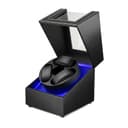
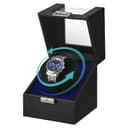
SONGMICS Single Watch Winder (UJWB030B01)

SONGMICS Single Watch Winder (UJWB030B01)

About the cheapest quiet single winder worth owning. Four winding settings, a quiet motor, an LED and USB-C power. If you just want to stop resetting one automatic and don't care about a settings menu, this removes the price excuse.

Best single
$39.99 · View on Amazon

Price as of October 11, 2026. #ad How we’re funded

Not published4 winding settingsUSB-C
3
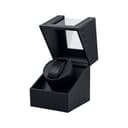
Mcbazel Double Watch Winder (2 Slots)

Mcbazel Double Watch Winder (2 Slots)

The cheapest double we'd actually recommend, from the same maker as our budget single. Quiet Japan-made motor, USB-C power, two slots, and — unusually for this price — a published turns-per-day range. That range is the reason it isn't ranked higher: it starts at 970 TPD, above what many movements need.

Best published figures
$33.79 · View on Amazon

Price as of October 11, 2026. #ad How we’re funded

970-2,430 TPD2 preset winding modes (B and L)USB-C (3-9V)
4
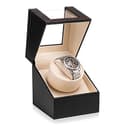
Anyasun 3-Watch Winder Box

Anyasun 3-Watch Winder Box

Four selectable rotation modes across three positions at a price that undercuts most doubles. The mode switch is the reason it edges the other budget triples — you can at least choose a direction.

Best direction control
$40.17 · View on Amazon

$44.9911% off

Price as of October 11, 2026. #ad How we’re funded

Not published4 rotation modesNot published
5
Mcbazel Single Watch Winder

Mcbazel Single Watch Winder

A budget single winder that leans on an ultra-quiet Japanese motor and multiple rotation modes, with AC or battery power. A solid alternative to the SONGMICS at a similar price if you prefer its look.

Best quiet single
$26.49 · View on Amazon

Price as of October 11, 2026. #ad How we’re funded

Not publishedMultiple rotation modesAC + battery
6
Efaithtek Single Watch Winder (Carbon Fiber)

Efaithtek Single Watch Winder (Carbon Fiber)

A battery-or-mains single for the price of a strap. If you need a winder that can sit in a safe or a drawer with no cable running to it, this is the cheapest honest way to do it.

Best without a cable
$23.35 · View on Amazon

$24.585% off

Price as of October 11, 2026. #ad How we’re funded

Not publishedMultiple rotation modesAC adapter or batteries

Specs read from each maker’s published data and retail listing on July 21, July 23 and August 11, 2026. Prices checked live — as of October 11, 2026. “Not published” means the maker does not state that figure; we don’t fill the gap with a guess.

The picks in full

#1Best overall under $50

ANWBROAD Wooden 3-Watch Winder

Three positions for less than the price of one premium single. It is a budget winder and behaves like one, but if the job is simply keeping three inexpensive automatics running it does that job.

Strengths

  • Three positions at a genuinely low price
  • Wood-finished rather than bare plastic
  • Same maker as the double and quad we already recommend

Trade-offs

  • No published TPD figures at all
  • Positions share a program — you cannot set them separately
Watches held3
Rotation settingsShared rotation modes
DirectionNot published
PowerNot published
Quiet motorYes
Includes storageNo

Why this one. At this price the three positions share one motor program. If your three watches want different turns per day, this is not the winder for you.

Specs read from the product listing and the maker’s published data, on August 11, 2026. “Not published” means the maker does not state that figure.

#2Best single

SONGMICS Single Watch Winder (UJWB030B01)

About the cheapest quiet single winder worth owning. Four winding settings, a quiet motor, an LED and USB-C power. If you just want to stop resetting one automatic and don't care about a settings menu, this removes the price excuse.

Strengths

  • Quiet motor and USB-C power at a rock-bottom price
  • Four winding settings cover common needs
  • Adjustable pillow fits most wrist sizes and bracelets

Trade-offs

  • Fewer TPD options than the 12-mode winders
  • Lightweight build feels its price
Watches held1
Rotation settings4 winding settings
DirectionNot published
PowerUSB-C
Quiet motorYes
Includes storageNo

Why this one. Four settings is fewer than the twelve-mode boxes, but for a single non-fussy automatic (a Seiko, an Orient) it's genuinely enough.

Specs read from the product listing and the maker’s published data, on July 21, 2026. “Not published” means the maker does not state that figure.

#3Best published figures

Mcbazel Double Watch Winder (2 Slots)

The cheapest double we'd actually recommend, from the same maker as our budget single. Quiet Japan-made motor, USB-C power, two slots, and — unusually for this price — a published turns-per-day range. That range is the reason it isn't ranked higher: it starts at 970 TPD, above what many movements need.

Strengths

  • Quiet Japan-made motor and USB-C power for around the price of a nice strap
  • Publishes its TPD range (970-2,430) where most budget doubles publish nothing
  • Programmed pauses between winding cycles rather than constant rotation

Trade-offs

  • Lowest setting is 970 TPD — more turns than plenty of automatics ask for
  • Two preset modes only, applied to both slots; no per-watch control
Watches held2
Rotation settings2 preset winding modes (B and L)
DirectionCW and CCW within each cycle
PowerUSB-C (3-9V)
Quiet motorYes
Includes storageNo

Why this one. Over-winding isn't the risk people fear — a healthy automatic's mainspring slips once full. The real cost of a high fixed TPD is unnecessary running hours on the winding mechanism, which is why we'd still take the adjustable Versa if the budget stretches.

Specs read from the product listing and the maker’s published data, on July 23, 2026. “Not published” means the maker does not state that figure.

#4Best direction control

Anyasun 3-Watch Winder Box

Four selectable rotation modes across three positions at a price that undercuts most doubles. The mode switch is the reason it edges the other budget triples — you can at least choose a direction.

Strengths

  • Four rotation modes, including direction choice
  • Marketed and reviewed as very quiet
  • Cheaper than most two-position winders

Trade-offs

  • No published turns-per-day numbers behind the mode names
  • Unbranded-tier build; no service or spares network
Watches held3
Rotation settings4 rotation modes
DirectionNot published
PowerNot published
Quiet motorYes
Includes storageNo

Why this one. Rotation 'modes' without published TPD numbers are the norm below $60. You are choosing between unlabeled programs, not setting a figure.

Specs read from the product listing and the maker’s published data, on August 11, 2026. “Not published” means the maker does not state that figure.

#5Best quiet single

Mcbazel Single Watch Winder

A budget single winder that leans on an ultra-quiet Japanese motor and multiple rotation modes, with AC or battery power. A solid alternative to the SONGMICS at a similar price if you prefer its look.

Strengths

  • Ultra-quiet Japanese motor for a bedside table
  • Multiple rotation modes and both power options
  • Compact footprint

Trade-offs

  • Crocodile-pattern finish is a taste call
  • No exact TPD readout — you pick a mode, not a number
Watches held1
Rotation settingsMultiple rotation modes
DirectionNot published
PowerAC + battery
Quiet motorYes
Includes storageNo

Why this one. Battery power matters more than it sounds — it lets you place the winder where there isn't an outlet, or move it into a safe.

Specs read from the product listing and the maker’s published data, on July 21, 2026. “Not published” means the maker does not state that figure.

#6Best without a cable

Efaithtek Single Watch Winder (Carbon Fiber)

A battery-or-mains single for the price of a strap. If you need a winder that can sit in a safe or a drawer with no cable running to it, this is the cheapest honest way to do it.

Strengths

  • Runs on batteries or the supplied adapter
  • Small enough to sit inside most home safes
  • Costs less than almost anything else that rotates

Trade-offs

  • No published TPD figures
  • Carbon-fiber-look PU is exactly as premium as it sounds
Watches held1
Rotation settingsMultiple rotation modes
DirectionNot published
PowerAC adapter or batteries
Quiet motorYes
Includes storageNo

Why this one. Battery running is the point. A winder run on AA cells will drain them faster the more turns per day you ask for, so budget for rechargeables.

Specs read from the product listing and the maker’s published data, on August 11, 2026. “Not published” means the maker does not state that figure.

What $50 buys, and what it does not

A winder has three jobs: hold the watch without stressing the bracelet, turn it the right way, and turn it the right number of times. Every pick on this page does the first job and the second job. The third one is where the money went missing.

1. Rotation, not turns per day

There is no ISO standard for turns per day, which means TPD guidance comes from each movement’s own maker — and acting on that guidance requires a winder that states a number. Five of these six do not. You press a mode button and the box does something. For a Seiko 4R36 or an Orient F6922, both of which are forgiving movements with roughly 40 hours of reserve, a program chosen blind will almost certainly keep the watch running. It is simply not control, and you should not pretend otherwise. Our TPD settings guide lists the figures by brand, and the adjustable-TPD roundup covers the winders that let you act on them.

2. One program across every position

The ANWBROAD triple states plainly that its three positions share one motor program. That is normal below $60 and it is the thing to check before you buy a multi-position winder at any price: if your three watches want different turns per day, a shared program cannot serve all three. Rothwell and Versa both publish per-watch settings on their doubles, which is exactly why they cost three to six times as much. Our single versus double comparison takes that distinction apart properly.

3. Build, finish and the absence of a service network

At this price the cases are moulded board, PU and veneer, and the brands have no repair channel — when a motor fails, the unit is the loss. That is worth keeping in proportion: a winder is one small motor and a power supply, and a $30 one that lasts three years has cost you ten dollars a year. But it does mean you should not buy a cheap winder expecting to keep it. Our page on how long watch winders last sets out the failure order and why no maker in the category publishes a lifespan.

The one specification worth paying attention to here

It is the power source, and it is the reason the Efaithtek is on this list despite publishing nothing. Four of these six run on batteries as well as mains, which lets you put the winder somewhere there is no outlet — inside a home safe, in a bedside drawer, on a shelf with no cable trailing down the wall. That is a genuine capability, not a spec-sheet line, and it is the one thing the budget end of this category does better than the premium end. Our battery-powered roundup goes deeper on what running cells actually costs you.

When to spend more, in plain terms

Three situations justify leaving this price band. If the watch is worth more than about $500, the delta between a $30 winder and a $90 one is trivial against what it is holding. If you own two or more automatics that want different winding programs, you need per-position control and nothing here has it. And if the winder is going on a bedside table, pay for a motor with a published quiet claim rather than a listing adjective — our quiet winder roundup covers which makers actually state something.

And one situation justifies not buying a winder at all: if the watches you want to protect are not in active rotation, winding them accumulates running hours for no benefit. A $22 ten-slot box does more for a resting collection than any winder on this page. Winder versus box works through that decision, and how many winders you need is the audit that usually returns a smaller number than people expect.
Frequently asked questions

Are cheap watch winders bad for your watch?

No, for the reason most people worry about. A healthy automatic cannot be overwound by a rotor or a winder - a slipping bridle on the mainspring barrel releases the tension once it is full. The real cost of a cheap winder is unnecessary running hours when its fixed program turns far more than your movement needs, and the absence of any published figure to check that against.

What is the cheapest watch winder worth buying?

Of the units we track with a live listing, the Efaithtek carbon-fibre single is the lowest-priced one we would name, and it earns the slot on capability rather than price: it runs on batteries as well as mains, so it can sit in a safe or a drawer with no cable. If you want a quiet motor specifically, the Mcbazel and SONGMICS singles both state one for a few dollars more.

Can you get a watch winder for two or three watches under $50?

Yes - and that is the main reason to shop this band. The ANWBROAD wooden triple, the Anyasun triple and the J&T triple are all three-position winders under $50, and the Mcbazel double is under $35. The catch is uniform: the positions share one program, so every watch gets the same treatment.

Do cheap watch winders publish turns per day?

Almost never. Of the six picks here, only the Mcbazel double publishes a range (970 to 2,430 TPD), and its floor is already above what plenty of movements ask for. Everything else offers numbered or lettered 'modes' with no figure attached. If setting an exact TPD matters to you, the cheapest honest route is a Versa or Rothwell, which publish their steps.

Is a $30 watch winder quiet enough for a bedroom?

Several of these state a quiet or 'Japanese' motor, and that claim is usually fair at the volume a winder runs at - the motor turns intermittently, not continuously. But no maker in this band publishes a decibel figure, so there is nothing to verify. If silence is the requirement rather than a preference, read our quiet winder page, where at least some makers state something measurable.

How long will a $40 watch winder last?

No maker in this category publishes a lifespan, an MTBF figure or a cycle count, so we do not give a number. What you can check is the warranty and whether the brand has any repair route at all - and below $50 the answer is generally no. Treat a cheap winder as a consumable rather than a purchase you keep.

Sources

Keep reading