Caller vs traveler: the distinction that matters
This is the single most useful thing to understand before buying a GMT, so it goes first.
On a caller GMT, the local hour hand and the 24-hour hand are linked to the same gear train, and the crown sets the 24-hour hand independently. You leave the main hands on your home time and point the GMT hand at wherever your colleague, client or family is. It is called a caller GMT because it was designed for someone making international phone calls from a desk. Every watch on this page works this way, including all four Seikos.
On a traveler GMT, the local hour hand jumps in one-hour increments independently of everything else. You land, pull the crown one click, click the hour hand forward three hours, and the watch never stops running — your home time stays visible on the 24-hour hand. This is what you want if you fly across time zones regularly. It is also considerably more expensive to build, which is why it is absent below roughly $1,500.
The practical test: if you mostly stay put and want to know what time it is somewhere else, buy a caller. If you cross time zones often enough that resetting a watch is a chore, save for a traveler. Everyone in the first group — the large majority — is well served by this page.
How we picked
1. A real mechanical GMT complication
Excluded from this list: quartz GMTs, and watches with a decorative 24-hour scale printed on the dial and no fourth hand to use it. A GMT watch has an independently settable 24-hour hand. If a listing does not describe how the second zone is set, assume it is decorative.
2. Seiko’s 4R34, and what it publishes
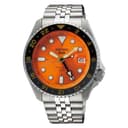
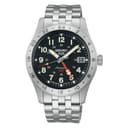
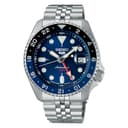
Four of the six picks use the same movement, and that is not laziness — it is the state of the market. Seiko publishes the 4R34’s specification: 24 jewels, 21,600 vibrations per hour, roughly 41 hours of power reserve, automatic with manual winding, and an independently adjustable 24-hour hand. Seiko does not publish an accuracy figure for any of these references specifically, and we have not invented one. Almost everything that separates the SSK models is cosmetic: case shape, bezel and dial color. The exception is the Japan-market field GMT, which is genuinely a smaller watch. If it is the 5 Sports GMT you are weighing up, our full Seiko 5 Sports GMT (SSK001) review goes through Seiko’s published dimensions, the caller-GMT limitation and the three complaints we think are fair — and explains why the orange SSK005 is now the one to buy. As of October 2026 it is the only SKX-cased 4R34 GMT with an ordinary listing: the black SSK001 has none at all, and the blue SSK003 survives only as a Japan-market import at roughly double the price for an identical watch.
3. Crystal, and the sapphire inversion
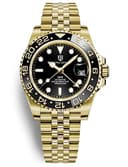
This category contains an oddity worth flagging: the $140 watch has a sapphire crystal and the $400 one doesn’t. Seiko fits its own Hardlex mineral glass across the SSK line; Pagani Design fits sapphire because it is the cheapest way to look premium on a spec sheet. Sapphire genuinely resists scratching far better. It is one of the clearest examples on this site of specification and quality not being the same thing.
4. Size, because GMT cases are not small
The SSK models are 42.5mm across and 13.6mm thick, per Seiko’s own listings. That is a substantial watch, and the 24-hour bezel makes it read larger still. The 40mm Pagani is the pick for anyone with a wrist under about seven inches, which is most of the reason it ranks where it does rather than lower — and the 39.4mm Japan-market field GMT is the only Seiko here that solves the same problem.
Seiko or the homage?
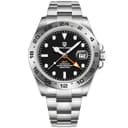
The honest comparison. The Pagani Design GMTs cost roughly a third of the Seikos and out-spec them on paper: sapphire crystal, a stated 100m water resistance, and a choice of 40mm or 42mm. They are also openly derivative — the styling copies a very famous Swiss GMT without faking a brand, which is legal and extremely common at this price.
What the Seiko premium buys is not specification. It is a movement whose maker publishes its data, a company that will service the watch in fifteen years, parts availability, a design that is Seiko’s own, and a watch worth something second-hand. Those are real things, and for a watch you plan to keep they are worth the difference. If you want the function and the look for the least money and you are relaxed about the rest, the Pagani is a rational buy and we would rather say so than pretend otherwise. Our page on whether cheap automatics are worth it covers this trade properly.
Setting a caller GMT
The process trips people up because the order matters. Set the 24-hour hand to your home time first, using the crown position the manual specifies. Then set the main hands to local time. If you do it the other way round on some calibers you will end up with the 24-hour hand twelve hours out, which is the most common “my GMT is broken” support question there is.
One further quirk: the 24-hour hand reads against a 24-hour scale, so 15:00 sits where 3 o’clock would be on the main dial but on the outer ring. Watches with a rotating 24-hour bezel let you track a third zone by turning the bezel — a genuinely useful trick, and the reason the bezel versions cost a little more than the fixed-ring ones.
Finally, all of these are automatics, so if the watch stops the GMT hand stops with it. Hand-wind it 20 to 40 turns before setting anything — our guide to winding an automatic watch explains why that is the right way to start one, and why you cannot overwind it.