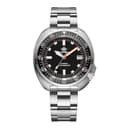
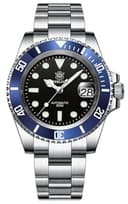
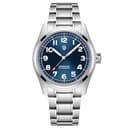
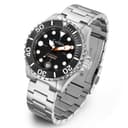
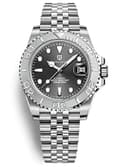
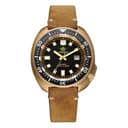
What the NH35 actually is
The Seiko connection
Seiko Instruments — the arm of the company that sells movements to third parties — produces the NH series. The NH35 is functionally the same design as the 4R35 that Seiko fits to its own watches: automatic with hand-winding, hacking seconds, 24 jewels, 21,600 vibrations per hour and roughly 41 hours of power reserve on Seiko’s published figures for the 4R family.
The practical difference is finishing and regulation. Seiko regulates the movements it fits to its own watches; a bought-in NH35 arrives however the micro-brand chose to receive it, which is usually unregulated. That is the single most common reason a new NH35 watch runs faster or slower than expected out of the box.
What Seiko publishes, and what it does not
For the 4R family, Seiko publishes an accuracy specification of roughly -35 to +45 seconds per day worn on the wrist. That is a wide window and it is honest — it is a specification for a workhorse movement, not a chronometer. Most NH35 watches in practice run well inside it. Micro-brands almost never publish an accuracy figure of their own, and where they do not, our spec tables read “Not published” rather than borrowing Seiko’s number for a watch it was not stated for.
NH35 vs NH34, NH36, NH38
The family is worth knowing. The NH35 has a date. The NH36 adds a day. The NH38 drops the date entirely and shows an open balance. The NH34 is the GMT version with an independently settable 24-hour hand — the movement behind the affordable GMT boom, covered on our GMT watch page. Same base architecture, different complications.
How we picked
1. Since the movement is fixed, judge the case
This is the whole method for this page. Every pick has the same heart, so ranking them on movement would be meaningless. Instead we have weighted crystal, water resistance, bezel material, bracelet quality and how coherent the design is. Five of the six state a sapphire crystal, which at these prices is the specification that most changes how the watch looks after two years.
2. Stated ratings, and what they are not
Several picks state 200m or 300m water resistance. That is a manufacturer claim, and it is not the same as an ISO 6425 “DIVER’S” certification, which requires every individual watch to be tested. We treat stated ratings as useful information and certification as a different, higher claim — our water resistance guide explains the distinction.
3. Homage or original?
An honest note about this category: a large share of NH35 watches are homages — deliberate reinterpretations of famous Swiss designs. Two picks here are openly derivative and we have said so on their cards rather than pretending otherwise. That is legal and extremely common, and whether it bothers you is a taste question. Buyers who want an original design are better served by the Seiko and Orient watches in our under-$300 guide; buyers who want the borrowed design done well should read our best homage watches roundup, which names the original behind each pick.
4. Service reality
The great advantage of the NH35, and the one most worth paying attention to. When a micro-brand disappears — and they do — a watch with a proprietary or unnamed movement becomes very hard to repair. An NH35 watch does not: replacement movements are cheap and widely available, and swapping one is a routine job. This single fact makes the whole category far lower-risk than it looks.
Regulation: the one thing worth knowing after you buy
A new NH35 watch commonly arrives running somewhere between roughly ten and thirty seconds fast or slow per day. That is within Seiko’s published tolerance for the family and is not a fault. It is also, unusually, fixable cheaply: regulating a movement is a short job for a watchmaker, and it will typically bring the watch to within a few seconds a day.
If your new watch is running badly, work through the ordinary causes first — power reserve, magnetism, resting position — before assuming it needs work. Our guide on why an automatic watch loses time covers that sequence, and what normal accuracy looks like sets expectations properly.
Is an NH35 watch better than a Seiko?
On specification, frequently yes: an NH35 micro-brand diver typically offers sapphire and a higher stated depth rating than a Seiko 5 at the same money, sometimes with a ceramic bezel on top. On everything else, no. Seiko regulates its movements, backs them with a global service network, sells parts, and puts its own design on the dial.
The clean way to decide: if this is your only mechanical watch and you want it to still be supported in fifteen years, buy the Seiko. If it is a second or third watch and you want the most specification for the money, buy the NH35. Our NH35 versus Miyota 9015 comparison covers the other side of the movement question.
The NH35 as a dive watch, specifically
Most NH35 watches sold are divers, because the caliber’s price leaves room in the budget for a 200m case and a sapphire crystal. Our best automatic dive watches under $200 is that slice of the market on its own, with the water-resistance claims read off each listing rather than assumed from the styling.
The best-documented NH35 diver we have found also gets a page to itself. Our Steeldive SD1970 review is the one case where a micro brand publishes the diameter, the thickness andthe lug-to-lug alongside the caliber — which is how an NH35 watch should be sold, and almost never is.
Two brands dominate the NH35 end of this market, and they are more different than their spec sheets suggest. Our Steeldive vs ADDIESDIVE comparison sets them against each other on the one thing that separates them: Steeldive publishes diameter, thickness and lug-to-lug, and ADDIESDIVE publishes none of the three.