Dial & Lume

Best Triple (3-Watch) Watch Winders

Three-position winders from about $43 to $340, compared on the one thing that separates them: whether all three positions share a single program, or each watch gets its own turns per day and direction.

By Stephen V.Last updated How we pick

Three is the awkward number in watch winders. Singles and doubles are everywhere, four-position boxes are the standard “multi” format, and three sits between them — which means the field is smaller and the quality spread inside it is much wider than usual. The gap between the cheapest and the most expensive winder on this page is roughly eight times, and the two ends are not doing the same job.

The distinction that decides this category is independent control. Some three-position winders drive all three cuffs from one motor and one program: pick a rotation mode and every watch gets it. Others give each position its own motor, its own turns-per-day setting and its own direction. If your three watches are, say, a Rolex, a Seiko and an Orient, they do not want the same program — and a shared-program winder means at least two of them are being wound to a figure that was chosen for something else.

Six picks below, ranked on that first, then on whether the maker publishes actual turns-per-day numbers rather than unlabeled “modes”. We have not handled any of these. Specifications are read from each maker’s own listing on the date shown, unknowns are marked “Not published” rather than guessed, and prices come from a live daily check rather than a number typed into this page.

How this is funded: we earn a commission if you buy through our links, at no extra cost to you. As an Amazon Associate we earn from qualifying purchases. It never changes which watch or winder we recommend, and we’ll tell you plainly when to skip one. Full disclosure.

Quick picks

Ranked on movement, specs and buyer fit. Select a row to jump to the full write-up. We have not tested these — here is exactly what we do instead.

#ProductBest forPrice
1
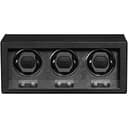
Rothwell Triple Watch Winder

Rothwell Triple Watch Winder

The three-position winder to buy if you actually care what the winder is doing. Rothwell's published spec gives five turns-per-day speeds and three rotation modes, and its doubles are already the reference for per-position control at this size.

Best overall
$309.95 · View on Amazon

Price as of September 4, 2026. #ad How we’re funded

2
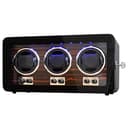
Oryx 3-Watch Wooden Winder

Oryx 3-Watch Wooden Winder

The value pick at three positions. A real wooden case rather than a plastic shell, from the same maker as the six-position box we recommend elsewhere, at roughly half what the premium triples cost.

Best value
$159.99 · View on Amazon

$169.996% off

Price as of September 4, 2026. #ad How we’re funded

3
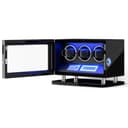
DUKWIN 3-Watch Winder with Fingerprint Lock

DUKWIN 3-Watch Winder with Fingerprint Lock

The one to buy if the winder also has to keep people out of it. A fingerprint lock and an LCD control panel on three positions — features nothing else at this capacity offers, at a price that reflects them.

Best with a lock
$267.96 · View on Amazon

$282.075% off

Price as of September 4, 2026. #ad How we’re funded

4
Anyasun 3-Watch Winder Box

Anyasun 3-Watch Winder Box

Four selectable rotation modes across three positions at a price that undercuts most doubles. The mode switch is the reason it edges the other budget triples — you can at least choose a direction.

Best budget pick
$42.74 · View on Amazon

$44.995% off

Price as of September 4, 2026. #ad How we’re funded

5
ANWBROAD Wooden 3-Watch Winder

ANWBROAD Wooden 3-Watch Winder

Three positions for less than the price of one premium single. It is a budget winder and behaves like one, but if the job is simply keeping three inexpensive automatics running it does that job.

Best cheap wooden case
$49.98 · View on Amazon

Price as of September 4, 2026. #ad How we’re funded

6
J&T Technology 3-Watch Winder

J&T Technology 3-Watch Winder

The cheapest three-position winder we would actually name, from the same maker as the four-position storage box elsewhere on this site. A Japanese motor at this price is the whole pitch.

Lowest cost per position
$43.23 · View on Amazon

$46.998% off

Price as of September 4, 2026. #ad How we’re funded

The picks in full

#1Best overall

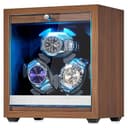
Rothwell Triple Watch Winder

The three-position winder to buy if you actually care what the winder is doing. Rothwell's published spec gives five turns-per-day speeds and three rotation modes, and its doubles are already the reference for per-position control at this size.

Strengths

  • Five published TPD speeds and three rotation directions
  • Quiet Japanese motors, one per position
  • Leather-finished case that suits a dresser rather than a desk

Trade-offs

  • Costs six times what the cheapest three-position boxes do
  • Big — three winders side by side is a wide object
Watches held3
Rotation settings5 TPD speeds x 3 directions
DirectionCW, CCW, both
PowerAC adapter or AA batteries
Quiet motorYes
Includes storageNo

Why this one. Rothwell publishes its TPD range, which most winder makers at any price do not. That is the single reason to pay this much for three positions.

Specs read from the product listing and the maker’s published data, on August 11, 2026. “Not published” means the maker does not state that figure.

#2Best value

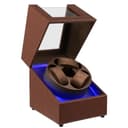
Oryx 3-Watch Wooden Winder

The value pick at three positions. A real wooden case rather than a plastic shell, from the same maker as the six-position box we recommend elsewhere, at roughly half what the premium triples cost.

Strengths

  • Wooden case rather than molded plastic
  • Three positions at a mid-market price
  • Same maker as the well-regarded six-position Oryx

Trade-offs

  • Turns-per-day figures are not published
  • Fewer program options than the Rothwell
Watches held3
Rotation settingsMultiple rotation modes
DirectionNot published
PowerNot published
Quiet motorYes
Includes storageNo

Why this one. Oryx sits between the sub-$50 boxes and the Rothwell/WOLF tier. You get the case material without the published-spec transparency.

Specs read from the product listing and the maker’s published data, on August 11, 2026. “Not published” means the maker does not state that figure.

#3Best with a lock

DUKWIN 3-Watch Winder with Fingerprint Lock

The one to buy if the winder also has to keep people out of it. A fingerprint lock and an LCD control panel on three positions — features nothing else at this capacity offers, at a price that reflects them.

Strengths

  • Fingerprint lock rather than a token key
  • LCD touchscreen control instead of a hidden rotary switch
  • Remote control and adjustable pillows

Trade-offs

  • The most expensive three-position winder here
  • Electronic lock is another thing that can fail
Watches held3
Rotation settingsMultiple rotation modes, LCD-set
DirectionNot published
PowerNot published
Quiet motorYes
Includes storageNo

Why this one. A fingerprint lock deters a casual hand, not a determined thief. Treat it as convenience and privacy, not as security for genuinely valuable watches.

Specs read from the product listing and the maker’s published data, on August 11, 2026. “Not published” means the maker does not state that figure.

#4Best budget pick

Anyasun 3-Watch Winder Box

Four selectable rotation modes across three positions at a price that undercuts most doubles. The mode switch is the reason it edges the other budget triples — you can at least choose a direction.

Strengths

  • Four rotation modes, including direction choice
  • Marketed and reviewed as very quiet
  • Cheaper than most two-position winders

Trade-offs

  • No published turns-per-day numbers behind the mode names
  • Unbranded-tier build; no service or spares network
Watches held3
Rotation settings4 rotation modes
DirectionNot published
PowerNot published
Quiet motorYes
Includes storageNo

Why this one. Rotation 'modes' without published TPD numbers are the norm below $60. You are choosing between unlabeled programs, not setting a figure.

Specs read from the product listing and the maker’s published data, on August 11, 2026. “Not published” means the maker does not state that figure.

#5Best cheap wooden case

ANWBROAD Wooden 3-Watch Winder

Three positions for less than the price of one premium single. It is a budget winder and behaves like one, but if the job is simply keeping three inexpensive automatics running it does that job.

Strengths

  • Three positions at a genuinely low price
  • Wood-finished rather than bare plastic
  • Same maker as the double and quad we already recommend

Trade-offs

  • No published TPD figures at all
  • Positions share a program — you cannot set them separately
Watches held3
Rotation settingsShared rotation modes
DirectionNot published
PowerNot published
Quiet motorYes
Includes storageNo

Why this one. At this price the three positions share one motor program. If your three watches want different turns per day, this is not the winder for you.

Specs read from the product listing and the maker’s published data, on August 11, 2026. “Not published” means the maker does not state that figure.

#6Lowest cost per position

J&T Technology 3-Watch Winder

The cheapest three-position winder we would actually name, from the same maker as the four-position storage box elsewhere on this site. A Japanese motor at this price is the whole pitch.

Strengths

  • Stated Japanese motor at a price where that is unusual
  • Three positions for less than most singles
  • Compact enough for a drawer or shelf

Trade-offs

  • No TPD or direction figures published
  • Plastic-and-veneer construction throughout
Watches held3
Rotation settingsMultiple rotation modes
DirectionNot published
PowerNot published
Quiet motorYes
Includes storageNo

Why this one. The cost per position is the argument here and the only argument. Buy it for cheap automatics you would not be upset to have to reset.

Specs read from the product listing and the maker’s published data, on August 11, 2026. “Not published” means the maker does not state that figure.

How we picked

1. Independent control, first and last

This is the criterion that reorders the whole list. A three-position winder whose positions can be set separately is a different product from one that cannot, and the price difference between them is entirely justified. The Rothwell publishes five turns-per-day speeds and three rotation directions and applies them per position; the sub-$50 boxes drive all three cuffs off a shared program. Both are legitimate purchases — but only if you know which you are buying.

2. Published turns-per-day, not “modes”

Almost every budget winder advertises “4 rotation modes” or “multiple settings” without ever saying what those modes do. That is not a small omission. Turns per day is the entire specification of a winder: it is the number your watch’s movement actually cares about. A winder that publishes 650–1,950 TPD can be matched to a movement; a winder that offers Mode 1, Mode 2 and Mode 3 cannot. Our guide to turns-per-day settings by brand has the reference table.

3. Noise, because three motors are three times the problem

A winder that is barely audible on its own is noticeably present when there are three of them running in one case. Every pick here states a quiet or Japanese motor, which is the standard claim; none of them publishes a decibel figure, so we have not invented one. If the winder is going in a bedroom, our quiet winder picks are the more careful place to start.

4. Do you actually need three?

The honest question. Winding is only useful for watches you wear often enough that resetting them is a chore, and complicated enough that resetting them is genuinely annoying — an annual calendar, a moonphase, a date you have to cycle through twelve hours to reach. A three-watch rotation of simple date automatics does not need three powered positions; it needs one, and a watch box for the other two. We make that argument at length in winder versus box.

Three positions or four?

Worth thinking about before you commit. Four-position winders are a far more competitive category — more makers, more listings, and consequently better value per position. It is common for a good four-position winder to cost less than a mediocre three, simply because volume drives the price down.

Buy three if the space genuinely will not take a four, or if the three-across proportion suits the furniture better. Buy four if you are undecided, because the spare position costs almost nothing and collections rarely shrink. Our multi-watch winder picks cover four, six and eight positions.

What a shared program actually means in practice

Suppose you set a shared-program winder to a bidirectional mode at whatever turns-per-day it defaults to. A Seiko 4R36, which winds bidirectionally and asks for relatively little, will be fine. A movement that winds in one direction only will get roughly half the effective turns it was promised, because half the rotation is doing nothing. It will probably still stay wound — most movements have generous margins — but you are relying on the margin rather than on the setting.

This is why we rank on independent control rather than on capacity. Three positions you cannot set separately is, functionally, one winder with three cuffs on it.

Frequently asked questions

Do all three positions on a triple watch winder run at the same time?

Yes on every model here — the positions run together whenever the winder is powered. What differs is whether they run the same program. Winders with per-position control let you give each watch its own turns per day and direction; shared-program winders apply one setting to all three cuffs.

Is a triple watch winder worth it over a double?

Only if you genuinely rotate three watches that are annoying to reset. A winder earns its keep on complicated watches — annual calendars, moonphases, anything where setting the date means cycling the hands through hours. For three simple date automatics, one winder and a watch box costs less and works just as well.

How many turns per day should a three-watch winder be set to?

It depends on the movements, which is exactly why per-position control matters. Most modern automatics sit somewhere between roughly 650 and 900 turns per day, bidirectional. If a winder does not publish its TPD figures you cannot match it to anything — you are choosing between unlabeled modes.

Are cheap three-watch winders bad for watches?

No. A cheap winder cannot overwind a watch — the mainspring's slipping bridle makes that mechanically impossible on a self-winding movement. The real risks are a noisy motor you end up unplugging, a badly shaped cuff that stretches a bracelet, and a shared program that does not match your movements.

Can a triple winder run on batteries?

Some can, but it is a poor fit at this capacity. Three motors draw roughly three times the current of one, so battery life falls accordingly. If the winder has to run without a socket nearby, a single or double is a far more sensible choice — see our battery-powered picks.

Do watch winders damage watches over time?

There is no evidence they cause damage in normal use, and overwinding is impossible. The reasonable counter-argument is that a winder keeps a movement running when it would otherwise be at rest, which is more running time between services. Whether that matters at all is covered in our guide on the question.

Sources

Keep reading