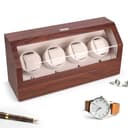
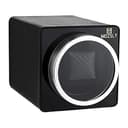
The three tiers, and who each is for
WOLF — the design tier
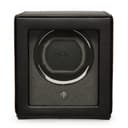
WOLF is the only winder brand a non-collector might have heard of, and it is the one whose products look like furniture rather than appliances. The Cub single is our representative pick. What you are buying is the patented spring-loaded cuff that holds a watch without stretching the bracelet, genuinely good materials, and a case you are happy leaving on a dresser.
What you are not buying is a longer settings menu. WOLF ships pre-set rotation programs rather than a numeric TPD dial, which is the opposite of the mid-tier proposition. If your priority is dialing in an exact turns-per-day figure, a WOLF is the wrong purchase at six times the price. Our WOLF versus Versa comparison takes that trade apart properly.
Barrington, Rothwell, Versa, Heiden — the control tier
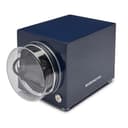
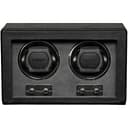
This is where most people should be shopping. All four use quiet Japanese motors, and all four give you settings expressed as choices rather than mystery modes. Barrington is the enthusiast-forum default: adjustable TPD, all three directions, and a modular design so a second unit stacks alongside the first rather than replacing it. Rothwell publishes the most specific figures of anyone — five named TPD speeds and three directions, set per watch. Versa undercuts both while keeping real rotation programs. Heiden is the one that scales, with quad units built for a collection rather than a favorite.
MOZSLY, Mcbazel, SONGMICS, ANWBROAD — the budget tier
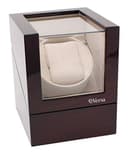
These brands are commodity manufacturers, and treating them as anything else leads to disappointment. What they reliably deliver is a motor that turns, a case that looks fine on a shelf, and a price around a tenth of the control tier. What they do not deliver is published specification, per-position control on multi-watch units, or any expectation of parts in five years.
That is a perfectly rational purchase for a $200 Seiko. It is a poor one for a watch you would be upset to damage — not because a cheap winder will hurt it, but because the cuffs are cruder and a bracelet that does not seat properly is the actual risk. Our under-$100 winder roundup covers this tier in detail.
How we picked
1. What the brand publishes about itself
The most reliable brand signal in this category is whether the maker has a specification page at all. Rothwell, Versa and Barrington all host their own product specs with TPD figures and direction options on them. Most budget brands host nothing, and everything you can know comes from the Amazon listing. That is not automatically disqualifying — but it means nobody, including us, can tell you what the winder does beyond what the box claims.
2. Rotation control, in real numbers
Weighted heavily, because it is the only functional difference that survives scrutiny. A winder with named TPD speeds and direction choice can be matched to a movement; one with a dial marked 1 to 4 cannot. See our adjustable-TPD roundup for the picks filtered purely on this.
3. Whether the range scales with you
Barrington’s modularity and Heiden’s multi-position units both answer the same real problem: collections grow, and rebuying a winder because you bought a single is a genuine cost. That is worth more than it sounds when you are choosing between two similarly-specified boxes.
4. What no brand publishes
Not one winder maker publishes a decibel figure, at any price. Every product in this category is described as quiet or silent by its own marketing, and none of those claims is measurable from the outside. We have not measured them either, so this page prints no noise numbers — only the observation that Japanese-motor units are the ones consistently described as bedroom-quiet by people who own them.
Which brand should you actually buy?
Two questions decide it. First: do you need to set a specific TPD figure? If your watch’s maker publishes one and you want to match it, you are shopping the control tier — Barrington or Rothwell — and the budget tier is out regardless of price.
Second: where will it live? If the winder sits on a dresser you look at every day, WOLF’s premium is buying something real, and people who pay it are generally happy. If it lives inside a wardrobe or a safe, you are paying several hundred dollars for a case nobody sees, and a Versa does the same mechanical work.
For most people reading this, the answer is the middle tier at around $90 to $200. Before you buy anything, though, it is worth being certain you need a winder at all — our guide on whether a watch winder is worth it makes the case against as honestly as the case for.
Two follow-ups to this ranking. How long watch winders last collects what each brand publishes about warranty and repairs, which is the only durability signal any of them actually gives you — and lockable winders and boxes covers the one feature none of these brands competes on.