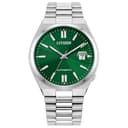
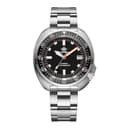
Why sapphire, in one paragraph of actual physics
Scratches happen when something harder drags across something softer. The Mohs scale ranks minerals exactly that way, and its numbers are the whole argument: corundum, which synthetic sapphire is, is a 9. Quartz is a 7. Glass is 5.5. Plastic is 2 to 2.5.
Sand, household dust and the grit on a car door handle are mostly quartz. At hardness 7 they cut glass at 5.5 and acrylic at 2 without any effort at all, and they do essentially nothing to a 9. That is why the same casual contact that leaves a mineral-glass watch looking tired after two years leaves a sapphire one looking new.
What sapphire does not fix
Hardness and toughness are different properties, and this is the honest caveat. Sapphire is harder than mineral glass but more brittle: a sharp impact on a corner is more likely to chip or crack it, where mineral glass may absorb the same knock and where acrylic will simply dent and can often be polished clear again. If your watch will meet concrete and door frames regularly, that trade is worth thinking about rather than assuming sapphire wins every category.
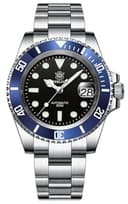
Sapphire also reflects more than mineral glass unless it has been coated. That is why anti-reflective treatment appears on the better listings — the Steeldive here states one — and why an uncoated sapphire dive watch can be harder to read in sunlight than you expect.
The price inversion that runs through this category
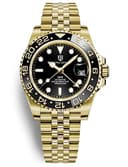
The strangest thing about sapphire in 2026 is where it turns up. A $150 Pagani Design has it. So does a $153 ADDIESDIVE. Meanwhile Seiko fits its own Hardlex mineral glass across the entire 5 Sports line, including watches at three times the price, and Timex fits domed acrylic to the Marlin.
This is not an accident, and it is not incompetence. Sapphire has become cheap to source, and for a brand with no name recognition it is the single most effective line item on a spec sheet — a real feature that a buyer can check and compare. Established makers are spending the same money on movement development, case finishing, service networks and warranty, none of which shows up in a bullet list.
The practical conclusion: sapphire is a genuine advantage, but it is not evidence that the cheaper watch is the better watch. It tells you what the brand chose to spend on. Our page on whether cheap automatic watches are worth it works through the rest of that trade.
How we picked
1. Sapphire confirmed, not assumed
Every watch here states a sapphire crystal on the maker’s or retailer’s own listing. Listings that say “sapphire coated” or “crystal glass” were excluded — sapphire-coated mineral glass is a thin hardened layer on soft glass, and it wears through.
2. A movement worth putting under it
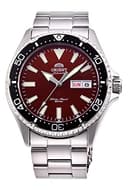
A hard crystal over a movement nobody will service is a poor trade. Four of the six picks run a caliber with published specifications behind it — Orient’s F6922, Miyota’s 9015, Seiko’s NH35 and Citizen’s 8210 — and the entries name which. Miyota publishes the 9015 in full: 28,800 vibrations per hour, 24 jewels, roughly 42 hours of reserve, 3.90mm thick, with hacking and hand winding.
3. Spread across use cases, not six of the same watch
A diver, a dress watch, a GMT, an everyday integrated-bracelet piece and two budget divers. There is little point ranking six near-identical homage divers when the crystal is the constant.
4. What we left out
Watches whose sapphire claim we could not verify on the listing, and anything where the crystal was the only reason to consider it. A sapphire crystal on a movement with no maker, no service path and no published specification is a hard window over a disposable watch.
Living with a sapphire crystal
There is nothing to maintain. Sapphire does not need protecting from anything you will encounter in normal life, and cleaning it is a microfiber cloth and nothing else. The one habit worth keeping is the same as for any watch: take it off before hot showers, because water resistance is a gasket problem rather than a crystal one — our water resistance guide explains why heat is harder on a watch than depth.
If a sapphire crystal does chip, it is replaceable, and on most watches it is a routine job for a watchmaker rather than a write-off. Budget for it as part of a service rather than as an emergency; our service cost guide covers what a proper overhaul should include.
One place sapphire earns its money more than most: a saturated colored dial, where crystal haze dulls the color in a way it never does on black. Only two of the five picks on our green-dial roundup publish sapphire, and the gap between those two and the mineral-crystal picks is the clearest illustration of this trade anywhere on the site.