How we picked
1. It has to actually be automatic
The most common trap in this category is a quartz watch listed with mechanical language. Two checks settle it. The seconds hand on an automatic sweeps in six to eight small steps per second so it looks continuous; a quartz jumps once per second in a single visible movement. And an automatic stops within a day or two on a dressing table, where a quartz runs for years. If a listing says “automatic date” rather than “automatic movement”, that is a quartz calendar function. Our automatic vs quartz explainer covers the difference properly.
2. A case genuinely sized for a smaller wrist
Not a shrunk men’s design with a smaller strap. The picks here are cases designed at their size, which shows in the lug-to-lug span — the measurement that actually determines whether a watch overhangs a wrist — rather than just the diameter.
3. A brand that will still be there
Because this market is thin, it attracts marketplace listings offering “ladies’ skeleton automatics” for $38. Some of them work. None of them comes with a company behind it, and at the point where the movement stops there is no service route at all. Every pick here is from Seiko, Orient, Fossil or Bulova, all of which have real warranty and service networks.
4. Honest about what is published
Seiko’s ladies’ 5 references are old, and Seiko publishes far less about them than about its current men’s lines. Fossil publishes nothing about its calibers at all. Rather than fill those gaps with plausible numbers, the spec tables print “Not published” — which is information in itself when you are comparing against a Seiko men’s model that states -35/+45 seconds a day.
The case for buying a “men’s” watch
This is the most useful advice on the page, so it gets its own section.
Watch sizing is marketing, not engineering. A 38mm case is a 38mm case, and it was the standard men’s size for most of the twentieth century — the fashion for 42mm-plus cases is recent and already receding. Plenty of watches sold in the men’s section are 38 to 40mm and look entirely correct on a smaller wrist, particularly field and dress designs with slim lugs.
The moment you accept that, the choice expands from five watches to fifty. The Orient Bambino at 38mm, the 38mm Praesidus A-11 on our field watch page, and most of the dress watches on our dress list are all realistic candidates. The measurement to check is lug-to-lug — the distance from the top of the upper lugs to the bottom of the lower ones. If it exceeds the flat part of your wrist, the watch will overhang regardless of the diameter.
Strap width is the other lever, and it is cheap. A 20mm strap on a 38mm watch reads sporty; an 18mm strap on the same watch reads elegant. Swapping a strap costs almost nothing and changes the character of a watch more than most people expect.
What the money buys in this category
The five picks span roughly $145 to $280, and the differences are clearer than in the men’s market because the field is smaller.
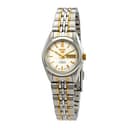
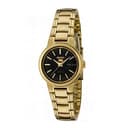
Around $145–$170 gets you a Seiko 5 — a genuine in-house automatic from a company with global service, in a case designed decades ago and looking it. The exposed crown and dated proportions are the price of admission, and the mechanics are the same class of object as the men’s version.
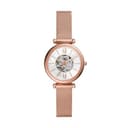
Around $250 gets you a Fossil Carlie Mini Automatic: a modern, genuinely attractive design on a mesh bracelet with high-street aftercare, at the cost of a movement nobody will tell you anything about.
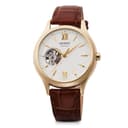
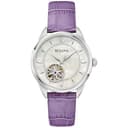
Around $260–$280 is where it gets interesting. The Orient open-heart gives you an in-house Japanese movement and a design worth looking at — the only pick here that does both. The Bulova is the dressiest and the one most likely to be received as jewelry.
Living with an automatic
Two practical things, because they come up more in this category than any other.
It will stop. An automatic winds from the motion of your wrist and runs for roughly 40 hours after you take it off. Leave it on a dressing table over a weekend and it will have stopped by Monday. That is entirely normal and harms nothing — wind it 20 to 40 turns at the crown, set the time, and put it on. Our guide to winding an automatic covers the mechanics, including why you cannot overwind one.
It will not keep perfect time. A mechanical watch that gains or loses fifteen seconds a day is behaving normally. If precision matters more to you than mechanism, quartz is genuinely the better technology and there is no shame in preferring it — our accuracy guide sets out what the numbers actually mean.
You almost certainly do not need a winder. Winders solve a convenience problem for people rotating several automatics, not a preservation problem for one — and our page on whether automatics need a winder says no for most people, at length.