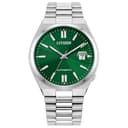
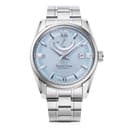
What the Tsuyosa actually is
A 40mm stainless steel automatic with an integrated bracelet, a date window at three o’clock, and Citizen’s own three-hand automatic movement with a stated 42-hour power reserve. It comes in a wide range of dial colors — blue, black, green, orange and others — which is a large part of its appeal, because the dial is doing most of the work on a watch this plain.
The name means roughly “strong” in Japanese. The reference numbers begin NJ0, and the variants differ only in dial and finish; there is no mechanical difference between the blue one and the green one, so buy on color and price.
Why it sells: the integrated bracelet
On a normal watch, the bracelet attaches to lugs with spring bars, and you can swap it for anything of the right width. On an integrated design, the first links are shaped to continue the case, so the bracelet is part of the watch’s silhouette rather than an accessory attached to it. Done well, it produces a watch that looks like a single object and sits closer to the wrist.
Done badly — and there are many badly done examples at this price — you get a conventional case with a slightly narrowed bracelet end and an obvious gap. The Tsuyosa is genuinely integrated, and that is the single biggest reason it became the recommendation it did.
The trade, and it is a real one: you are committed to that bracelet. You cannot fit a leather strap, a NATO or a rubber strap without ruining the design, and if you dislike the bracelet or it does not size well to your wrist, there is no remedy. On a conventional watch a $30 strap changes everything. Here, it doesn’t.
Where the money was saved
Three places, and none of them is the movement.
Finishing. The integrated-bracelet designs this borrows from are defined by sharply alternating brushed and polished surfaces, with crisp transitions between them. That is expensive hand work. At this price the finishing is good rather than remarkable, and the difference is visible when the two are side by side under a light.
Water resistance. Citizen does not present this as a tool watch, and it isn’t one. Treat it as an everyday watch rather than a swimming one unless the specific listing states a rating you have checked. What the depth markings actually permit is covered on our dive watch page, and the short version is that the numbers mean less than they sound like.
Published detail. Citizen states the power reserve and the movement type but not an accuracy figure for this caliber. That is normal at this price — Seiko is unusual in publishing -35/+45 seconds a day — but it does mean you have no benchmark to hold the watch to. Our accuracy guide explains what to expect and when a watch genuinely is running badly.
Who should buy it
Buy the Tsuyosa if you want the integrated-bracelet look, you want a mechanical movement from a major manufacturer, and you want to spend around $380 rather than $700 or $7,000. Nothing else at this price does all three, and that is a genuinely unusual position for a watch to occupy.
Don’t buy it if you like changing straps — you can’t — or if the bracelet doesn’t size well to your wrist, which is worth checking before you commit because there is no fallback. And don’t buy it as a swimming or tool watch; that is not what it is for.
The alternatives, and when each one wins
Orient Bambino — if you actually wanted a dress watch
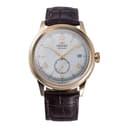
A lot of people cross-shop these two and want the Bambino. It is a proper dress watch: domed crystal, clean dial, leather strap, and Orient’s own automatic with hand-winding. It costs meaningfully less, and it goes under a cuff in a way an integrated-bracelet sports watch never quite does. If the Tsuyosa appealed because it looked smart rather than because you wanted the integrated look, buy the Bambino. Our full Bambino review covers the versions.
Seiko 5 SRPD65 — if you want to spend half as much
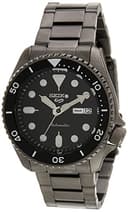
The reference first automatic. Seiko’s own 4R36 with day-date, hacking and hand-winding, a 100m case, and a support network nothing else matches. It is a completely different look — sports, bezel, conventional bracelet — but mechanically it gives up nothing to the Tsuyosa and costs far less. If the budget is the constraint, this is the answer.
Timex Marlin — if you want to be noticed
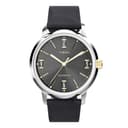
A faithful reissue of a 1960s Timex, and a watch nobody else on the train will be wearing. Timex publishes nothing about the caliber, so this is a purchase made entirely on design — which is a legitimate reason to buy a watch, and the Marlin is one of the few affordable automatics with genuine character. See our Marlin review.
Orient Star — if the Tsuyosa left you wanting more finishing
The step up. Orient Star is where the finishing, the sapphire crystal and the sense of occasion arrive, and it answers the question “what comes after an affordable Japanese automatic?” without jumping to Swiss prices. Expect to pay roughly 50 per cent more than the Tsuyosa, and to notice where it went.
Tsuyosa or Seiko 5 Sports?
This is the cross-shop almost every Tsuyosa buyer runs, and it comes down to two specifications pulling in opposite directions: the Citizen has the sapphire crystal, the Seiko has twice the water resistance and a full published sheet. Our Seiko 5 Sports vs Citizen Tsuyosa comparison works through both, including the integrated bracelet you can never change. The Tsuyosa’s size class is covered in full on our 40mm roundup.
If you want a Citizen automatic but not this shape, the Tsuyosa is not the only one. Citizen also sells it at 37mm, a Sport Automatic with 100m and conventional lugs, and the Promaster Dive automatics — our best Citizen automatic watches roundup ranks all of them on Citizen’s own spec sheets.