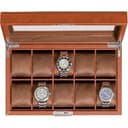
The five, compared on the lock
Every figure here comes from the pick’s own listing. Where a maker does not publish something — turns per day on the DUKWIN cabinets, for instance — this page says so rather than filling the gap:
| Pick | Lock type | Winds | Stores | Note |
|---|
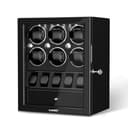
| DUKWIN 6-watch winder with storage | Key lock on the cabinet | 6 positions | Watch + jewelry storage | Quiet motor; DUKWIN does not publish a TPD figure |
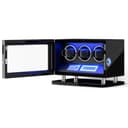
| DUKWIN 3-watch winder, fingerprint lock | Fingerprint reader | 3 positions | None | LCD touchscreen control and a remote |
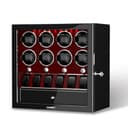
| DUKWIN 8-watch winder with storage | Key lock on the cabinet | 8 positions | 6 static slots | Furniture-sized; one power cable for the whole collection |
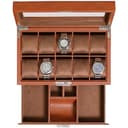
| Rothwell 10-slot leather box, valet drawer | Locking glass top | None | 10 slots + drawer | Microsuede liner; drawer sized for sunglasses |
| Rothwell 10-slot leather box | Locking lid | None | 10 slots | The cheapest way to put ten watches behind a lock |
What a lock on a watch cabinet is actually worth
It is worth being blunt, because this is the part the category never says out loud. The locks fitted to watch winders and watch boxes fall into three classes, and none of them is security hardware:
- A cam or wafer key lock— the usual fitting on a wooden or leatherette cabinet. It stops a lid being lifted. It does not stop the cabinet being carried out of the room, which is what actually happens in a burglary.
- A fingerprint reader— better, because there is no key to find in the same drawer, and genuinely convenient when the winder lives somewhere semi-public. It is still mounted in a box made of wood and glass.
- A locking glass top— the display-box fitting. It keeps a lid closed and keeps dust out. Glass is, obviously, the least secure material a lock can be fitted to.
So the sensible way to read this list is: buy the lock for privacy, children and casual hands. If the collection is genuinely valuable, the lock is not the purchase — a rated safe is, and some winder makers sell winders built to sit inside one. In that case what you want from the winder is battery power, because a safe rarely has a socket in it.
How we ranked them
The order follows how many people each pick is actually right for, not which lock is cleverest.
The 6-watch DUKWINleads because the collection that wants a lock is usually a collection of ten or more watches, and this is the size that matches it: six positions turning, storage alongside for everything that is resting, one cable, one lid. Paying for the eight-position version is the classic overspend in this category — eight spinning positions is more watches than most people own, let alone wear in rotation.
The fingerprint three-position DUKWINwins on the lock specifically. It is the only pick here where the lock is not a token: no key to lose, no key to leave next to the box. The trade is honest — an electronic lock is one more component that can fail, and if it does, the thing it is protecting is on the wrong side of it.
The two Rothwell boxesare on this page because for a lot of readers they are the right answer to the question being asked. If the watches are quartz, hand-wound, or automatics you simply are not wearing this month, winding them achieves nothing — see whether you need a winder at all. A leather box with a locking glass top costs a fraction of a winder cabinet and keeps ten watches behind a lock.
If you only need one or two watches locked away
There is no single-position winder on this site with a lock, and we are not going to invent one to fill the slot. Two routes work instead. Put a compact winder inside something that locks — a cupboard or a safe — and pick one that will run on batteries; the single-winder roundup and the battery-powered roundup cover the options. Or step up to the three-position fingerprint cabinet above and leave two positions empty, which is less wasteful than it sounds given what a lockable single would cost if anyone made a good one.
Settings still matter more than the lock
A locking cabinet is still a winder, and the same rules apply to it as to every other one: match the turns per day and the direction to the movement, and err low. Neither DUKWIN publishes a TPD figure for these cabinets, which is a genuine mark against them — it means you are setting a program you cannot verify. Our TPD settings guide lists what the common movements actually ask for, and the adjustable-TPD roundup is the page to read if published, controllable settings matter more to you than a lock does.