How we picked
1. A live price under $200, checked rather than assumed
The cap is verified against our own price layer on the date stamped at the top of this page, not against a list price. Everything in our registry that a maker or a listing positions as a field or field-style automatic and that cleared $200 on that check is here — the band is small enough that this is the whole field, not a selection from it.
2. Then: does anyone name the movement?
Two do. BERNY states a Miyota 8215, which Miyota publishes at 21 jewels, 21,600 vph and roughly 42 hours, with an accuracy band of −20 to +40 seconds a day — and a posture difference under 50 seconds. CADISEN states a Seiko NH35A, the unbranded cousin of Seiko’s 4R35, which hacks, hand-winds and can be serviced or swapped by any watchmaker. The Boderry and the ADDIESDIVE say “automatic” and leave it there. That is not proof of a bad movement; it is the absence of a benchmark you could hold it to.
One honest note on the BERNY: Miyota’s own 8215 page lists a stop-second device among the caliber’s functions, while BERNY’s listing states the seconds hand keeps running. Both are printed. If a hacking seconds hand matters to you, the CADISEN states hacking outright and its caliber family is documented for it — our guide to hacking explains why anyone cares.
3. Then: crystal and rating
BERNY states AR-coated sapphire and 10 ATM. Boderry states 100 m and no crystal material. CADISEN and ADDIESDIVE state neither. On a watch meant to be worn outdoors, a stated water-resistance figure is worth more than it is on a dress watch, and an unstated one should be read as less than 30 m rather than more. Our water resistance guide covers what the numbers mean in practice.
4. Then: size, which is the one number everybody gives
Three of the four publish a diameter — Boderry 40 mm, CADISEN 40 mm, ADDIESDIVE 36 mm — and BERNY does not. 40 mm is the classic field-watch size and 36 mm is the historically correct one, which is why the ADDIESDIVE is on this page even though it is the least specified watch on it: it is the cheapest way to find out whether a genuinely small watch suits you.
What $200 buys, and what it does not
It buys titanium, sapphire and a named caliber — sometimes all three. That combination did not exist at this price a few years ago and it is the single best reason to shop this band rather than saving up.
It does not buy a service network. Every brand here is a micro-brand with no repair infrastructure of its own. The counter-argument is the caliber: a Miyota 8215 or a Seiko NH35 can be worked on by any competent watchmaker, which is most of why naming the movement matters. Our service cost guide puts numbers on that.
It does not buy the obvious benchmark. Seiko’s 5 Sports Field sits just above this band at around $250, and Seiko publishes everything for it — the 4R36, 39.4 mm across, 13.2 mm thick, 48.1 mm lug-to-lug, 10 bar, curved Hardlex, about 41 hours. If published dimensions matter more to you than titanium does, spend the extra fifty dollars. Our main field roundup is where that watch is the top pick.
Which one, for whom
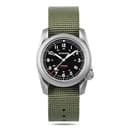
Wear it every day and forget it. The BERNY. A full titanium field automatic you stop feeling by lunchtime, with the best-documented specification in the band.
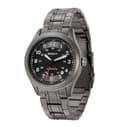
Want the date and the day. The Boderry: titanium, 40 mm, a day-date and a stated 100 m. See our day-date roundup for how rare a genuine day and date is at this money.
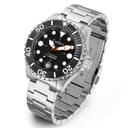
Want a caliber you can look up. The CADISEN. A named Seiko NH35A in a 40 mm steel case for about a third of what a branded watch with that caliber costs — our NH35 roundup is the full field.
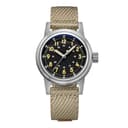
Have a small wrist. The ADDIESDIVE 36 mm, on a nylon strap that sizes down easily. It is the least specified watch here and the cheapest way to test the idea before spending real money on it — our small-wrist page is where that goes next.