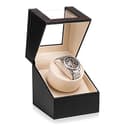
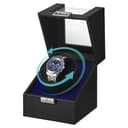
How we picked
1. Settings you can actually read
The single most useful thing a winder listing can do is print a number. Versa publishes 650–1,850 TPD across four settings on its double; Barrington publishes a full TPD range plus direction choice. ANWBROAD publishes five named rotation cycles including clockwise, counter-clockwise, alternating and a rest-heavy three-hours-on / nine-hours-off program, which is more disclosure than most $50 winders manage. Against that, “mode 1 to 5” tells you nothing.
2. Bidirectional, because the movement is
A Swiss ébauche-based automatic winds in both directions, so the safest winder setting is alternating. Five of these six offer it explicitly. If you are not sure what your particular reference wants, start at the bottom of the band and step it up only if the watch runs down — the reasoning is in which direction should a watch winder turn.
3. Power, which decides where the winder can live
This matters more for a watch worth four figures than it does for a Seiko 5, because the answer is often “in a safe”. Three picks run on batteries as well as mains: the Barrington, the ANWBROAD and the Efaithtek, which is why the Efaithtek is on this page at all — it is the cheapest honest way to put a winder somewhere with no cable. The Versas and the SONGMICS need a socket or a USB port. Our battery-powered winder roundup covers that field properly.
4. Noise
Five of six state a quiet motor. The exception on this page is nobody — all six do. That is a reminder that “ultra-quiet Japanese motor” is a marketing phrase at this point rather than a specification, and why our quiet winder page is written around the small number of listings that publish an actual decibel figure instead.
How much winder does a TAG Heuer need?
Less than you would guess. The function — hold the watch, turn it the right number of times in a direction the rotor can use, quietly — is fully covered by the $90 Versa. Everything above that is materials, cuff engineering, battery operation and the likelihood that the company is still around to sell you a replacement adapter in 2032. Those are real things to buy; they are not performance.
More than the very cheapest, if the watch is heavy. A steel Aquaracer on a bracelet is a substantial object, and the cuff is what fails first on a budget winder. Not one listing on this page publishes a maximum case size or watch weight, so the practical advice is the same every time: buy from a seller with a returns policy and check the fit in the first week.
Two positions if you rotate two watches, not because two looks better. Insist on independent per-position control, which the Versa Double Elite has and most budget doubles do not — a shared setting forces two different movements onto one compromise. The rest of that field is in our double watch winder roundup, and single vs double is the decision itself.
What a winder does not do
It does not service the watch, it does not improve accuracy, and it will not overwind anything. A self-winding movement runs a slipping bridle on the mainspring barrel, so once the spring is full it slips rather than breaking — the real cost of running an unnecessarily high TPD is extra hours on the winding mechanism. That is the argument for starting low rather than high, and it is the same argument for not leaving a winder running for a watch you wear every day.
If the watch sits unworn for long stretches, a box suits it better than a spinning position. Our winder vs watch box comparison and the watch boxes for luxury watches page cover that side of it, and is a watch winder worth it is the honest version of this whole question.