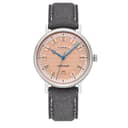
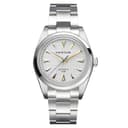
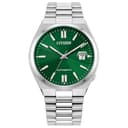
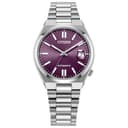
9015 or 8215? The two sheets side by side
This is the whole decision, and both sets of numbers come from Miyota’s own product pages rather than from us.
Caliber 9015 (Premium Mechanical). Miyota publishes -10 to +30 seconds a day, 24 jewels, 28,800 vibrations per hour, approximately 42 hours of running time, a height of 3.90 mm, a stop-second device, and automatic plus hand winding.
Caliber 8215 (Standard Mechanical). Miyota publishes -20 to +40 seconds a day, 21 jewels, 21,600 vibrations per hour, approximately 42 hours of running time, a height of 5.67 mm, a posture difference of under 50 seconds, automatic and hand winding, and quick date setting.
Three things fall straight out of that. The 9015’s published accuracy window is 40 seconds a day wide against the 8215’s 60, so on paper it is the tighter movement — and worth noting, both are wider windows than Orient publishes for its F6S22 (+25 to -15) and roughly comparable to Seiko’s +45/-35 on the 4R36. The 9015 runs at eight beats a second against the 8215’s six, which is why its seconds hand sweeps more smoothly. And the 9015 is 1.77 mm shorter, which is why it turns up in watches that are trying to be thin — our dress-watch roundup is full of that argument.
The one disagreement we are not going to resolve for you
Miyota’s 8215 page lists “stop second device” among the caliber’s functions. BERNY’s listings for both of its 8215 watches say the seconds hand keeps running when you pull the crown — in other words, that it does not hack. Those two published statements disagree, and we print both rather than pick the one that suits the page. If being able to set a watch to the second matters to you, the two 9015 picks remove the doubt: Miyota publishes a stop-second device for that caliber and TOPHILL and Hestur both state hacking for their references. Our guide to what hacking means explains why it is worth caring about at all.
Where Citizen fits
Citizen owns Miyota outright, and the Tsuyosa’s caliber 8210 is a Miyota-based automatic sold under Citizen’s own name. That is why both Tsuyosas are on this page rather than treated as a separate brand: mechanically they belong here. What you get for the extra money over a micro-brand 9015 is documentation and support. Citizen publishes the identical sheet for the 40 mm NJ0150 and the 37 mm NJ0200 — caliber 8210, sapphire crystal, 50 m, a 42-hour reserve and a hack feature — and the only line that differs between the two is case width. Choose between them on your wrist, not on the movement.
What you do notget is an accuracy figure. Citizen publishes none for the 8210, where Miyota publishes one for both of the calibers it sells under its own name. That is an odd inversion worth knowing about: the parent company’s movement division is more forthcoming than the parent company. Our Citizen roundup and the Tsuyosa review go further into the line.
What a Miyota buys you that an NH35 does not
Both families are Japanese, both are bought in by the hundreds of thousands, and at the bottom of the market they are close to interchangeable. The differences that actually matter:
The 9015 beats faster and sits thinner than an NH35 (28,800 vph and 3.90 mm against the NH35’s 21,600 vph), which is the entire reason a dress watch would choose it. That is the comparison our NH35 vs Miyota 9015 page exists for.
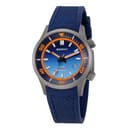
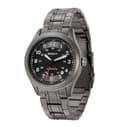
The 8215 is the cheapest named caliber you can get in a titanium case. Both BERNY picks name it, and both state AR-coated sapphire with a screw-in crown; the diver adds a stated 20 ATM and an internal rotating bezel, which is a sensible choice on titanium because there is no external bezel edge to scuff. Neither publishes a diameter, thickness or lug-to-lug, which is the real cost of buying from a small brand — see our titanium roundup for the material argument in full.
Parts and servicing are the NH35’s win, not the Miyota’s. Seiko Instruments’ NH family is the caliber independent watchmakers see most often and stock parts for most readily. Miyota publishes parts lists and exploded views on its own site for both calibers here, which is genuinely more than most movement makers do, but the practical servicing network for an unbranded micro-brand watch is thinner either way. Buy a Miyota watch for the watch, and treat a full overhaul on a $150 automatic as uneconomic — our guide to what a service costs puts numbers on that.
How we picked
The caliber has to be named for that exact reference. This is the only entry rule, and it did most of the work. Several watches in our registry are widely assumed to carry a Miyota — the Timex Marlin’s “21-jewel automatic” is the obvious one, and Bulova names a Miyota 8N24 on exactly one of its own product pages while naming nothing on the rest — and none of them is on this page. A caliber that is “widely reported” is not a published specification, and this page would be worthless if it treated the two the same.
Then crystal, then case documentation. Five of the six picks state sapphire, which is unusual for this price band and is mostly why they beat better-known names. The two Citizens publish full case figures; the two BERNYs publish none at all; TOPHILL and Hestur publish a diameter and little else. Where a figure is absent the spec table says “Not published” rather than filling the gap.