The three things that decide a blue dial
1. Which blue, and who says so
Dial finish moves the color further than pigment does. A sunrayor sunburst dial is brushed in rays from the center, so it shifts from bright at one angle to nearly black at another — which is why photographs of sunray dials never match the watch on a wrist. Gradient dials are lighter in the middle and darker at the edges by design. Matte dials hold one color in all light, which is predictable and less interesting. Lacquered or glossy dials read deeper and pick up more reflection.
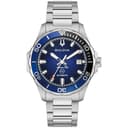
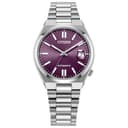
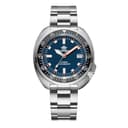
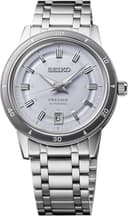
Bulova is the only maker here that tells you which it used — a sunray that goes bright blue to black. For everything else on this page the color word comes from a retail listing: “Navy Blue Dial” on the ADDIESDIVE, “Blue Dial” on the Citizen and the OLEVS, “Silver-Blue Dial” on the Seiko Presage, “Blue Dial” on the Prospex. Those are real published words and good enough to build a page on, but they are not a maker’s specification, and they are written to sell rather than to describe. Treat them as the floor of what you know, not the ceiling.
The practical move is the same one we give for green dials: look for owner photographs taken outdoors rather than studio shots, assume anything electric in a product image will be darker in person, and buy from a retailer with free returns if a specific shade genuinely matters.
2. Navy that reads black is the commonest disappointment
This is the blue-specific trap. A deep navy dial under indoor light is functionally a black watch; it only shows its color in daylight or near a window. Plenty of people want exactly that — a watch that is quietly blue rather than loudly blue — and plenty of others open the box and find the black watch they were trying to avoid buying.
The tell is in the words. “Navy”, “midnight” and “petrol” all run dark. “Bright”, “royal”, “cobalt” and “ice” run light. Bulova’s “bright blue at the center to black toward the edge” is telling you it does both, deliberately, across the same dial. The ADDIESDIVE’s own listing says navy, which is honest and tells you to expect the darker end.
3. Crystal matters more on a colored dial than a black one
Three of these six publish sapphire: the Bulova Marine Star (anti-reflective), the Citizen Tsuyosa and the ADDIESDIVE. Both Seikos publish Hardlex, Seiko’s own hardened mineral glass — box-shaped on the Presage, flat on the Prospex. And the OLEVS publishes no crystal material at all, which is why its row reads “Not published”. Note which way that falls: the two cheapest-but-one picks have the harder crystal and the two Seikos do not.
That split matters more here than it would on a black watch. A hazed, fine- scratched crystal dulls a saturated color in a way it does not dull black, and a sunray dial loses its whole effect behind one. Sapphire is corundum at Mohs 9; everyday grit is mostly quartz at Mohs 7, so mineral glass scuffs and sapphire largely does not. The counter is brittleness — sapphire chips where mineral scuffs. Our sapphire versus mineral comparison has the trade in full, and the sapphire-crystal roundup is the registry sorted on exactly that.
What each price bracket buys you here
Around $150 to $170, from brands with no service network
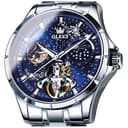
The ADDIESDIVE and the OLEVS. The ADDIESDIVE is the better watch of the two by a wide margin on paper: a named Seiko NH35, sapphire, a stated 200m and a named BGW9luminous grade rather than the word “luminous”. What you give up is information — no case diameter is published for it, so you are buying a watch whose size you discover on arrival. The OLEVS is the cheapest blue automatic here and the busiest dial, with a moon-phase display and a skeletonized center, and it publishes nothing at all: no case size, no crystal, no water rating. Both are covered in the wider under-$200 roundup.
Around $350 to $450, from makers that publish sheets
The Citizen Tsuyosa 37mm, the Bulova Marine Star and the Seiko Presage SRPL73. This is the sweet spot on this page. The Tsuyosa gives you Citizen’s own 8210 caliber with a published 42-hour reserve and a hack feature, sapphire, and a 37mm case — the smallest proper automatic we could find live, and the answer if integrated-bracelet watches usually swamp you. The Marine Star gives you sapphire, WR200 and the only maker-published shade on the page. The Presage gives you Seiko’s 4R35, 39.5mm across, 12.0mm thick and 46.2mm lug-to-lug — the most completely documented fit on this list — in exchange for a Hardlex crystal and a 5 bar rating.
Around $600, for size rather than specification
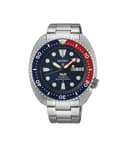
The Prospex SRPE99 is a 45mm, 200m diver’s-rated Seiko with the 4R36, LumiBrite on hands, indexes and bezel, and a screw-down crown. It is on this page because it is a genuinely blue Seiko diver that is live and purchasable, and because a 45mm case is what some wrists want. It is also the single most expensive way to buy a blue dial here, on a mineral crystal, and 45mm will overhang a wrist under about seven inches. Measure first with the watch size guide, and read the large-wrist roundup if that is genuinely your size. Seiko also sells the SRPG57 under a “Light Blue” listing at a little less money if you want the smaller 42.4mm case — it is on our Seiko 5 vs Prospex page.
The two we left out, and why
Bulova’s own 96A330 Sutton fails the entry rule and it is worth explaining, because it is the clearest example of the trap. It is a 40mm watch with an anti-reflective domed sapphire crystal, 21 jewels and 42 hours of published reserve, on a blue leather strap, and Bulova describes the dial as an open dial with blue applied indicesand matching hands. The markers are blue. The dial is not. In a photograph it looks like a blue watch; in Bulova’s own words it is not one. We card it on the Bulova roundup instead, where it belongs.
Several Invicta Pro Diversare sold as blue-dial automatics and one is in our registry as such, but the live listing title for that reference no longer states a color at all on the date we built this page — it reads “Silver”. Since the listing was the only published source for the color in the first place, the pick does not survive the rule. It stays on the Invicta roundup, where it is carded for its case size and rating rather than its dial.
What a blue dial does not change
Anything mechanical. Dial color has no effect on accuracy, power reserve, servicing interval or longevity, and the blue version of a reference is the same watch as the black one. So the questions that actually decide the purchase are the usual ones: case diameter against your wrist, what the water rating permits — see water resistance explained — and whether the movement is one you can get serviced. On this page the answer to that last one is yes for the Seikos, the Citizen and the Bulova, and no in any meaningful sense for the two cheapest picks.
Blue does have one genuine practical advantage over green or burgundy: it is the easiest non-black dial to pair. Brown and tan leather, gray and black rubber, steel bracelets, canvas — almost everything works. Most of the picks here come on a steel bracelet, which sidesteps the question entirely. And if you want blue on the wrist without committing to a dial, a blue strap on a black-dialed automatic is a $20 experiment instead of a $400 one. Our guide to resizing a bracelet covers the other half of that job.
Finally, the lume. A blue dial and a blue gloware unrelated — luminous material sits on the hands and markers, not the dial surface. Two picks here name a material: Seiko states LumiBrite on the Prospex and the ADDIESDIVE listing names BGW9, which glows blue-green. The other four name nothing. Our best-lume roundup ranks the whole registry on what makers actually put in writing, and what lume is covers how long a charge should hold.