What the Marlin actually is
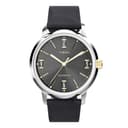
A 40mm stainless steel automatic in a design lifted directly from Timex’s own 1960s catalog: a domed crystal, a slim polished bezel, simple stick markers, and a case that tapers into narrow lugs the way watches did before the fashion for slab-sided sports cases. The version we feature runs on a black leather strap with a black dial; the line extends to bracelets, colored dials, and periodic collaborations.
Timex is unusual in this: it has an archive worth reissuing and it reissues it honestly rather than approximating something Swiss. The Marlin looks like a Timex from 1962 because it is one, and there is not much else in this price band you can say that about.
What it gets right
Proportions. 40mm with narrow lugs and a thin bezel wears considerably smaller than 40mm on a modern sports case — closer to a vintage 36 or 37mm. That makes it one of the more wearable automatics on this site, and a realistic option for a smaller wrist. It is also why it appears on our dress watch page: it goes under a cuff.
The domed crystal. A domed crystal distorts light at the edges the way old watches do. It is a small thing that does a great deal of work, and it is the single detail that most makes the Marlin read as a period piece rather than a modern watch with retro markers printed on it.
Restraint. There is almost nothing on the dial. No day-date fighting for space, no unnecessary text, no lume slathered across the markers. In a price band full of watches trying to look expensive, one that is confident enough to be plain stands out.
A brand that will still be here. Timex has a warranty department, a returns process and a retail presence. Compared against the micro-brands on our under-$200 page, that is worth real money when something goes wrong.
What it doesn’t get right
The undisclosed movement. This is the big one. Timex does not name the caliber, publish an accuracy range or state a power reserve. That means you cannot compare it on specification with anything, you have no benchmark to judge its timekeeping against, and a watchmaker asked to service it is working without a data sheet. Our guide to automatic watch movements explains why a named caliber matters more than most buyers realize.
Mineral crystal, not sapphire. The Waterbury line states mineral glass, and there is no indication the Marlin is different. On a domed crystal that sits proud of the case, scratches are more likely and more visible than on a flat one. Expect it to mark, and price a replacement crystal into your thinking if you plan to keep it a decade.
Water resistance you should read conservatively. This is a dress watch on a leather strap. Treat it as splash-resistant, keep it out of the shower, and the strap will give out long before the case does anyway. Our dive watch page explains what the depth markings actually permit.
The price has drifted. The Marlin launched considerably cheaper than it now sells for. At its current price it is competing with in-house Japanese automatics that publish everything it doesn’t — and on any spec-led comparison it loses. The live price on this page is the number to judge it by, not what you remember it costing.
Who should buy it
Buy the Marlin if you want a watch with character, you like the 1960s aesthetic, and you already own or don’t need a watch you can hold to a specification. It is a wonderful second or third automatic, and one of very few at this price that will get a comment.
Don’t buy it as your only automatic. For a single watch you intend to keep and service, an Orient or a Seiko gives you a documented movement, a published accuracy range and a parts supply that lasts decades, for similar money. That is the boring answer and it is the right one.
The alternatives, and when each one wins
Timex Waterbury Automatic — if you want the brand for less
Timex’s everyday automatic. A stated 50m water resistance — genuinely more useful than the Marlin’s — American-heritage styling that is still Timex’s own rather than borrowed, and a lower price. The design is less special. If you liked the idea of a Timex automatic but not the 1960s styling, this is the one.
Orient Bambino — the spec-led answer
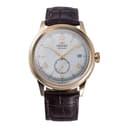
The same dress-watch brief, done with an in-house Orient automatic with hand-winding, a domed crystal of its own, and a maker that publishes what it built. Usually cheaper. If you cross-shopped these two and cannot decide, the Bambino is the safer purchase and the Marlin is the more interesting one. Read our Bambino review and choose on temperament.
Seiko Presage — if you want the dial to be the point
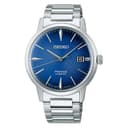
The step up. Seiko’s Presage line is built around dial finishing — lacquer, texture, depth — on top of a documented in-house movement. It costs appreciably more than the Marlin and it is obvious where the money went, which is the best thing you can say about a price increase.
Stuhrling Winchester — if the budget is the constraint
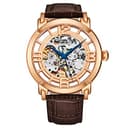
Roughly half the money, and a completely different proposition: a full skeleton dress watch where the movement is the decoration. Nothing about the finishing competes with the Marlin, and the brand has no heritage to speak of. But if you want a mechanical watch that looks interesting for around $130, it delivers exactly that — see our skeleton watch picks for the full context.
The comparison most Marlin shoppers end up wanting is against the other default sub-$300 dress automatic: Orient Bambino vs Timex Marlin Automatic, where the named caliber and the 50m rating pull in opposite directions.