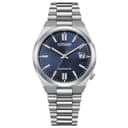
Check this first: automatic or Eco-Drive?
This is the mistake the Citizen catalog is built to invite, so it comes before anything else. Citizen describes Eco-Drive as a watch that converts light, natural or artificial, into energy stored in a power cell, and says a fully powered one runs for up to six months in complete darkness. It is Citizen’s answer to the battery in a quartz watch. It does not run on a mainspring, and it has nothing to do with the mechanical watches on this page.
The automatics are the other half of the catalog. Citizen’s own wording on every automatic page we read is the same: a mechanical movement, powered by the release of a wound spring, with an oscillating weight that winds that spring as your arm moves. On a listing, the quick test is the title. “Automatic” plus a caliber number in the 8200s or 9000s means mechanical; “Eco-Drive” means it is not. When a title says neither, our guide to telling whether a watch is automatic has the fuller set of checks.
Which should you buy? That is a question about what you want the watch to do. An Eco-Drive is the better tool if you want to pick it up after a month in a drawer and find it running on time. An automatic is the better choice if the mechanism is the point — if you want a watch that runs on a spring you can wind rather than on a cell. Our automatic vs quartz guide sets out that trade in full. Everything below assumes you have already chosen mechanical.
Citizen’s automatic calibers, in one paragraph each
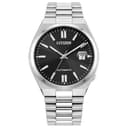
8210 is the date-only movement in the Tsuyosa. Citizen’s own manual for the 8200 and 8210 gives 21,600 oscillations per hour and recommends winding the crown five to ten times to start the watch, and Citizen’s current Tsuyosa pages list a 42-hour power reserve and a hack feature. What Citizen does not publish for it, anywhere we could find, is a daily accuracy figure.
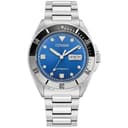
8200 is the 8210’s sibling with a day display added — the shared manual lists the day of week as “8200 only”. It powers the Sport Automatic here, and again Citizen lists 42 hours and a hack feature on the product page, and again no accuracy figure.
8204 is the dive-watch caliber, used in the NY0 Promaster series. It is the one Citizen documents properly: its own 8203/8204 manual gives an average daily difference of -20 to +40 seconds, about 42 hours fully wound, a manual-winding function and a second-hand stop. Citizen is careful to say that figure is static accuracy at normal temperature, and that a mechanical watch drifts from it with how fully the mainspring is wound, the position it sits in, and temperature, magnetism and shock. For comparison, Seiko publishes +45 to -35 seconds a day for its 4R36 under its own stated conditions, so the two are windows of the same class rather than a win for either.
9051 is the step up, and the one we could not put on this page. Citizen publishes -10 to +20 seconds a day, a 42-hour reserve and a magnetic-resistance rating it calls “Antimagnetic 16000” for the NB6021 Promaster, in a 41mm Super Titanium case rated to 200m. The Amazon listings we found for that line all returned “Currently unavailable” on our check.
All of this comes out of the same organization as Miyota. Citizen built a movement factory in the town of Miyota, in Nagano, in 1959 and launched the MIYOTA brand in 1980, and Miyota says its movements are now used in millions of watches — several of them on this site. Our guide to who makes automatic movements covers where Citizen sits in that picture.
The three specifications that actually sort this page
1. Water resistance, which Citizen labels in plain words
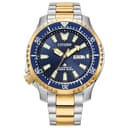
Citizen does something useful here that most makers do not: it prints what each rating is for next to the number. On its own pages the two Tsuyosas read WR50 — Still Water Swimming, the Sport Automatic reads WR100 — Swimming, Showering & Snorkeling, and the Fugu reads 200M — Scuba Diving. That is the whole ranking on one line, and it is why the Sport Automatic, not the more famous Tsuyosa, is our pick if one watch has to go everywhere.
Only the Fugu carries Citizen’s statement that it is ISO compliant with a screw-down crown. The diver’s standard, ISO 6425, requires a minimum 100m rating, a unidirectional or lockable timing bezel, legibility in the dark and testing of every individual watch rather than a sample, so that sentence is the difference between a dive watch and a watch that looks like one. Our water resistance guide has the full table of what each marking permits.
2. The crystal, which is Citizen’s real advantage
Citizen lists sapphire on the Tsuyosa in both sizes, the Sport Automatic and the Fugu. At the same prices Seiko fits Hardlex, its hardened mineral glass, to the 5 Sports and the Prospex divers — our best Seiko automatic watches roundup shows it on every pick. Sapphire sits at 9 on the Mohs hardness scale against about 5.5 for glass, and the grit in ordinary dust is largely quartz at 7: hard enough to mark mineral, not hard enough to mark sapphire. Over years of desk edges and door frames, that is a visible difference.
It is not free of trade-offs. Mineral glass tolerates a sharp knock better, which is part of why Seiko still fits it to tool watches, and our crystal comparison covers both directions. The one exception on this page is the budget Promaster, for which Citizen no longer publishes anything, so its crystal row reads “Not published”.
3. Case width, and the bracelet you are buying into
Citizen publishes a case width for every reference it documents here — 37mm, 40mm, 42mm and 44mm, plus the 41mm the budget Promaster’s Amazon listing states — and publishes no case thickness or lug-to-lug for any of them. Width alone is a poor guide to fit, because lug-to-lug decides whether a watch overhangs your wrist; our watch size guide explains how to measure your own ceiling, and our 40mm roundup sits in the middle of this range.
The bracelet matters as much as the width. The Tsuyosa’s is integrated: it continues the case line with no conventional lugs, which is the look people buy it for, and it means you can never fit a leather strap or a NATO. The Sport Automatic has conventional 22mm lugs and the Fugu 20mm, so the whole strap aftermarket is open to both. If you like changing straps, that decides it before anything else does.
The budget pick, and what we could not confirm
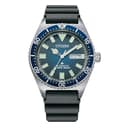
The NY0129-07L Promaster is the cheapest Citizen automatic we could find live on Amazon, and it is a genuine Citizen dive-style automatic on a polyurethane strap. It is also the least documented watch on this page. Citizen no longer carries the reference on its US site, so the only specification we can stand behind is the 41mm the Amazon listing states. It belongs to the NY0 family whose manual covers calibers 8203 and 8204 — but that manual covers two calibers, so it cannot tell us which one is inside this watch, and its spec table below says “Not published” on the rows Citizen will not confirm.
Buy it if the price is the priority and you are comfortable with that. If you want a Citizen diver you can hold to a published specification, the Fugu is the one — and if the budget is firm, our dive watches under $200 shows what the rest of the market offers with its numbers published.
What is not on this page, and why
The NB6021 Promaster and its 9051 caliber, for the stock reason above. It is the Citizen automatic we would most like to recommend on paper, and it belongs on this list the day a live listing exists. Series 8, the line above it, did not appear in our Amazon search at all.
The Disney Tsuyosa (the Mickey Mouse NJ0156-50L and its Minnie sibling) is live, and Citizen’s page for it lists the standard 40mm Tsuyosa specification — 8210, sapphire, 50m, 42 hours, hack feature — under a licensed dial. Buy it for the dial; it is the same watch as our top pick. The same is true of the Tsuyosa’s many dial colors: Citizen’s pages for different NJ0150 references differ only in the dial, so choose on color and price.
If your question is really Citizen against the other Japanese makers rather than Citizen against itself, the Seiko vs Orient vs Citizen comparison is the page you want, the Seiko 5 Sports vs Citizen Tsuyosa head-to-head takes it down to the two watches most often cross-shopped, and best Orient watches is the equivalent of this page for the brand that competes with Citizen hardest on sapphire.