Five things one brand publishes and the other does not
1. The caliber
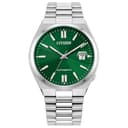
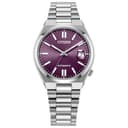
Citizen names the 8210 on both Tsuyosas, and its own manual for the 8200/8210 family states 21,600 oscillations per hour, automatic winding and a quick-set date. Elsewhere in the Promaster line Citizen names the 8204 (day-date) and the higher-grade 9051, and publishes accuracy bands for both — -20 to +40 sec/day for the 8204 and -10 to +20 for the 9051.
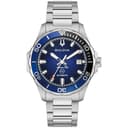
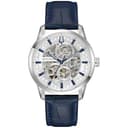
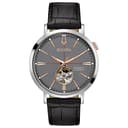
Bulova names nothing on the Marine Star 98B466, the Sutton 96A330 or the Aerojet 98A187. The 96A330 gets as close as Bulova gets without naming it: “the dial reveals the captivating mechanics of the 21-jewel skeletonized automatic movement, which offers 42-hours of power reserve”. Twenty-one jewels and forty-two hours, with no caliber attached — which, read next to the published Miyota 8N24 figures, tells you roughly where you are without telling you anything you could verify.
2. Accuracy — where neither brand covers itself in glory
Neither maker publishes an accuracy figure for any of these six watches. That matters more against Citizen than Bulova, because Citizen demonstrably can: it publishes -20 to +40 for the 8204, -10 to +20 for the 8203 and -10 to +20 for the 9051, and even notes that those are static figures at normal temperature which vary with wind, position and environment. For the 8210 in the Tsuyosa, Citizen’s own manual states no daily accuracy figure at all.
The practical reading: at this price, expect a mechanical watch running within roughly a handful of seconds either side of the Miyota-class bands above, and do not treat an unpublished figure as a promise. If a rate specification matters to you, the brand that publishes one on the reference you are buying is Seiko — see Bulova vs Seiko, where the same documentation argument runs with a different answer.
3. Crystal: Bulova’s clearest win
Citizen puts sapphire on both Tsuyosas (anti-reflective on the 37mm) and publishes no crystal material at all for the bracelet Promaster Automatic. Bulova puts an anti-reflective sapphire on the 98B466, an anti-reflective domed sapphire on the 96A330, and a double-curved mineral box crystal on the Aerojet.
Two sapphires out of three on the Bulova side, including on the cheapest 200m diver in this comparison, is the strongest single argument for the American badge. The hardness figures behind why that matters are in our sapphire vs mineral crystal comparison.
4. Water resistance, stated in meters
This is where Bulova’s paperwork gets slippery. The 98B466 states WR200(20 bar, 666 ft, suitable for swimming, showering and snorkeling) — a real figure with real guidance. But the Sutton 96A330 states only “WR [Splash Resistant]” with no meter figure, and the Aerojet gives 30 meters in its description while its own details panel also reads “WR [Splash Resistant]”.
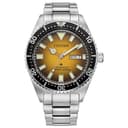
Citizen is consistent: WR50 (“Still Water Swimming”) on both Tsuyosas, and a diver’s 200m on the Promaster, which has “AUTOMATIC DIVER’S 200m” printed on the dial. Elsewhere in the line Citizen goes further and states ISO compliance with a screw-down crown. If you plan to swim in the watch, our water-resistance guide explains why “splash resistant” with no number is the one answer you should not accept.
5. The hack feature, and why it is the one you will notice
Citizen publishes a “Hack Feature”in the movement-functions list for both Tsuyosas. That means the seconds hand stops when you pull the crown, so you can set the watch to the second against a phone. Bulova publishes no such statement for any reference here — although the Miyota 8N24 it names on one other watch does have a stop-second device, so the capability plainly exists inside the group.
It is a small feature with an outsized effect on how a watch feels to own, and it is the clearest case on this page of Citizen’s documentation being worth money rather than just being tidier. Our guide to what hacking means on a watch covers why.
Which should you buy?
Buy Citizen if you want a named caliber, a published reserve, a hack feature and a sapphire crystal on a 37mm or 40mm everyday watch; if you want a diver with a genuine ISO-style 200m rating from a maker that publishes its mechanical calibers; or if the idea of not knowing what movement is in your watch bothers you. The 40mm Tsuyosa is the single best-documented watch in this comparison and the reason it takes the overall slot.
Buy Bulova ifyou want sapphire and a 200m rating in the same case for less than Citizen charges for its cheapest mechanical diver; if you want a 40mm skeleton dress watch with a domed sapphire, which Citizen does not offer; or if you simply prefer the way Bulova’s cases look, which is a perfectly good reason to buy a watch and the one Bulova is really selling.
Buy neither if a published accuracy band is on your list. Seiko publishes +45 / -35 sec/day for the 4R35/4R36 across most of its range, and neither brand on this page publishes a rate for any of these six references.
For the full lists either side of this comparison, see the best Citizen automatic watches and the best Bulova automatic watches. For the three-way version of the same question across the Japanese brands, Seiko vs Orient vs Citizen is the one to read.