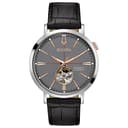
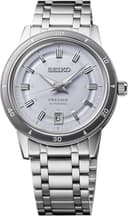
The five figures that decide it
1. Crystal — Bulova’s one clean win
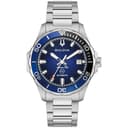
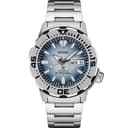
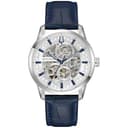
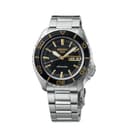
This is the surprise, and it is worth the whole page. Bulova publishes an anti-reflective sapphire crystal for the Marine Star 98B466 and an anti-reflective domed sapphire for the 40mm Sutton 96A330. Seiko, on the three references here, publishes Hardlex— its own hardened mineral glass — on all three: Hardlex with magnified glass on the SRPG57, curved Hardlex on the 5 Sports SRPK99, box-shaped Hardlex on the Presage SRPL73.
Sapphire is corundum, Mohs 9. Quartz is Mohs 7, and the grit in everyday dust is mostly quartz, which is why mineral glass hazes over a few years of ordinary wear and sapphire does not. The counter-argument is brittleness: sapphire chips where mineral scuffs. Read sapphire vs mineral crystal for the full trade. For this matchup the point is narrower and harder: at around $410 Bulova gives you sapphire, and at around $500 Seiko’s nearest diver does not. Seiko does sell sapphire — the Prospex PADI SRPK01 is the one reference Seiko publishes it for — but it costs substantially more than anything on this page.
2. Caliber and accuracy — Seiko by a mile
Seiko names the movement on all three: 4R36 on the Prospex SRPG57 and the 5 Sports SRPK99, 4R35 on the Presage SRPL73, each with approximately 41 hours of reserve, hand winding and a stop-second function. And on the 5 Sports Seiko publishes a rate: +45 / -35 seconds per day. That is a wide band by chronometer standards and an entirely normal one for an entry-level automatic, but the important thing is that it exists — you can hold the watch to a published number.
Bulova publishes no caliber and no rate for any of its three. What it publishes instead is a jewel count and a reserve on two references (21 jewels and 42 hours on the Sutton 96A330; 40 hours on the Aerojet 98A187) and, on the Surveyor, nothing beyond the word “Automatic”. Those figures are consistent with the Miyota 8N24whose sheet Bulova cites on a different reference — Miyota publishes -20 to +40 sec/day, 21 jewels, 21,600 vibrations per hour and about 42 hours — but Bulova does not name it on these, so we do not record it. Movement by movement, our NH35 vs 4R36 comparison and who actually makes automatic movements are where this family tree is laid out.
3. Water resistance — Seiko, consistently
Seiko’s three publish 200m (a diver’s rating with a screw-down crown), 100m and 5 bar respectively. Bulova’s three publish WR200 on the Marine Star, “Splash Resistant” with no meter figure at allon the Sutton 96A330, and 30 meters on the Aerojet. So at the top of each range they match; below that, Seiko’s worst case is a 50m dress watch and Bulova’s worst case is a number its maker declines to print.
Neither brand’s picks here are ISO 6425certified divers. Seiko’s SRPG57 carries the “200m diver’s” marking on its own specification page, which is the strongest claim on this page; the Marine Star is WR200, which Bulova describes as suitable for swimming, showering and snorkeling. What any of that permits in practice is covered in water resistance explained.
4. Fit — Seiko lets you work it out in advance
Seiko publishes a diameter, a thickness and a lug-to-lug for each of these: 42.4mm / 13.4mm / 49.4mm on the SRPG57, 42.5mm on the 5 Sports, 39.5mm / 12.0mm / 46.2mm on the Presage. Lug-to-lug is the figure that actually predicts whether a watch overhangs your wrist, and it is the figure Bulova never prints. Bulova gives you a case width— 41mm, 40mm, 41mm — and a lug width for the strap, and nothing else.
In practice that means a Bulova is a watch you size on arrival and a Seiko is one you can size from a tape measure. If you are near the edges of normal, that gap matters: measure with our watch size guide, then use the 40mm roundup or the large-wrist roundup depending on which way you fall.
5. Service, parts and resale — Seiko, and not narrowly
Both brands have a real US service operation, which is the whole reason either costs more than a budget homage diver. The difference is everything around it. Seiko’s 4R family is so widely used that independent watchmakers know it cold, parts are available, and a service quote is predictable — see what servicing actually costs. Seiko bracelets, lug widths and aftermarket parts are a market of their own.
Bulova is a smaller aftermarket, and an unnamed caliber is harder for a third party to quote on sight. Resale follows the same pattern: a Seiko 5 Sports or a Prospex has a visible second-hand price, a Bulova automatic has a thinner one. None of this makes Bulova a bad purchase — it makes it a purchase you should expect to keep rather than trade.
Pick by pick: what we would actually buy
At around $300 — Seiko
The 5 Sports SRPK99 against the Aerojet 98A187. Seiko publishes a named 4R36, a rate band, 100m, 42.5mm and a day-date, with an exhibition case back. Bulova publishes 40 hours, 41mm, a mineral box crystal and 30m. The Aerojet is the prettier dress watch of the two; the Seiko is a better watch and a vastly better documented one. If you want a dressier look at the same money, the Orient Bambino beats both on paperwork.
At around $400 — Bulova, if you want sapphire
The Marine Star 98B466 is the only place on this page where Bulova is ahead on a spec that affects the watch in five years’ time. Sapphire with an anti-reflective treatment, WR200, a unidirectional bezel, a 42-hour reserve, a crystal case back, 41mm. The 40mm Sutton 96A330 is the same argument in a dress case, with the caveat that it is splash-resistant only. If you have decided you want a hard crystal under about $450 and you do not care who made the movement, Bulova is the answer. The alternative route is a budget diver that also publishes sapphire — our sub-$200 dive roundup is full of them, at a quarter of the money and none of the brand.
At around $450 to $500 — Seiko
The Presage SRPL73 and the Prospex SRPG57. At this money Seiko is selling you a complete specification sheet, LumiBrite on hands, indexes andbezel on the Prospex, a diver’s rating, and a dimension set precise to a tenth of a millimeter. Bulova has nothing at this price that answers it. The honest caveat stands: both are Hardlex, and if that bothers you, re-read section one.
Who should buy which
Buy Seiko if this is your first automatic, if you want to be able to look up what you own, if you want a predictable service path, or if you want a watch with a second-hand market. That covers most people, and it is why our entry-level roundup and first-automatic gift guide lean Seiko so heavily.
Buy Bulova if you want a sapphire crystal and a 200m rating from an established brand for around $400, or if you have seen a Bulova case you actually want and the paperwork is not the point. A watch you like wearing beats a watch that documents itself better and sits in a drawer. Just go in knowing what is not on the sheet: no caliber, no rate, no thickness, no lug-to-lug. The full brand picture is our Bulova roundup; the equivalent for the other side is best Seiko automatic watches.
And if this comparison has mostly told you that you care about published specs, the brand that publishes the most for the least money is neither of these two. Orient prints a caliber, a reserve, a diameter, a thickness, a lug-to-lug anda dial color on most references, with sapphire on its divers — the Orient roundup and Seiko vs Orient vs Citizen are the next two pages to read.