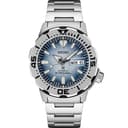
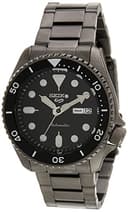
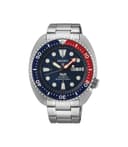
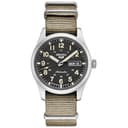
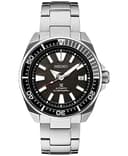
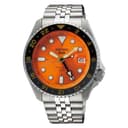
The four differences, and nothing else
Everything below is read from Seiko’s published specification for each reference, not from a retailer’s bullet list. Comparing the SRPD65 against the SRPG57 — the closest pair in the two lines, and the two watches most people are actually choosing between — this is the complete list of what changes.
1. The water-resistance marking
Seiko states “10 bar” for the SRPD65 and “200m / 660ft diver’s” for the SRPG57. Those are not two ways of writing the same thing. Ten bar is an ordinary water-resistance rating: it is fine for swimming and showering and it is tested to the general standard. The word diver’sis regulated under ISO 6425, which sets a 100m minimum, requires a unidirectional or lockable elapsed-time bezel and legibility in darkness, and — the part that costs money — requires that every individual watch is tested, not a sample from the production run.
That is the honest answer to “is the Seiko 5 a real dive watch?” No. It is a diver-styled watch with a genuine 10 bar case. It will survive your holiday. It has not been certified as dive equipment and Seiko has never claimed it was.
2. The crown
Seiko lists a screw-down crownin the SRPG57 and SRPE99 feature sets. It does not list one for the SRPD65. This is the single most functional difference on the page: a screwed crown is a mechanical lock on the most likely leak path in any watch, and it is why the diver’s rating is possible at all. It is also why a Prospex is slightly more annoying to set.
3. Lume on the bezel
The two 5 Sports references whose pages we read for this comparison, the SRPD65 and the SRPG35, are both specified as LumiBrite on hands and index(es). The SRPG57 and the SRPE99 are specified as LumiBrite on hands, index(es) and bezel. A luminous bezel pip is the thing that makes an elapsed-time bezel usable in the dark, which is exactly the situation a dive bezel exists for.
This one does not split cleanly along line names, and it is worth knowing before you assume you are buying it. The third Prospex here, the SRPF03, is specified by Seiko as LumiBrite on hands and index(es)— no bezel, exactly like the 5 Sports. If bezel lume is the reason you were stepping up, check the reference rather than the line. If legibility at night is the whole point for you, our lume roundup ranks both lines against the micro-brands.
4. How it wears
Diameter is where people look and lug-to-lug is what decides fit. Seiko publishes 46.0mm lug-to-lug on the SRPD65 and 49.4mmon the SRPG57 — nearly three and a half millimeters of extra footprint on a case that is a tenth of a millimeter narrower. The Prospex is the bigger watch on the wrist despite the spec sheet suggesting otherwise. Our watch size guide explains how to measure your own ceiling before you order either.
The same trap catches the small watch on this page. Seiko publishes 39.4mm across for the field-style 5 Sports SRPG35 — and a 48.1mm lug-to-lug, which is more than two millimeters longer than the 42.5mm SRPD65. Buy it because you want a clean dial without a dive bezel, not because you assume the smaller number means it will fit a smaller wrist. It very likely will not.
What the Seiko 5 has that the Prospex does not
This runs one way too, and it is rarely mentioned. Seiko lists a see-through screw case back on the SRPD65 and a plain screw case back on the SRPG57. You can watch the 4R36 rotor turn on the cheaper watch and not on the more expensive one, because a display back is a compromise on water resistance.
The 5 Sports is also the more versatile watch. It is the line that covers field, dive-style and street dials on one movement platform, which is why it anchors so many of our lists — our Seiko 5 roundup works through which reference to buy. A Prospex diver is a dive watch and dresses like one.
How we picked
1. Seiko’s numbers, not a retailer’s
Every figure quoted here was read from Seiko’s US product page for the specific reference. That matters because retail listings routinely paraphrase “200m water resistant” for a watch Seiko rates at 10 bar, which erases the exact distinction this page is about.
2. Three from each line, at different sizes
Seiko’s published diameters here run from 39.4mm to 45.0mm. Since fit is the thing most likely to make you regret either watch, the picks are spread across that range rather than clustered at 42mm.
3. Where the tables say “Not published”
Most of the spec tables below print “Not published” against stated accuracy. That is not a gap in our research. Seiko publishes an accuracy figure for the 4R36 caliber— roughly −35 to +45 seconds a day worn on the wrist — but not for these individual references, and a number does not get moved out of the document it was written for. The caliber sheet is cited at the bottom of this page, and our NH35 vs 4R36 comparison covers what that movement family actually is.
Treat the caliber figure as the expectation for every watch here, because they all run it. It is a wide tolerance by quartz standards and an ordinary one for an affordable mechanical watch — neither line is regulated to chronometer specification, and neither claims to be.
4. What we left out
The reference most people expect to see — the cushion-cased Prospex the enthusiast forums call the Turtle, which we cover on its own Seiko Turtle page — came back from Amazon as unavailable on the day we built this, so it is not a pick. We check availability before featuring a watch. The 45.0mm SRPE99 here is the closest full-size Prospex we could confirm was actually purchasable.
So which one should you buy?
Buy the Seiko 5 Sports if you are not diving.That is most people. You get the identical movement, a smaller footprint, a view of the rotor, and roughly a hundred dollars back at today’s prices. Nothing about the 5 Sports is a compromised version of the Prospex; it is a differently specified case around the same engine.
Buy the Prospex if you want the crown, the bezel lume or the marking.If you actually dive, the certification is not a luxury and the decision is made for you. If you do not dive but you want a screw-down crown and a bezel you can read at night, that is a legitimate reason to spend the money — just buy it knowing that is what you are buying, and not because you were told the movement is better.
If neither line is quite right, the honest cross-shop is Orient: the Kamasu gives you a sapphire crystal and an in-house movement at 5 Sports money, and our dive watch roundup ranks the whole category rather than one brand.
If you are still deciding between Seiko lines
This page compares two of the four. Our best Seiko automatic watches roundup ranks all of them — 5 Sports, Prospex, Presage and the 5 Sports GMT — on the sheets Seiko publishes itself, and it is the faster way to see where the extra hundred dollars goes at each step. If this page has already sold you on Prospex, the best Seiko Prospex roundup compares six references inside that line alone, and Prospex vs Citizen Promaster is the version of this argument with a different maker on the other side. Every head-to-head we run lives on the comparisons hub.