What each maker publishes
Read this table as a disclosure comparison rather than a performance one. Not one row claims a watch is worse — the rows say what you can find out before you pay:
| Line / reference | Caliber | Power reserve | Case, as published | Water rating |
|---|
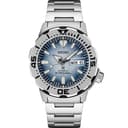
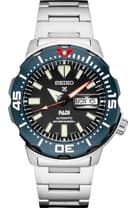
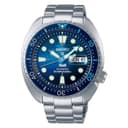
| Seiko Prospex (SRPG57, SRPE27, SRPK01) | 4R35 or 4R36, named per reference | Approximately 41 hours | 41.7-45.0mm, thickness published | 200m, “suitable for scuba diving” |
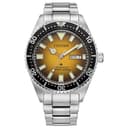
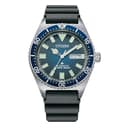
| Citizen Promaster automatic (Amazon references) | Not published on the listing | Not published | 41mm width only | “AUTOMATIC DIVER’S 200m” on the dial |
| Citizen Promaster NB6021-17E (own site only) | 9051, with -10/+20 sec/day stated | 42 hours | 41mm Super Titanium | 200m, “Scuba Diving” |
The third row is the one that reframes the argument. Citizen’s best-documented mechanical diver beats every Prospex here on paper — titanium, sapphire, a published accuracy band, antimagnetic to a stated figure — and you cannot buy it on the retailer most people shop at. What you can buy there is the cheap end of the same line, with the paperwork stripped out.
The one number both lines really do share
Both are marked 200m, and in both cases that marking means something specific. Under ISO 6425 a watch may only be marked “Diver’s 200m” if it meets a defined set of requirements — at least 100m of resistance, a unidirectional or lockable elapsed-time bezel, legibility in the dark at 25cm, and testing of every individual watchrather than a batch sample. Seiko states its Prospex divers are “suitable for scuba diving” and follow ISO standards for scuba diving. The bracelet Promaster prints “AUTOMATIC DIVER’S 200m” on the dial, which is the marking the standard governs.
So on the thing a dive watch is for, these are genuinely equivalent, and anyone telling you the Seiko is “more waterproof” is guessing. Our water resistance guide explains what the rating does and does not promise, and why the screw-down crown matters more than the number.
Where Seiko is clearly ahead
You can look the movement up.Seiko names the 4R35 or the 4R36 on the sheet, and then publishes a caliber document for the family: 24 jewels, 21,600 vibrations an hour, approximately 41 hours of reserve, manual winding, a stop-seconds function and an accuracy band of +45 to -35 seconds a day. You can hand “4R36” to any watchmaker in the world. You cannot hand them “automatic”.
You can predict the fit.Seiko publishes a thickness and often a length for each reference — 12.3mm on the SRPL15, 13.22mm on the SRPK01, 13.4mm on the SRPG57 — and thickness is what decides whether a dive watch lives under a shirt cuff. Citizen publishes a 41mm width for its Amazon automatics and nothing else about the case.
You can choose your crystal.Most Prospex references use Hardlex, Seiko’s mineral crystal, which is a genuine weakness — glass sits at about 5.5 on the Mohs scale, everyday grit is largely quartz at 7, so hairline scratches arrive over a few years. But Seiko gives you the way out and prints it: the SRPK01 is published with sapphire and an anti-reflective inner coating. On the Citizen listings the crystal is simply not stated, so there is no choice to make.
Where Citizen wins anyway
Price, by a wide margin.Both Citizen automatic divers sit well under the cheapest Prospex here, and the strap reference sits further under again. If the decision is “a mechanical dive watch from a major Japanese maker or nothing”, Citizen answers it at a price Seiko does not currently match in this line.
Day-date on the cheap reference.Both Citizen Promaster automatics here show a day as well as a date. On the Seiko side only the 4R36 references do, and the two 4R35 ones — the SRPF03 and the SRPL15 — are date-only.
A bracelet without the Prospex premium. The 41mm Promaster comes on a steel bracelet. On the Seiko side a bracelet means the SRPE27 or moving up to 45mm, and both cost appreciably more.
It is a 41mm watch. Only one Prospex reference on this site is narrower. If 42mm-plus is too much watch for your wrist, the Citizen is not a compromise choice, it is the correct one. Our watch size guide covers why the lug-to-lug figure predicts fit better than the diameter, and the small-wrist roundup is the page to read if neither of these fits.
What “not published” actually costs you
It is tempting to treat a blank specification row as a formality. Three places it bites:
- Service. A named caliber tells a watchmaker what parts to order. An unnamed one means opening the watch to find out, and that is billable time. Our guide to automatic service costs puts numbers on the difference.
- Expectations.Seiko publishing +45 to -35 seconds a day for the 4R family sounds unimpressive until you realize it is a promise you can hold them to. Where no figure is published, a watch running 25 seconds fast is neither within spec nor outside it — there is no spec.
- Resale and comparison. You cannot compare two watches on figures that only one of them publishes, which is exactly why the cheap Promaster automatics stay cheap while Prospex prices climb.
Who should buy which
Buy the Seiko Prospex if this is your only mechanical watch and you want it documented, if you want a choice of case size between 41.7mm and 45mm, if you want the option of a sapphire crystal, or if you expect to service rather than replace the watch. Start with the full Prospex roundup and pick on thickness.
Buy the Citizen Promaster if the budget is the real constraint, if you want a day-date on a steel bracelet at 41mm, or if you want a mechanical diver from a top-three Japanese maker for the price of a decent NH35 micro brand. Accept that the specification sheet is thin, and that the Citizen references which arefully documented — the 9051 titanium diver, the 8204 Fugu — live on Citizen’s own site rather than on Amazon.
Buy neither if what you actually want is specification per dollar. At Prospex money an NH35 diver with sapphire, a ceramic bezel and a 300m rating is a better-equipped watch from a maker with no service network and no history, and that is a legitimate trade for some people. Our best automatic dive watches page is the cross-brand version of this decision, and Seiko vs Orient vs Citizen takes the three Japanese makers apart on movements and finishing rather than one line each.
Living with either one
Both are automatics with hand-winding, so a stopped watch starts from the crown rather than a shake — Citizen’s own 8200-family manual actually recommends winding the crown five to ten times to start the watch. Both hold roughly 41 to 42 hours off the wrist where a figure is published, which means either one will be stopped by Monday if you take it off on Friday night.
That is the whole argument for a winder on a watch like this, and it is weaker than winder marketing suggests for a single watch: resetting one day-date takes fifteen seconds. We argue both sides in do automatic watches need a winder, and if you decide you want one, winders sized for a Seiko covers the cushion fit that a 42mm-plus diver needs.