How to tell real wood from wrapped board on a listing
You cannot touch the box before you buy it, so the listing has to do the work. Four things reliably separate the tiers.
- The material line names a species. “Solid walnut” and “solid pine” are claims a seller can be held to. “Wooden,” “wood finish” and “carbon-fiber pattern” are not.
- Weight is stated and is not trivial. A solid hardwood 12-slot box is heavy. A wrapped-board one of the same size is not, and sellers of the latter tend not to publish a weight at all.
- The corners are shown in the photographs. Mitred, sanded corners indicate joined timber. A perfectly uniform grain that wraps around a corner without interruption indicates printed film.
- The price is consistent with the claim. A solid walnut twelve-slot box with a drawer at $22 is not a bargain; it is a different product being described in optimistic language.
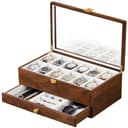
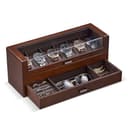
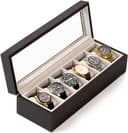
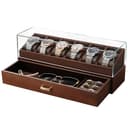
The picks below sit in the first two tiers only. Where a maker states a stained or veneered finish rather than solid timber, the entry says so rather than letting the word “wooden” do the work.
What actually matters after the material
Padding, which is where cheap boxes fail first
The pillows matter more than the case. You want them removable and soft enough to compress under a bracelet, because a hard, oversized pillow forces a metal bracelet open and makes loading the watch a two-handed fight. This is the single most common real complaint about budget boxes, and it is independent of what the outside is made of.
Glass lid or solid lid
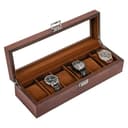
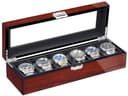
A glass lid is worth having if the box sits somewhere you look at it, because seeing the collection is most of the reason to own a box rather than a drawer. If the box lives inside a wardrobe, a solid lid is fine and keeps light off the dials. Every pick on this page states a glass lid on its own listing, which is simply where the wooden-box market has landed.
A drawer, which is more useful than more slots
Once you own two automatics you own spare straps, a spring-bar tool and a microfiber cloth, and they end up loose in a drawer somewhere. A second layer or a pull-out drawer solves that for less space than four more watch slots would take. Our valet box roundup covers that format properly.
How we picked
1. A stated material, not an implied one
Every pick names what it is made of on its own listing. Where a maker states “walnut finish” rather than solid walnut, the spec table says exactly that. This is the whole point of the page.
2. Slot counts that match how people actually collect
Five of the six picks are six or twelve slots, because that is where almost everybody lands. Buy for the collection you have plus a little headroom — a 24-slot box with six watches in it looks worse than a full six-slot box, and the empty capacity is dead weight. Our large box roundup is there if you genuinely need the space.
3. Honest about finish variation
Wood is a natural material and stained wood varies between units — grain, tone and how closely the box matches its own product photograph. Every pick here has that noted in its cons where it applies. It is not a defect and it is not something any seller can fully control.
4. What we left out
Anything described as “wooden” with no species, no weight and a price that makes the claim implausible. Also excluded: boxes whose lock is presented as security. A lock on a display box is casual deterrence — anything you truly need to protect belongs in a safe.
Wood, leather, or a winder?
Three different purchases that get compared as if they were one.
A wooden box is the display option: it looks like furniture, it keeps dust off, and it is the right answer if the collection lives out in a room you use. A leather box is the softer, quieter version of the same idea and generally travels better — see our leather box roundup. A winder is a completely different product that keeps one or more automatics running rather than storing them, and most people who think they want one actually want a box. Our winder versus box comparison settles that question before you spend. If you have settled it and the answer was a winder, our wooden watch winder roundup applies the same material grading to that category — where, tellingly, no maker states solid hardwood at all.
Whichever you choose, a stopped automatic in a box takes nothing worse than a restart — our guide to storing automatic watches covers what actually happens to a mechanical watch left unworn, and the three storage mistakes that do cost real money.