How we picked
1. Restraint on the dial
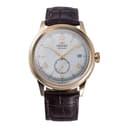
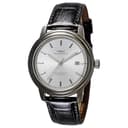
A dress dial should tell you the time and as little else as possible. That means a clean layout, no more than one line of text under the logo, and markers that are applied rather than printed if the price allows. A date window is acceptable and genuinely useful; a day-date on a dress watch usually is not, because it breaks the symmetry the whole style depends on. Everything on this list passes that test, and the Bambino passes it most convincingly — which is most of why it has been the default answer at this price for a decade.
2. Case thickness above case diameter
The classic dress-watch failure is a beautiful dial in a 13mm case that will not go under a cuff. Where makers publish thickness we have weighted it heavily. The Bambino’s 40.5mm diameter sounds large for a dress watch and wears fine because the lugs are slim and the bezel is thin; a 38mm sports case would wear bigger. Judge the proportions, not the headline number.
3. A strap that suits the job
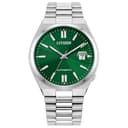
Leather is the traditional and generally correct answer for a dress watch: it sits flatter than a bracelet and looks right with a suit. The exception is the integrated-bracelet style — the Citizen Tsuyosa here — where the bracelet is part of the design and cannot be swapped without ruining it. That is a legitimate look with a real trade-off, and worth knowing before you buy: an integrated bracelet means you are committed to it.
4. A movement you would want to see
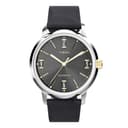
Dress watches are where display casebacks earn their place, because the watch is thin enough that you actually notice the movement when you take it off. Orient and Seiko both build their own calibers, which is the strongest argument for the top two picks. Timex does not publish its caliber data, so those picks are here on design merit and their cards say so.
What makes a watch “dressy”?
Four things, roughly in order of how much they matter.
Thinness. Under about 11mm reads as dressy; over about 13mm doesn’t, no matter how elegant the dial is.
A quiet dial. Low contrast rather than high, no luminous paint slathered on the markers, minimal text. A dress watch should be slightly harder to read in the dark than a field watch; that is the trade you are making.
No bezel function. A rotating bezel is a tool feature. A dress watch has a fixed, polished bezel, or barely any bezel at all.
A leather strap, or an integrated bracelet done deliberately. A sports bracelet on a dress case is the most common way people accidentally undo an otherwise correct watch.
Notably absent from that list: price. A $250 Bambino on a good strap looks entirely correct with a suit. Dress watches are the one category where the cheap option is genuinely hard to distinguish at conversational distance, which is why it is such a good place to start a collection.
The open-heart question
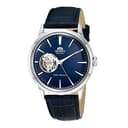
An open-heart dial has a small aperture cut over the balance wheel, so you can see the one part of the movement that visibly moves. It sits between a solid dial and a full skeleton, and it divides people completely.
The case for it: a mechanical watch that shows you it is mechanical is a more interesting object, and the balance wheel is genuinely mesmerizing. The case against: the aperture breaks dial symmetry, and on a dress watch symmetry is most of the point. Our advice is that an open heart is a second dress watch rather than a first one. Buy the plain Bambino first; if you find yourself wishing you could see more, the open-heart version is waiting.
What more money buys
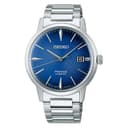
Above about $400, three things change. Sapphire becomes standard rather than occasional. Dial finishing gets genuinely impressive — the lacquered and enamel dials in Seiko’s Presage line are the obvious example, and they are the reason that pick ranks where it does despite the price. And case finishing improves in ways you feel rather than see: sharper edges, better-defined transitions between brushed and polished surfaces.
Our under-$1,000 page covers that step properly, and the honest summary is that dress watches reward the extra money more than sports watches do — because on a plain dial, finishing is all there is to look at. If you are working the other way, the under-$300 band is where four of these six picks live and where the value is at its best.
Two watches on this list are the ones people cross-shop most, and we have put them head to head: Orient Bambino vs Timex Marlin Automatic, including the Bambino sizing trap that catches buyers who order by line name.