Dial & Lume

Best Battery-Powered Watch Winders

Winders that run on AA cells for a safe, a drawer or a room with no convenient socket — with an honest account of what running one on batteries actually costs you.

By Stephen V.Last updated How we pick

There are exactly three reasons to want a battery-powered winder, and they are all about where it lives rather than what it does. It goes inside a safe, where there is no socket and drilling one is not an option. It goes inside a drawer or a cupboard, where a trailing cable would stop the drawer closing. Or it goes somewhere temporary — a hotel room, a second home, a desk you do not want another cable on.

If none of those is your situation, mains power is better in every respect and you should ignore this page. Battery running is a compromise, and it is worth being straight about the cost: a winder motor turning several hundred times a day will go through alkaline AA cells, and the more turns per day you ask for, the faster it does. Rechargeable cells and a charger will pay for themselves quickly. Every winder here also runs from the supplied adapter, so you are buying the option rather than committing to it.

Six picks, ranked on rotation control first and then on how sensibly they behave off mains power. We have not handled any of them. Specifications are read from each maker’s listing on the date shown; no maker publishes a measured battery-life figure, so we have not quoted one. Prices come from a live daily check.

How this is funded: we earn a commission if you buy through our links, at no extra cost to you. As an Amazon Associate we earn from qualifying purchases. It never changes which watch or winder we recommend, and we’ll tell you plainly when to skip one. Full disclosure.

Quick picks

Ranked on movement, specs and buyer fit. Select a row to jump to the full write-up. We have not tested these — here is exactly what we do instead.

#ProductBest forPrice
1
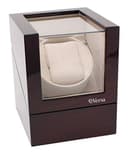
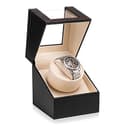
Versa Single Watch Winder Elite

Versa Single Watch Winder Elite

The value sweet spot. A quiet Japanese motor and twelve rotation programs — enough TPD and direction combinations to suit almost any automatic — at roughly a fifth of a premium single's price. The one to buy when you want real control without the badge premium.

Best overall
$89.99 · View on Amazon

Price as of September 4, 2026. #ad How we’re funded

2
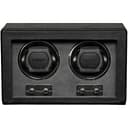
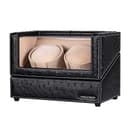
Rothwell Double Watch Winder

Rothwell Double Watch Winder

The widest settings range on this list, in the nicest case. Rothwell publishes five TPD speeds up to 1,950 and three directions, gives each watch its own setting, and runs two separate quiet Japanese motors instead of driving both positions off one. It also takes AA batteries, which is the difference between a winder that has to sit by an outlet and one that can go in a safe.

Best for two watches
$204.95 · View on Amazon

Price as of September 4, 2026. #ad How we’re funded

3
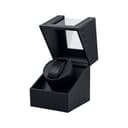
Mcbazel Single Watch Winder

Mcbazel Single Watch Winder

A budget single winder that leans on an ultra-quiet Japanese motor and multiple rotation modes, with AC or battery power. A solid alternative to the SONGMICS at a similar price if you prefer its look.

Best on a budget
$26.49 · View on Amazon

Price as of September 4, 2026. #ad How we’re funded

4
BEWISHOME Single Watch Winder SYQ05Y

BEWISHOME Single Watch Winder SYQ05Y

A tidier-looking budget single than most, from a maker whose four-position box we already recommend. Mains or battery power, and a case that does not shout about being cheap.

Best looking cheap one
$36.99 · View on Amazon

Price as of September 4, 2026. #ad How we’re funded

5
Efaithtek Single Watch Winder (Carbon Fiber)

Efaithtek Single Watch Winder (Carbon Fiber)

A battery-or-mains single for the price of a strap. If you need a winder that can sit in a safe or a drawer with no cable running to it, this is the cheapest honest way to do it.

Best for a safe
$24.58 · View on Amazon

$25.885% off

Price as of September 4, 2026. #ad How we’re funded

6
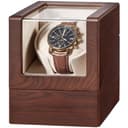
TRIPLE TREE Double Watch Winder (Piano Finish)

TRIPLE TREE Double Watch Winder (Piano Finish)

A two-position winder in a genuine wood shell with a piano lacquer finish, at a price where almost everything else is molded plastic. The finish is the reason to pick it.

Best wood finish
$66.99 · View on Amazon

Price as of September 4, 2026. #ad How we’re funded

The picks in full

#1Best overall

Versa Single Watch Winder Elite

The value sweet spot. A quiet Japanese motor and twelve rotation programs — enough TPD and direction combinations to suit almost any automatic — at roughly a fifth of a premium single's price. The one to buy when you want real control without the badge premium.

Strengths

  • Twelve rotation programs cover the TPD/direction range most watches need
  • Quiet Japanese motor
  • AC or battery power for placement flexibility

Trade-offs

  • Cabinet finish is fine, not luxurious
  • No app or memory beyond the on-unit settings
Watches held1
Rotation settings12 rotation programs
DirectionCW, CCW, both
PowerAC adapter + battery
Quiet motorYes
Includes storageNo

Why this one. Twelve programs is the number that matters here: it's enough to cover the common TPD bands (roughly 650-1950) and both directions, which is the whole job of a winder.

Specs read from the product listing and the maker’s published data, on July 21, 2026. “Not published” means the maker does not state that figure.

#2Best for two watches

Rothwell Double Watch Winder

The widest settings range on this list, in the nicest case. Rothwell publishes five TPD speeds up to 1,950 and three directions, gives each watch its own setting, and runs two separate quiet Japanese motors instead of driving both positions off one. It also takes AA batteries, which is the difference between a winder that has to sit by an outlet and one that can go in a safe.

Strengths

  • Five published TPD speeds (650/750/850/1000/1950) with per-watch settings
  • Two separate quiet Japanese motors rather than one shared drive
  • Runs on AA batteries or mains — Rothwell states roughly 3-4 weeks per set

Trade-offs

  • The most expensive pick here by a wide margin
  • Large at roughly 11.75 x 6.25 x 7.25 inches — it needs real dresser space
Watches held2
Rotation settings5 TPD speeds x 3 directions, set per watch
DirectionCW, CCW, both
PowerAC adapter or AA batteries
Quiet motorYes
Includes storageNo

Why this one. The 1,950 TPD top step matters for the small number of movements that genuinely want a high turn count; most automatics sit far below it. Battery operation is the quieter selling point — it's what lets the winder live somewhere without a socket.

Specs read from the product listing and the maker’s published data, on July 23, 2026. “Not published” means the maker does not state that figure.

#3Best on a budget

Mcbazel Single Watch Winder

A budget single winder that leans on an ultra-quiet Japanese motor and multiple rotation modes, with AC or battery power. A solid alternative to the SONGMICS at a similar price if you prefer its look.

Strengths

  • Ultra-quiet Japanese motor for a bedside table
  • Multiple rotation modes and both power options
  • Compact footprint

Trade-offs

  • Crocodile-pattern finish is a taste call
  • No exact TPD readout — you pick a mode, not a number
Watches held1
Rotation settingsMultiple rotation modes
DirectionNot published
PowerAC + battery
Quiet motorYes
Includes storageNo

Why this one. Battery power matters more than it sounds — it lets you place the winder where there isn't an outlet, or move it into a safe.

Specs read from the product listing and the maker’s published data, on July 21, 2026. “Not published” means the maker does not state that figure.

#4Best looking cheap one

BEWISHOME Single Watch Winder SYQ05Y

A tidier-looking budget single than most, from a maker whose four-position box we already recommend. Mains or battery power, and a case that does not shout about being cheap.

Strengths

  • Mains or battery operation
  • Cleaner styling than most sub-$40 winders
  • Established budget-storage brand rather than a one-listing seller

Trade-offs

  • TPD and direction are described by mode name only
  • Single position — no room to grow
Watches held1
Rotation settingsMultiple rotation modes
DirectionNot published
PowerAC adapter or batteries
Quiet motorYes
Includes storageNo

Why this one. BEWISHOME is one of the few budget names that keeps its listings alive across years, which matters when you want a matching second unit later.

Specs read from the product listing and the maker’s published data, on August 11, 2026. “Not published” means the maker does not state that figure.

#5Best for a safe

Efaithtek Single Watch Winder (Carbon Fiber)

A battery-or-mains single for the price of a strap. If you need a winder that can sit in a safe or a drawer with no cable running to it, this is the cheapest honest way to do it.

Strengths

  • Runs on batteries or the supplied adapter
  • Small enough to sit inside most home safes
  • Costs less than almost anything else that rotates

Trade-offs

  • No published TPD figures
  • Carbon-fiber-look PU is exactly as premium as it sounds
Watches held1
Rotation settingsMultiple rotation modes
DirectionNot published
PowerAC adapter or batteries
Quiet motorYes
Includes storageNo

Why this one. Battery running is the point. A winder run on AA cells will drain them faster the more turns per day you ask for, so budget for rechargeables.

Specs read from the product listing and the maker’s published data, on August 11, 2026. “Not published” means the maker does not state that figure.

#6Best wood finish

TRIPLE TREE Double Watch Winder (Piano Finish)

A two-position winder in a genuine wood shell with a piano lacquer finish, at a price where almost everything else is molded plastic. The finish is the reason to pick it.

Strengths

  • Real wood shell with a gloss lacquer finish
  • Stated Japanese motor
  • Flexible pillows that suit small and large wrists

Trade-offs

  • No published TPD or direction figures
  • Gloss lacquer shows dust and fingerprints immediately
Watches held2
Rotation settingsMultiple rotation modes
DirectionNot published
PowerNot published
Quiet motorYes
Includes storageNo

Why this one. A lacquered wood shell at this price is unusual and genuinely changes how the thing looks on furniture. It does not change how it winds.

Specs read from the product listing and the maker’s published data, on August 11, 2026. “Not published” means the maker does not state that figure.

How we picked

1. It has to genuinely run on batteries

A surprising number of listings mention batteries while meaning a backup for the clock, or a battery compartment on a model that ships without a working circuit for it. Every pick here states AC-adapter-or-battery operation as its normal running mode. Where a maker specifies the cell type we have said so; where it does not, the field reads “Not published” rather than a guess.

2. Low turns per day, because turns cost power

This is the practical rule for battery running and it is not obvious. A winder motor draws power in proportion to how much it turns. A watch programmed at 1,800 turns per day will flatten a set of cells substantially faster than the same watch at 750. If you are running on batteries, use the lowest setting that keeps the watch running — for most modern automatics that is a modest figure. Our turns-per-day guide has the numbers by movement.

3. Size, because safes are small

The single most common reason a battery winder gets returned is that it does not fit in the safe it was bought for. Measure the internal height of your safe before you buy anything — winders are taller than they look in photographs, because the cuff has to clear the case as it rotates. The single-position picks here are the ones that fit most home safes; the doubles generally do not.

4. Quiet, since a drawer amplifies

A winder in a closed wooden drawer is louder than the same winder on a dresser — the cabinet acts as a soundbox. Every pick here states a quiet or Japanese motor. If the winder is going somewhere you sleep, start instead with our quiet winder picks.

What running on batteries actually costs

No maker on this page publishes a runtime figure, and we are not going to invent one — the honest answer is that it depends heavily on the turns-per-day setting, the cell chemistry and how much resistance the watch puts on the motor. What we can say with confidence is the shape of it: alkaline cells in a winder running daily are a consumable, not a one-off, and the cost adds up over a year.

Two practical conclusions follow. First, buy rechargeable NiMH cells and a charger at the same time as the winder; the payback period is short. Second, if the winder is going somewhere a cable could reach with a small amount of effort — a drilled grommet in a cabinet back, a flat cable under a drawer — do that instead. Mains power is quieter to live with in every sense.

Winders inside safes: the honest caveats

This is the most common use case for a battery winder, so it deserves its own section. A safe is a sealed box: it traps heat, and it traps humidity. A motor running inside one adds a small amount of the first, and a safe in a basement or garage can have plenty of the second. Neither will destroy a watch quickly, but a silica-gel pack in the safe is a sensible companion purchase.

The second caveat is access. Changing batteries in a winder inside a safe means opening the safe, taking the winder out, and putting it back — which is exactly the chore you were trying to avoid by not resetting the watch. If the watches in your safe are ones you wear rarely, the honest recommendation is not a winder at all. It is a watch box, and setting the watch when you take it out.

When mains is simply better

For a winder that lives on a dresser, mains power wins outright: no consumables, no declining performance as cells drain, and no risk of the winder having quietly stopped days ago. A winder running down on flat batteries is worse than no winder at all, because you will trust it and find the watch stopped anyway.

Everything on this page also runs from its adapter, so buying one of these is not a commitment to batteries. It is buying the option to move the winder somewhere a cable cannot go.

Frequently asked questions

How long do batteries last in a watch winder?

No maker on this page publishes a figure, and it varies enormously with the turns-per-day setting — a winder at 1,800 TPD drains cells far faster than the same winder at 750. Treat alkaline cells as a running cost and buy rechargeable NiMH cells with a charger instead; the payback is quick.

Can you put a watch winder inside a safe?

Yes, and it is the main reason to buy a battery-powered one. Two cautions: measure the safe's internal height first, because winders are taller than they look once the cuff has to clear the case, and add a silica-gel pack, since a sealed safe traps humidity.

Are battery watch winders as good as mains ones?

The mechanism is identical — the same motor and the same programs. What differs is reliability of supply: a winder on flat cells stops silently, which is worse than no winder, because you will assume the watch is wound. For anything on a dresser, use the adapter.

What size batteries do watch winders use?

AA cells in almost every case, usually two or four depending on the model. Where a maker does not state the cell type or count on its listing, we have marked it as not published rather than guessing — check the listing before you buy the batteries.

Does a lower TPD setting make batteries last longer?

Yes, substantially. The motor's power draw is roughly proportional to how much it turns, so halving the turns per day meaningfully extends cell life. Use the lowest setting that keeps your watch running — for most modern automatics that is a modest figure, not the maximum.

Can a battery-powered winder run more than one watch?

Some doubles do, but the economics get worse quickly — two motors draw roughly twice the current. Beyond two positions, battery operation stops being sensible and you should be looking for a way to get mains power to the winder instead.

Sources

  • Barrington Watch Winders — How to set optimal winding parametersA winder maker's guidance on turns per day (TPD) and rotation direction, and why the wrong direction winds nothing — there is no ISO standard for TPD, so maker guidance is the authority (accessed July 21, 2026)
  • Automatic watch — WikipediaReference on self-winding watches: most automatics can also be wound by hand at the crown, and a slipping bridle on the mainspring barrel makes overwinding by a rotor or a winder mechanically impossible (accessed August 11, 2026)
  • Rothwell — Double Watch Winder (Black/Grey) specificationRothwell's own spec for its double winder: five TPD speeds (650/750/850/1000/1950), three rotation modes, two quiet Japanese motors, AC or AA-battery power, and per-watch settings (accessed July 23, 2026)
  • Versa Watch Winders — Elite Double Watch Winder specificationVersa's own spec for the Elite Double: four turns-per-day settings (650/950/1250/1850), clockwise, counter-clockwise and bi-directional operation, and 'set each winder independently' (accessed July 23, 2026)

Keep reading