Dial & Lume

Best Open-Heart Automatic Watches

A window onto the balance wheel is not the same thing as a skeleton dial — and the difference is exactly why some open hearts look expensive and others look like a toy.

By Stephen V.Last updated How we pick

An open heart is a small aperture cut into an otherwise normal dial, positioned so you can see the balance wheel oscillating underneath. That is the whole complication — and calling it a complication is generous, because nothing about it changes what the watch does. It is a window, and its entire job is to show you the one part of a mechanical movement that visibly moves.

It is worth being precise about this, because listings are not. An open heart is a dial with a hole in it. A skeleton dial is a dial that has largely been removed, or a movement whose bridges have been cut away. They photograph similarly and they are completely different watches to own: an open heart stays legible because you still have a real dial, hands and markers, while a skeleton frequently does not. If it is the second one you want, our skeleton watch roundup covers it.

Six picks below, from about $147 to $500, split between watches that do this properly and one that does it cheaply enough to be worth knowing about. We have not handled any of them. Specifications come from each maker’s listing on the date cited; prices come from a live daily check.

How this is funded: we earn a commission if you buy through our links, at no extra cost to you. As an Amazon Associate we earn from qualifying purchases. It never changes which watch or winder we recommend, and we’ll tell you plainly when to skip one. Full disclosure.

Quick picks

Ranked on movement, specs and buyer fit. Select a row to jump to the full write-up. We have not tested these — here is exactly what we do instead.

#ProductBest forPrice
1
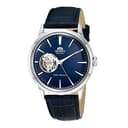
Orient Bambino Open Heart

Orient Bambino Open Heart

The Bambino with a window cut over the balance wheel. It keeps everything that makes the standard Bambino the default affordable dress watch, and adds the one detail that reminds you it is mechanical every time you check the time.

Best overall
$275.00 · View on Amazon

Price as of September 4, 2026. #ad How we’re funded

2
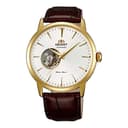
Orient Esteem II Open Heart (FAG02003W0)

Orient Esteem II Open Heart (FAG02003W0)

The open-heart done the classical way: a small aperture at 12 o'clock showing the balance wheel, on a white dial with applied markers rather than a skeletonized mess. Orient's own automatic movement sits behind it, which is the part most cheap open hearts cannot claim.

Best classic dial
$289.98 · View on Amazon

Price as of September 4, 2026. #ad How we’re funded

3
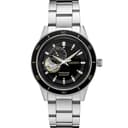
Seiko Presage SSA425 Open-Aperture

Seiko Presage SSA425 Open-Aperture

Seiko's open-aperture Presage, styled on the brand's own 1960s watches. It is the most expensive way onto this page and also the only pick with a service network behind it, which is the argument for it in one sentence.

Best step-up
$499.80 · View on Amazon

Price as of September 4, 2026. #ad How we’re funded

4
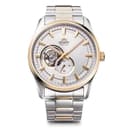
Orient Contemporary Semi-Skeleton (RN-AR0006S)

Orient Contemporary Semi-Skeleton (RN-AR0006S)

The open heart taken a step further: Orient cuts away more of the white dial than a single aperture would, so you see the going train as well as the balance. It is the only watch on this page whose listing publishes a real accuracy specification, and at +25 to -15 seconds a day that figure is tighter than Seiko's 4R band.

Best semi-skeleton
$339.99 · View on Amazon

Price as of September 4, 2026. #ad How we’re funded

5
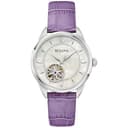
Bulova Sutton Automatic Open Heart Ladies (96L339)

Bulova Sutton Automatic Open Heart Ladies (96L339)

Bulova's women's Sutton pairs a floral open-heart dial with a proper automatic movement and a heritage American brand behind it. The dressiest mechanical on this list, and priced like it.

Best smaller case
$261.45 · View on Amazon

Price as of September 4, 2026. #ad How we’re funded

6
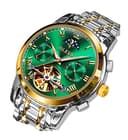
OLEVS Moon Phase Skeleton Automatic

OLEVS Moon Phase Skeleton Automatic

The mid-budget option: an automatic with a moonphase-style sub-dial and a partly skeletonized face, at roughly a third of what the Orients cost. It looks like more watch than it is, which is either the appeal or the problem.

Best on a budget
$147.00 · View on Amazon

Price as of September 4, 2026. #ad How we’re funded

The picks in full

#1Best overall

Orient Bambino Open Heart

The Bambino with a window cut over the balance wheel. It keeps everything that makes the standard Bambino the default affordable dress watch, and adds the one detail that reminds you it is mechanical every time you check the time.

Strengths

  • Orient in-house automatic with hand-winding
  • Open-heart aperture without turning into a full skeleton
  • Classic 40.5mm Bambino dress proportions

Trade-offs

  • The aperture eats into dial symmetry
  • Mineral crystal on most Bambino variants, not sapphire
MovementOrient automatic with hand-winding
Stated accuracyNot published
Power reserveNot published
Case size40.5 mm
Water resistanceNot published
CrystalNot published
Hacks / hand-windsNot published / Yes

Why this one. An 'open heart' shows the balance wheel through a small dial aperture. It is the restrained middle ground between a solid dial and a full skeleton.

Specs read from the product listing and the maker’s published data, on September 3, 2026. “Not published” means the maker does not state that figure.

#2Best classic dial

Orient Esteem II Open Heart (FAG02003W0)

The open-heart done the classical way: a small aperture at 12 o'clock showing the balance wheel, on a white dial with applied markers rather than a skeletonized mess. Orient's own automatic movement sits behind it, which is the part most cheap open hearts cannot claim.

Strengths

  • Aperture at 12 o'clock keeps the dial symmetrical and legible
  • In-house Orient automatic with hand-winding rather than a generic caliber
  • Classic white dial and applied markers wear far dressier than skeleton alternatives

Trade-offs

  • Costs several times what an unbranded open heart does
  • Orient does not publish a full spec sheet for this reference
MovementOrient automatic with hand-winding
Stated accuracyNot published
Power reserveNot published
Case sizeNot published
Water resistanceNot published
CrystalNot published
Hacks / hand-windsNot published / Yes

Why this one. An open heart is a window over the balance wheel, not a skeletonized movement. The Esteem II is the clearest illustration of that distinction on this list.

Specs read from the product listing and the maker’s published data, on August 19, 2026. “Not published” means the maker does not state that figure.

#3Best step-up

Seiko Presage SSA425 Open-Aperture

Seiko's open-aperture Presage, styled on the brand's own 1960s watches. It is the most expensive way onto this page and also the only pick with a service network behind it, which is the argument for it in one sentence.

Strengths

  • Seiko automatic in the Presage line, fully supported for service and parts
  • Vintage 1960s-derived styling rather than a generic skeleton look
  • Seiko states 50m water resistance for this reference

Trade-offs

  • Costs roughly five times the budget open hearts
  • Seiko does not publish an accuracy figure for this reference
MovementSeiko automatic
Stated accuracyNot published
Power reserveNot published
Case sizeNot published
Water resistance50 m
CrystalNot published
Hacks / hand-windsNot published / Not published

Why this one. Presage aperture models sit above the Cocktail Time tier on dial and case finishing rather than on movement specification.

Specs read from the product listing and the maker’s published data, on August 19, 2026. “Not published” means the maker does not state that figure.

#4Best semi-skeleton

Orient Contemporary Semi-Skeleton (RN-AR0006S)

The open heart taken a step further: Orient cuts away more of the white dial than a single aperture would, so you see the going train as well as the balance. It is the only watch on this page whose listing publishes a real accuracy specification, and at +25 to -15 seconds a day that figure is tighter than Seiko's 4R band.

Strengths

  • Orient publishes +25 / -15 seconds a day for this reference — most makers here publish nothing
  • Self-winding and hand-winding, with a stated running time over 40 hours
  • Semi-skeleton dial shows more than an aperture without losing the hour markers

Trade-offs

  • Orient publishes no case diameter, crystal or water resistance for it
  • More dial cut away means less contrast than the plain Bambino Open Heart
MovementOrient automatic with hand-winding
Stated accuracy+25 / -15 sec/day
Power reserveNot published
Case sizeNot published
Water resistanceNot published
CrystalNot published
Hacks / hand-windsNot published / Yes

Why this one. A semi-skeleton sits between an open heart and a full skeleton: the dial is opened out over part of the movement rather than removed entirely, so the watch stays readable. Orient is a movement maker in its own right, which is what separates this from the unbranded skeletons lower down the page.

Specs read from the product listing and the maker’s published data, on September 3, 2026. “Not published” means the maker does not state that figure.

#5Best smaller case

Bulova Sutton Automatic Open Heart Ladies (96L339)

Bulova's women's Sutton pairs a floral open-heart dial with a proper automatic movement and a heritage American brand behind it. The dressiest mechanical on this list, and priced like it.

Strengths

  • Automatic movement with an open-heart floral dial
  • Bulova's brand history, warranty and service network
  • Reads as jewelry without being a fashion quartz

Trade-offs

  • The most expensive women's pick here
  • Decorative dial won't suit anyone wanting plain legibility
MovementAutomatic
Stated accuracyNot published
Power reserveNot published
Case sizeNot published
Water resistanceNot published
CrystalNot published
Hacks / hand-windsNot published / Not published

Why this one. Bulova has been building watches since 1875 and still publishes reserve and jewel counts on much of its automatic range — unusual among brands at this price.

Specs read from the product listing and the maker’s published data, on August 11, 2026. “Not published” means the maker does not state that figure.

#6Best on a budget

OLEVS Moon Phase Skeleton Automatic

The mid-budget option: an automatic with a moonphase-style sub-dial and a partly skeletonized face, at roughly a third of what the Orients cost. It looks like more watch than it is, which is either the appeal or the problem.

Strengths

  • Automatic movement with a visible balance
  • Moonphase sub-dial plus skeleton work at a low price
  • Widely stocked, so returns are straightforward

Trade-offs

  • Movement is not named anywhere on the listing
  • 3ATM rating means splashes only, not swimming
MovementAutomatic
Stated accuracyNot published
Power reserveNot published
Case sizeNot published
Water resistance30 m
CrystalNot published
Hacks / hand-windsNot published / Not published

Why this one. Unnamed movements are the norm at this price. It does not mean the watch is bad, it means nobody has published anything you can check.

Specs read from the product listing and the maker’s published data, on August 11, 2026. “Not published” means the maker does not state that figure.

What the window actually shows you

The balance wheel is the timekeeping element of a mechanical watch: a weighted wheel on a hairspring that swings back and forth at a fixed rate, releasing the gear train one step at a time through the escapement. At 21,600 vibrations per hour — the rate of the Seiko and Orient calibers here — it completes three full oscillations every second, which is why it reads as a blur of motion rather than a tick.

That blur is the point. It is the clearest possible demonstration that the watch is running on a spring and not a battery, and it is why open hearts sell to people buying their first mechanical watch. There is no functional benefit whatsoever, and anyone who tells you the aperture improves anything is inventing a reason.

Where the aperture sits, and why it matters

Two conventions exist. A window at 12 o’clock keeps the dial symmetrical about its vertical axis and generally reads as the more classical design — the Orient Esteem II here is the clearest example. A window at 9 or 10 o’clock is the more common modern placement and leaves the top of the dial for the brand name.

Whichever position, the aperture eats dial real estate, and cheap open hearts handle that badly: markers get dropped, minute tracks get interrupted, and the watch becomes noticeably harder to read at a glance than the plain version of the same model. The picks here are the ones that lose the least legibility for the window they open.

How we picked

1. A real movement behind the window

The aperture only means anything if what it reveals is worth looking at. Orient builds its own automatic calibers and Seiko builds the Presage movements, which is why four of the six picks come from those two makers. A window onto an anonymous movement is still a window — but the finishing you can see through it is the difference between interesting and industrial.

2. Legibility that survived the hole

Judged from the dial layout on each listing: does the watch still have applied markers, a complete minute track and hands you can read at a glance? Several popular open hearts fail this and were left out, because a dress watch you have to squint at is a bad dress watch regardless of the party trick.

3. A dressy case, because that is what this style is for

Open hearts overwhelmingly live on dress and semi-dress watches. Every pick here works with a shirt cuff. The Bulova is the pick for a smaller wrist at a case size that suits it — our small-wrist roundup has more if that is the constraint.

4. The honest note on the budget pick

The OLEVS is here because it costs a fraction of the others and genuinely has an open aperture, not because it competes with them. Its listing does not name a caliber, publishes no accuracy figure and states no water resistance we could verify. Those fields render “Not published” in its spec table below because that is what the maker discloses, and that omission is information in itself.

Open heart, skeleton, or exhibition caseback?

Three different ways of seeing a movement, and they are worth separating before you spend.

An open heart shows you one moving part through a small window and keeps a usable dial. A skeleton removes most of the dial and trades legibility for spectacle — genuinely striking, and genuinely harder to read the time on. An exhibition caseback shows you the entire movement including the rotor, from the back, and costs you nothing on the dial side at all.

If the goal is simply to see the mechanism, the caseback is the rational answer and most of the watches on this site have one. The open heart exists because people want to see it from the front, while wearing it, without turning their wrist over. That is a perfectly good reason, and it is worth being clear that it is the reason. Our guide to how automatic watches work explains what all three views are actually showing you.
Frequently asked questions

What is an open-heart watch?

A watch with a small aperture cut into the dial so you can see the balance wheel — the oscillating timekeeping element of a mechanical movement — swinging underneath. It has no functional benefit. Its purpose is entirely visual: it shows you that the watch runs on a spring rather than a battery.

What is the difference between an open-heart and a skeleton watch?

An open heart keeps a normal dial and cuts one window in it, so the watch stays legible. A skeleton removes most of the dial, or cuts away the movement's own bridges, so you see through the whole watch. Skeletons are more dramatic and considerably harder to read the time on.

Are open-heart watches good quality?

The aperture says nothing about quality either way — it is a dial-design choice, not a movement feature. What matters is what is behind it. Orient and Seiko build their own calibers and publish specifications for them; budget open hearts frequently name no caliber at all, and that omission tells you most of what you need to know.

Does an open heart weaken the watch?

No. The aperture is cut in the dial, which is a decorative plate rather than a structural one, and it does not affect the case, the crystal or the water resistance. What it does affect is legibility, because the window takes space that markers and the minute track would otherwise use.

Where should the open-heart window be on the dial?

Both conventions are common. A window at 12 o'clock keeps the dial symmetrical and reads as more classical; a window at 9 or 10 o'clock is the more usual modern placement and leaves the top of the dial for the brand name. It is entirely a matter of taste — neither position changes anything mechanically.

Is an open heart better than an exhibition caseback?

They serve different wishes. An exhibition caseback shows you the whole movement including the rotor and costs you nothing on the dial. An open heart shows you one part, from the front, while you are wearing the watch. If you simply want to see the mechanism, the caseback is the better answer and most automatics have one.

Sources

Keep reading