What the three terms actually mean
Open heart
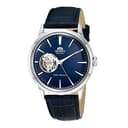
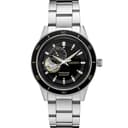
A window in an otherwise ordinary dial, cut where it will frame the balance wheel — the oscillating part, which is the only component in the watch that visibly moves at speed. That is why open hearts are satisfying out of proportion to how little they reveal: the balance is the bit that looks alive. Orient and Seiko have both built this style for decades. Our open-heart roundup is the full field.
Skeleton
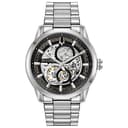
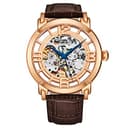
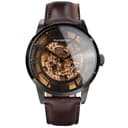
Dial material removed so the movement itself is the face, usually with the bridges and sometimes the mainplate decorated because they are now on show. Often paired with an exhibition caseback so the watch is open from both sides. Our skeleton roundup has the picks.
Semi-skeleton
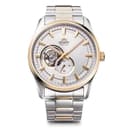
A larger opening than a window but with a dial surface and a full set of markers retained — the Orient Contemporary above is exactly this. In our view it is the format that survives daily wear best, because nothing is sacrificed that you needed.
Legibility: the trade nobody mentions at purchase
This is where the two styles genuinely separate, and it is worth being concrete. Reading the time quickly depends on contrast between the hands and whatever sits behind them. An open heart keeps a solid dial behind both hands everywhere except one small arc, so contrast is preserved. A full skeleton puts moving gold or silver-coloured machinery behind silver-coloured hands, and the hands have to be either heavily lumed, heavily outlined or dark to stay readable.
Good skeletons solve this — that is part of what separates the Bulova Sutton from a $50 skeleton — and a skeleton bought mainly to be looked at does not need to solve it. Just do not buy a full skeleton as your one everyday watch and then be surprised. If a watch you can read in a hurry is a requirement, the open heart is the version of this idea that keeps it.
The disclosure gap, and what to do about it
Here is the pattern laid out:
- Orient Contemporary Semi-Skeleton: Orient publishes caliber F6S22, +25 to −15 seconds a day, about 40 hours, a sapphire crystal and 40.8mm, with hand-winding.
- Seiko Presage SSA425: Seiko publishes caliber 4R39, about 41 hours, a box-shaped Hardlex crystal and 40.8mm.
- Bulova Sutton skeleton: “21-jewel automatic” with a stated 42-hour reserve. No caliber name.
- Stuhrling Winchester 44: “mechanical (self-winding)”. No caliber, no rate, no reserve.
- FORSINING skeleton: “mechanical (self-winding)”. Same.
There is a plausible commercial reason for it, and it is not flattering to the category: a skeleton is sold on how the movement looks, so the maker has no incentive to tell you what it is, and every incentive to buy whichever caliber is cheapest that month. A watch sold on the strength of a caliber has to name the caliber.
What to do with that: treat “21 jewels” and “mechanical self-winding” as the absence of information rather than as a specification, and weight the brand accordingly. A Bulova with no caliber name still comes with Bulova’s warranty and aftercare behind it; an unbranded skeleton with no caliber name comes with nothing. Our guide to what “21 jewels” means unpacks why that number is not the quality claim it looks like.
Durability, and the question of what is behind the hole
Neither style is inherently fragile — the opening is in the dial, not the case, and the case is what keeps water and dust out. What does change is how much dust shows: a speck on a black dial is invisible and a speck on a polished bridge is not. Both styles here are dress-class watches with 50m ratings at best, so they are showering-and-splashes watches rather than swimming ones. Our water resistance guide covers what the numbers actually permit.
One genuine mechanical note: these are movements with roughly 40 to 42 hours of reserve, so they stop on the second day off the wrist. If a watch like this is your occasional dress piece rather than your daily, you will be resetting it every time — which is the one case where a winder earns its place. Our do automatics need a winder guide is the honest version of that calculation.
Which to buy, in one line each
Buy an open heart if this is a watch you will wear regularly and you want the mechanism acknowledged rather than displayed. Buy a semi-skeleton if you want the most movement visible that is still compatible with telling the time — our pick, and the format we would choose ourselves. Buy a full skeleton if the watch is a second or third piece and the point is the object. And if what you actually want is a complication to look at rather than bare gears, a moonphase gives you movement on the dial with the dial intact.