How we picked
1. Legibility above everything
The entire point of a field watch is reading the time instantly, in bad light, without thinking about it. That means high contrast — white or cream on black, or black on white — full Arabic numerals rather than baton markers, and hands that are clearly different lengths and shapes. It also means restraint on the dial: every extra word printed on a dial is a fraction of a second added to reading it. Watches that fail this test are excluded regardless of specification.
2. Case size, which matters more here than anywhere
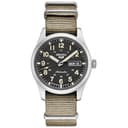
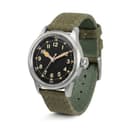
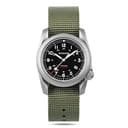
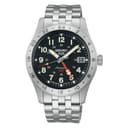
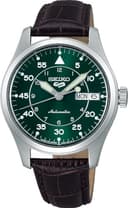
Field watches were historically 32–38mm because they had to fit under a uniform cuff and not snag on anything. Modern ones drift to 42mm and above, which looks the part in a product photo and reads as oversized on a normal wrist. The Seiko SRPJ89 at 36.4mm across and 44.4mm lug-to-lug is the smallest case here and the one to start from on a slim wrist, with the Praesidus A-11 at 38mm and the Boderry at 40mm next. Seiko’s wide 5 Sports bezel does mean those cases read a little larger than their stated diameter, which is worth knowing before you order.
3. A strap you can replace, on lugs you can get at
Field watches live on straps, and straps are consumables. Nylon or canvas is the traditional and correct answer — it dries fast, costs almost nothing and can be swapped in a minute. Leather looks better and is the wrong choice if the watch will get wet, because repeated soaking ruins it. Budget for a spare regardless of what the watch arrives on.
4. A movement that hacks and hand-winds
Hacking — the seconds hand stopping when the crown is pulled — matters more on a field watch than anywhere else, because the whole military lineage of the design is about synchronizing with other people. Hand-winding lets you start a stopped watch properly rather than shaking it. Both are standard on Seiko’s in-house calibers and on the NH35, and frequently absent below that. Our guide to winding an automatic explains why hand-winding is the right way to wake one up.
What “field watch” actually means
The modern field watch descends from the A-11, a United States military specification issued during the Second World War. It was a specification rather than a brand — several manufacturers built to it — and it laid down what the category still looks like: a black dial, white Arabic numerals, a central seconds hand, hacking, and a case small enough to be unobtrusive. Watches built to it were sometimes described as “the watch that won the war”, which is marketing, but the design brief was real and unusually clear-headed.
That history is why a reissue like the Praesidus A-11 is a different proposition from a watch merely styled to look military. One is a reproduction of a specification; the other is a design decision. Both can be good watches — just be clear which you are buying, because the price difference is often explained entirely by that distinction.
Field watch or dive watch?
This is the real cross-shop, and the honest answer is that most people should buy the field watch and don’t.
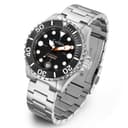
A dive watch gives you a rotating elapsed-time bezel and, if it is properly rated, more water resistance. The bezel is genuinely useful for timing things — parking, cooking, laps — and if you actually dive, it is not optional. But most dive watches are bought by people who will never use the bezel for anything, and who are paying for a thicker, heavier case in order to have it. Our dive watch picks cover the ones that earn their ratings.
A field watch gives you a thinner case, better legibility, a lower price and a watch that goes under a cuff. What you give up is the bezel and, usually, some water resistance — most field watches are rated 50m or 100m, which covers swimming but not diving. What those ratings actually permit is worth reading carefully, because the numbers are far more conservative than they sound.
Titanium, steel, or does it matter?
Titanium has become genuinely affordable in this category — the Boderry gives you a titanium case at $145, which would have been a $500 feature not long ago. It is meaningfully lighter than steel, which you notice within an hour, and it does not provoke the nickel reactions some people get from steel.
The trade is that titanium scratches more visibly. It is harder than steel in some respects, but the surface marks show, and a titanium case that has been worn for three years looks worn in a way a steel one doesn’t. On a field watch, plenty of people consider that a feature. If you want a case that stays looking new, steel is the safer choice.
One watch, or the start of several?
If this is going to be your only mechanical watch, buy the Seiko. Not because it is the best on paper — the Boderry out-specs it for a hundred dollars less — but because Seiko’s parts, servicing and aftermarket support mean you will still be able to keep it running in twenty years, and a one-watch collection is a long-term relationship.
If it is joining others, the calculus changes and the micro-brands become far more attractive. A $145 titanium field watch that eventually becomes unserviceable is a perfectly rational purchase when it is the third watch in a drawer. Our page on whether cheap automatics are worth it works through that trade in detail.
The neighbouring style
Field and pilot watches solve the same problem — maximum legibility, no bezel — from different directions, and buyers cross-shop them constantly. Our automatic pilot watch roundup covers the flieger layout, the Type A versus Type B dial and what the movement actually is in each case.