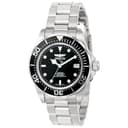
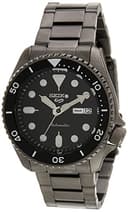
What the 8926OB actually is
A 40mm stainless steel dive-styled automatic with a rotating bezel, a date window, a steel bracelet, and a Japanese automatic movement. It has been in production, in recognizably this form, for a very long time — long enough that its reliability is a known quantity rather than a gamble, which is unusual at this price and is most of why it is the pick on our under-$100 page.
What it genuinely does well
It is a real automatic. Not a quartz with a sweeping seconds hand. A self-winding mechanical movement that runs off the motion of your wrist, stops after a day or two on a shelf, and can be wound at the crown. At this price that alone is the achievement.
The case and bracelet are better than the price suggests. Solid steel, decently finished for the money, with a bracelet that does not feel like an afterthought. Plenty of $200 fashion watches feel cheaper in the hand.
It is everywhere. Enormous production volume means it is almost never out of stock, spare bracelets and bezel inserts are easy to find, and there is a substantial community of owners who have modified, serviced and documented it. For a first mechanical watch, that ecosystem has real value.
It is genuinely disposable. That sounds like an insult and isn’t. If you want to find out whether you like mechanical watches — whether the sweep, the winding, the daily drift are charming or annoying — spending under $100 to answer the question is the cheapest research available. Our page on whether cheap automatics are worth it makes that argument in full.
The two criticisms that are fair
The styling is copied. The 8926OB is a close homage to a very famous Swiss diver, down to the bezel, the case profile and the bracelet. That is legal and common at this price — a homage copies a design without faking a brand — but it means the watch is wearing someone else’s idea, and people who care about that care about it a lot. If it bothers you, the coin-edge variant is the same watch with its own bezel design and is the better buy. If it does not, the 8926OB leads our roundup of the best homage watches, where it sits against five other picks named against the designs they echo.
The branding is loud. Invicta prints its name prominently and the dials carry more text than a watch this simple needs. This is a matter of taste, but it is the single most common reason people who own one stop wearing it.
A third complaint deserves a mention because it is about the seller rather than the watch: Invicta’s stated “list prices” are frequently many times the actual selling price, which makes every listing look like a spectacular discount. Ignore them entirely. The live price shown on this page is the number that matters, and it comes from a daily check rather than a marketing claim.
What you don’t get
A named movement. The listing says “Japanese automatic” and stops there. No caliber, no accuracy figure, no power reserve. That means no benchmark to judge it against and no realistic service path — when it eventually stops, the economics say replace rather than repair. Our guide to automatic watch movements explains why that matters.
Sapphire. Mineral crystal, which will scratch. Sapphire starts appearing around $130–$150.
An ISO dive rating. It looks like a dive watch. It is not a certified one — only a watch marked “DIVER’S” to ISO 6425 is, and that standard requires testing of every individual piece, not a sample. Treat the rating conservatively and read our dive watch guide before you take any watch underwater.
Resale value. Effectively none. Buy it to wear.
Which variant should you buy?
8926OB is the classic: the full homage look, the most-recognized reference, and usually the one people mean when they say “Pro Diver”.
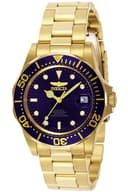
8930 is the cheapest way into the family and one of several references whose listing names the caliber: an NH35A with 24 jewels, in the same 40mm case, 14mm thick, with the same 200m rating. The trade is the finish — this is the gold-tone execution with a blue dial, so it reads as jewelry rather than as a tool watch. The plain-steel 17044 that used to hold this slot is no longer listed on Amazon.
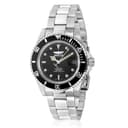
The coin-edge version swaps the bezel for a fluted coin-edge design. It reads dressier, it stops looking like a copy of something specific, and it is our recommendation for anyone who wanted the price but not the homage.
And there are variants outside this case entirely. Invicta also sells a two-tone 8927, a 42mm blue-dialed 29179 and a 48mm Grand Diver rated to 300m, and how much each of them publishes varies reference by reference. Our roundup of the best Invicta automatic watches compares all five on case size, crystal and water resistance, and there is a green 47mm Pro Diver on the green-dial roundup if color is what you are after.
When to spend more instead
Two situations where we would tell you to skip this watch entirely.
If it is going to be your only nice watch. Step up to the Seiko 5 SRPD65. Roughly double the money buys Seiko’s own 4R36 with hacking, hand-winding and a published accuracy range, a 100m case, and a global service network. For a watch you plan to keep, that is a much larger step up than the price difference implies.
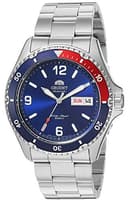
If you actually want a dive watch. The Orient Mako II is a real one, from a company that builds its own movements, at a price that is still reasonable. It is the natural next stop and it appears on our dive watch page for good reason.
But if the budget is genuinely under $100, we are not going to pretend there is a better answer than this. There mostly isn’t, and saying so is more useful than a knowing remark about the brand.
The other comparison worth reading before you buy is against Citizen’s mechanical divers: Invicta Pro Diver vs Citizen Promaster, which is really a comparison of how much each maker is willing to publish about the movement inside.
The step up from here is an Orient, and it is worth understanding exactly what the extra money buys: a named in-house caliber, a published 40-hour reserve, a sapphire crystal and a design Orient drew itself. We lay it out figure by figure in Orient Kamasu vs Invicta Pro Diver.