The four differences that are actually documented
1. The crystal
The Kamasu has a sapphire crystal; the Pro Diver has mineral. This is the most visible long-term difference between them, because it is the part of a watch that collects damage from ordinary life. Sapphire (corundum) is 9 on the Mohs scale and quartz is 7, and everyday grit is largely quartz — so mineral glass accumulates fine scratches from doorframes, desks and sand, and sapphire does not. In five years the Orient will still look new through the glass and the Invicta probably will not. Our crystal comparison has the detail.
2. The named movement
Orient states the F6922, which it builds itself, and states that it hacks (the seconds hand stops when you pull the crown) and hand-winds. Invicta names “IM-A-005” on the 8926OB, and publishes neither a power reserve nor an accuracy figure for it, so both rows read “Not published” in our table. If you want the Invicta price with a named caliber, the 8930 listing above states an NH35A with 24 jewels — the same Seiko-made movement half the budget diver market runs. What hacking and hand-winding are worth in practice is a matter of how you use the watch, not of status.
3. The size, which Orient publishes and Invicta mostly does not
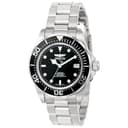
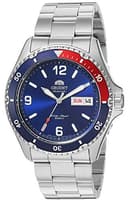
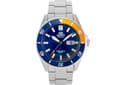
Orient states 41.88mm across and 47mm lug-to-lug for the Kamasu, 41.5mm and 47mm for the Mako II, and 44mm and 50.5mm for the Kanno. The Pro Diver listings state 40mm diameter and nothing else. Diameter alone is the weakest predictor of fit — the lug span is what decides overhang — so the Orient range is the one you can shop by measurement. If your wrist is under about 6.5 inches, that matters more than the crystal. See the watch size guide for the method.
4. Who made the design
The Kamasu and the Kanno are Orient’s own dive designs. The Pro Diver is a Submariner homage down to the coin-edge bezel, and Invicta has never pretended otherwise. There is nothing illegitimate about an homage — it is a long established corner of the market — but it is a different purchase from a design its maker drew, and if that distinction matters to you it outranks every number on this page. Our homage roundup draws the line between an homage, a replica and a frankenwatch.
What the two have in common
More than the price gap suggests. Both state a 200m water-resistance rating with a unidirectional bezel. Both are automatics that will run for decades with occasional attention. Neither states ISO 6425 compliance, which is the standard that requires a lockable elapsed-time bezel, dark legibility and pressure testing of every individual watch before a dial can read “DIVER’S”. Both are comfortably swimming watches and neither is a scuba instrument on paper. The practical reading of those ratings is in can you swim with an automatic watch.
Orient is not an independent underdog — and that is good news
Worth knowing, because it changes how you read the brand: Orient began in 1950 and, per its own history page, merged with Seiko Epson in 2017, which now operates both the Orient and Orient Star brands “from planning to manufacturing”. So an Orient diver at this price is not a marketplace brand that bought in a movement. It is a watch designed and built inside one of the two Japanese groups that make their own calibers at scale. That is the actual reason the Kamasu reads as more watch than its price — and why we put it up against Seiko rather than against Amazon brands in Seiko vs Orient vs Citizen.
The honest recommendation, by budget
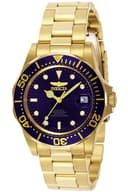
Under about $150, buy the Invicta — there is no credible alternative with a real automatic movement, and the 8926OB is the version to get rather than the gold-tone executions. Between $150 and $250, buy the Orient Mako II: the same in-house F6922 as the Kamasu, 200m, mineral crystal, and the cheapest route into a watch whose maker publishes everything. Above $250, buy the Kamasu and stop shopping — sapphire is the one upgrade over the Mako II and it is the upgrade that keeps mattering. If your wrist is big enough to carry 44mm and 50.5mm lug-to-lug, the Kanno usually undercuts the Kamasu for the same movement. The full lists are best automatic dive watches and the sub-$200 divers.