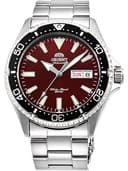
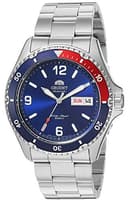
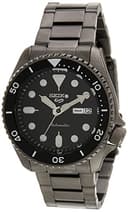
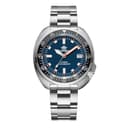
The two sheets, side by side
These figures are Orient’s, not ours, and they are the whole argument:
- Caliber — F6922 on both, with hacking and hand-winding, approximately 40 hours of reserve on both.
- Crystal — sapphire on the Kamasu, mineral on the Mako II. The only substantive difference.
- Diameter — 41.88mm (Kamasu) against 41.5mm (Mako II).
- Thickness — 12.8mm against 13mm.
- Lug-to-lug — 47mm on both. Lug width — 22mm on both.
- Water resistance — 200m on both, with a screw-down crown on both.
- Bezel — 120-click unidirectional on both.
Note what is not on that list: nothing about finishing, nothing about accuracy, nothing about the bracelet. Orient does not publish a daily rate for either reference, so neither spec table below carries one — a null is a finding, not a gap in our research.
Why the crystal is the entire decision
Sapphire sits at 9 on the Mohs hardness scale. Ordinary mineral glass sits at about 5.5. The grit in everyday dust is largely quartz, at roughly 7 — hard enough to mark mineral glass and not hard enough to touch sapphire. That is the mechanism behind every “my watch looks tired after two years” complaint, and it is why the Kamasu is the one that still looks new in 2031.
The counter-argument is real and rarely made: mineral glass tolerates a sharp impact better than sapphire, which is harder but more brittle. A watch that spends its life near brick and steel is arguably better served by the Mako II. Our crystal comparison works through both directions, and the sapphire roundup covers the wider field of automatics that fit it.
Who should buy which
Buy the Kamasu if this is going to be your daily watch for years, if you are the sort of person who notices a hairline scratch across a dial, or if you want the specification that resells most easily. It is the better watch on paper and the difference is permanent.
Buy the Mako II if you rotate several watches, if this is your first automatic and you are still working out whether you like divers at all, or if the saving takes you from “thinking about it” to “wearing it.” You are giving up scratch resistance on a watch that is otherwise identical, and you are getting a genuine in-house Japanese automatic for the price of a fashion-brand quartz.
Buy neither if you actually want a bigger watch, which is where the Kanno comes in: Orient publishes 44mm across, 50.5mm lug-to-lug and 12.9mm thick. That is 3.5mm more lug span than either watch here, which is the dimension that decides overhang. The big-wrist roundup has the wider field at that size, and the size guide covers measuring your own ceiling first.
The Ray II footnote
One thing that trips up anybody comparing Orient divers: the Ray II. Orient publishes exactly the same figures for it as for the Mako II — caliber F6922, approximately 40 hours, mineral crystal, 41.5mm, 47mm lug-to-lug, 13mm thick, 22mm lugs, 200m, screw-down crown, 120-click unidirectional bezel. The two watches differ in the dial and the hands, not in a single dimension. If you are agonising between a Mako II and a Ray II, you are choosing a face, and you should pick the one you like looking at.
Where these sit in the wider market
Against Seiko, the comparison is unflattering for Seiko on paper and kinder in practice. A 5 Sports SRPD65 is stated at 10 bar rather than a 200m diver’s rating, has no screw-down crown listed on Seiko’s sheet, and uses Hardlex rather than sapphire — but it costs less, it holds resale value, and Seiko will service it anywhere in the world. Our Seiko vs Orient vs Citizen comparison takes that apart, and best Orient watches ranks Orient’s whole range including both watches here.
Against the micro-brands, both Orients cost more than an NH35 diver with a sapphire crystal and a 200m rating — and both are buying you something the micro-brands cannot: a caliber Orient designed and builds itself, a published spec sheet, and a service path. Our sub-$200 dive roundup is the honest version of the cheaper option.