How to judge a leather strap you cannot touch
1. Read the grade, and notice when there isn’t one
Work down the ladder. Full-grainkeeps the hide’s original surface, which is why it develops a patina instead of wearing through; it is the only grade worth paying extra for. Top-grain is the next layer down and is the commonest good-quality strap. Corrected-grain has been sanded and embossed to look uniform, which is exactly why cheap straps all look identical and all crack in the same place. Bonded leather is shredded scrap in a polyurethane binder, and as little as 10% of it needs to be leather fiber.
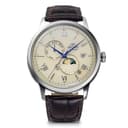
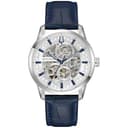
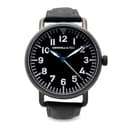
Now the uncomfortable part: noneof the six references on this page states which of those grades it used. Four say “leather” or “leather band” and stop. The two that do better — Orient with its 21mm band, Bulova with an embossed strap and a 20mm lug width — give you the width and the finish and still never name the grade. So price is the only proxy you have, and it is a weak one.
Which leads to the most practical advice on this page: on anything under about $200, assume the strap is the part the budget ran out onand price in a $20-$40 replacement. That is not a criticism of these watches — a good steel case, a working automatic movement and an honest crystal for $60 to $170 is a genuinely good deal, and the strap is where that deal was paid for.
2. Lug width is the number you actually need
To replace a strap you need the lug width in millimeters, and most listings do not publish it. Two here do. Orient states 21mmfor the Bambino Sun & Moon, which is also the awkward size — less aftermarket choice than 20mm or 22mm, and much better to know before you buy. Bulova states 20mm for the Sutton 96A330, which is the easiest width in the world to shop for.
For the other four you will be measuring the gap between the lugs yourself with a ruler, or reading owner comments. If you are buying a watch mainly to put your own strap on it, that is a real cost of the information gap, and it is worth picking a reference where the number is published.
3. Leather and water do not mix — and the rating is about the case
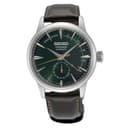
This is the mistake that ruins more straps than wear does. A watch’s water-resistance rating describes the case, not the strap. The Orient here is rated 30m and the Seiko 50m; both will survive a splash, and the leather on either will stiffen, darken and eventually crack if you repeatedly soak it. Sweat does the same thing more slowly. If you swim, run or work in the heat in the same watch every day, buy the watch for the case and the movement and put it on rubber or a steel bracelet for those days.
Our water-resistance guide explains what each rating actually permits, and whether you can swim with an automatic covers the case side of the same question.
4. A leather strap makes a crystal matter more
Leather-strap automatics are, overwhelmingly, dress and vintage-style watches — which means they live on a cuff, get knocked against door frames and desk edges, and are looked at closely in good light. Two of the six picks here state a hard crystal: the Bulova Sutton 96A330 states an anti-reflective domed sapphire, and Seiko’s Presage SSA459 uses a box-shaped Hardlex, Seiko’s own hardened mineral glass. The Orient uses a domed box mineral. The three cheapest publish no crystal material at all.
If a scratch-free face matters on a watch you will wear to events, start with the automatics that publish a sapphire crystal and work back from there; the sapphire vs mineral comparison has the hardness figures.
Leather, steel or rubber: picking the right band
Leather is the right default for a dress or vintage-style watch, for a watch you wear with a jacket, and for anyone who finds a steel bracelet heavy or cold. It is the wrong default for a diver, for a watch you wear in the gym, and for anyone whose skin reacts to a dyed strap in the heat.
The useful thing about this particular choice is how cheap it is to reverse. A steel bracelet costs what the watch costs; a strap costs about what a lunch costs. Several of the watches on this page are strong buys mainly becauseyou can change the strap and get a second watch out of them — which is also why we do not grade any pick down for a mediocre band. We grade it down for a mediocre case, crystal or movement, because those are the parts you keep.
If you want the case metal to be the story instead of the strap, our titanium automatic roundupis the other half of this material argument — lighter, softer, and much better documented than any strap on this page. And for the dress watches these picks compete with on steel, see the best automatic dress watches and vintage-style automatics.
Caring for a leather watch strap
Three things do nearly all the damage: water, heat and being worn every single day without a rest. Leather is a skin; it absorbs sweat, swells, dries and stiffens. A strap worn five days a week lasts roughly twice as long as the same strap worn seven, which is the cheapest maintenance advice there is — rotate two watches, or two straps.
Beyond that: wear it a hole looser than feels right in hot weather so air can get between the strap and your wrist, wipe it dry rather than letting sweat dry into it, keep it out of direct sun when you take it off, and leave conditioners alone unless the strap is genuinely dry — most are oil-based and will darken a light strap permanently. And when it does finally crack at the spring-bar holes, replace it. That is the strap doing its job as the part designed to fail first.
If the watch itself stops when you leave it off for a couple of days, that is normal automatic behavior, not a fault: letting an automatic stop is harmless, and a single watch winder only earns its keep once resetting it becomes a chore.