The caliber decides the calendar, and the caliber is published
This is the whole shortcut. You do not need to squint at a product photo to work out whether a watch has a day window; you need to read one line of the spec sheet. Here is what the three makers on this page publish, in their own documents.
Seiko: 4R36 yes, 4R35 no, 4R34 no
Seiko covers seven calibers in a single instruction booklet — 4R35, 4R36, 4R37, 4R38, 4R39, 4R71 and 4R72 — and the contents page alone settles the question. One section is titled “How to set the time and date (4R35).” The next is titled “How to set the time, date, and day of the week(4R36).” In the specification table only the 4R36 lists a date/day of the week display; the 4R35 and 4R37 are date only, and the 4R38, 4R71 and 4R72 have no calendar at all. Everything else about them matches: 21,600 vibrations per hour, approximately 41 hours of reserve, +45 to -35 seconds a day at normal temperatures.
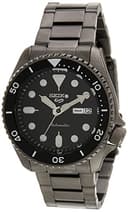
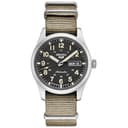
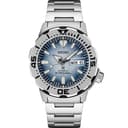
That single fact sorts most of Seiko’s catalog for you. The 5 Sports references and the 4R36 Prospex divers on this page have a day window. The Presage Cocktail Time line runs the 4R35, so it has a date and no day — which is correct for a dress watch and is also why it is not on this page. Our Seiko brand roundup maps the whole range line by line if you want the wider picture.
Citizen: 8200 yes, 8210 no — from the same manual
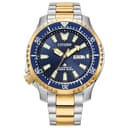
Citizen publishes one instruction manual covering calibers 8200 and 8210 together. Both run at 21,600 oscillations per hour, both wind automatically, both have a quick-set date — and the manual states the day of the week is on the 8200 only. That is the reason the Tsuyosa, which Citizen builds on the 8210, shows a date and nothing else, while the Sport Automatic on the 8200 shows both. Two watches, one manual, one wheel of difference.
Orient: the F6922 has both, across the whole diver line
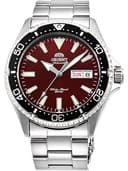
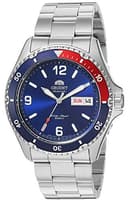
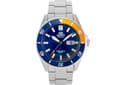
Orient makes it simple. Open Orient Watch USA’s sheet for the Kamasu, the Mako II or the Kanno and the feature line reads identically on all three: “Day, Date, Luminous Hour Markers And Hands.” Same caliber F6922, same approximately 40-hour reserve, same hacking and hand-winding, same 200m and screw-down crown. Three of our seven picks are Orients for exactly that reason — it is the only line at this money where the day-date is the default rather than the exception. The Orient brand roundup covers what separates them once the calendar is a given.
What the rule excluded, and why that is the useful part
Five watches we rate elsewhere on this site did not make it. Each exclusion tells you something you would otherwise learn after paying.
- Seiko 5 Sports GMT (SSK003) — the obvious assumption is that a 5 Sports GMT is a 5 Sports with a second time zone added. It is not. Seiko publishes “Date display” and a “24-hour hand (dual time display function)” for the SSK003, because the 4R34 spends the day wheel on the GMT hand. If you want both, you are buying two watches. Our Seiko 5 GMT review makes the case for it on its own terms.
- Citizen Tsuyosa — caliber 8210, so date only, per Citizen’s own manual. It is an excellent watch and the site recommends it repeatedly; it simply cannot be on a day-date page. Seiko 5 Sports vs Citizen Tsuyosa is the head-to-head, and the calendar is one of the real differences between them.
- Seiko Presage Cocktail Time — caliber 4R35. Date, no day, by design. The Presage roundup covers which reference to buy when the calendar is not the point.
- Citizen Promaster Dive NY0129-07L — the closest miss on the page. The retail listing names it as a day-date, and we have no particular reason to doubt that, but Citizen’s own site returns a 404 for the reference, so there is no maker document to check it against. Our rule here is the maker’s sheet for the exact reference, so it stays off. It appears on the dive roundup where the water resistance is the claim being made.
- Invicta Pro Diver, and most sub-$150 automatics — Invicta labels its movement only as “IM-A-005” and publishes no caliber specification at all, so there is no document that says what its calendar does. The same is true of most OLEVS, FORSINING and unbranded NH35 listings: they may well have a day wheel, but nobody publishes it. That is the honest reason the cheapest confirmed day-date on this page is a $240 Orient rather than a $90 diver — and our Pro Diver review argues for that watch on the things Invicta does state.
Setting a day-date without breaking it
This is the part that costs people money, and it is written down by every maker. Seiko’s instructions for the 4R36 say the date and the day of the week are both adjusted from the first crown click, and the time from the second. They also carry an explicit caution: “Do not set the date or the day of the week between 9:00 p.m. and 4:00 a.m.” Seiko’s stated reason is that doing so “may cause problems such as the date or the day of the week failing to change the next day or may cause damage.”
The mechanism behind that warning is simple. A calendar watch spends several hours around midnight with its date and day wheels already engaged and slowly turning over. Forcing the quick-set while those parts are under load is how a calendar jumper gets bent. The safe habit is to move the hands to roughly 6 or 7 o’clock first, set the calendar, then set the time — and remember that a watch with a 12-hour dial has no idea whether you mean morning or evening, so wind the hands past 12 once to confirm the date flips before you settle on the time. The exact window varies by caliber — our guide to setting an automatic covers the general rule; the figure quoted above is Seiko’s own, for this movement.
The second thing worth knowing: none of these is a perpetual calendar. Seiko states plainly that the date needs adjusting by hand at the end of February and every 30-day month. That is five corrections a year on any watch on this page. If that sounds tedious, it is the strongest practical argument for either wearing the watch constantly or storing it properly so the corrections stay predictable.
What a day window actually costs you
Three trade-offs, in the order they matter.
Dial space. A day and a date at three o’clock is a wide aperture, and it eats the 3 marker entirely. On a busy dive dial that is invisible; on a clean dress dial it breaks the symmetry, which is why Seiko keeps the 4R35 in the Presage line and the 4R36 in the 5 Sports and Prospex lines. If you want a dress automatic, the honest answer is usually to give up the day — our dress roundup is built on exactly that assumption.
More resetting, not less. Two displays to correct instead of one, five times a year, plus every time the watch stops. An automatic with roughly 40 hours of reserve that comes off on Friday evening is stopped by Sunday lunchtime; that is normal, not a fault, and why an automatic stops covers it. This is also the one genuine case where a winder earns its keep — not for the movement’s sake, but because you stop resetting a calendar you hate resetting.
Not much thickness, and no accuracy penalty. Seiko publishes 13.4mm for the 4R36-powered SRPD65 and 13.4mm for the 4R36-powered SRPG57, and the 4R35 Presage references in the same catalog are not meaningfully thinner for losing the day. The accuracy figure is identical across the family: +45 to -35 seconds a day. The day wheel is an extra part, not an extra compromise.
How to choose between the seven
All seven publish the same calendar, so the decision comes down to three specifications that are also published.
Crystal. Only two picks here have sapphire: the Orient Kamasu and the Citizen Fugu. Everything else is mineral or Seiko’s Hardlex, which scratches. Over five years that is the difference you will actually notice, and the sapphire versus mineral comparison works through what the hardness figures mean in practice. It is also the entire Kamasu-versus-Mako-II decision — same movement, same case, same calendar, different glass.
Water resistance, and the word on the dial. Orient publishes 200m with a screw-down crown for all three of its divers here. Seiko publishes “10 bar” for the 5 Sports references and “200m diver’s” for the SRPG57 — and that word diver’s is regulated, not marketing. Citizen describes the Fugu as ISO compliant with a screw-down crown at 200 meters. Our water resistance guide explains what each marking permits.
Size, measured properly. The published diameters here run 39.4mm to 44mm, and diameter is the less useful number. Seiko publishes 48.1mm lug-to-lug for the 39.4mm SRPG35 and 46.0mm for the much wider 42.5mm SRPD65 — the smaller watch has the longer lug span. Orient publishes 47mm for both the Kamasu and the Mako II and 50.5mm for the 44mm Kanno, which is the number that makes the Kanno a big-wrist watch rather than just a wide one. The watch size guide covers measuring your own wrist, and the big-wrist roundup is the page to read if 44mm sounds right.