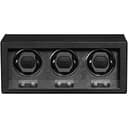
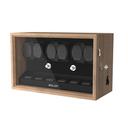
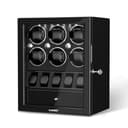
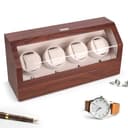
How we picked
1. A live price under $500 on the day we checked
The band is verified against our own price layer rather than against a list price, and the date is stamped on this page. Winder prices move constantly on Amazon — several picks here have carried a struck-through list price at some point in the last quarter — so a page that quotes a band has to say when it looked.
2. Then: does the maker publish a number?
Only one pick in this band prints a turns-per-day range: Rothwell, at 650–1,950 across five speeds and three directions, set per watch. Barrington publishes a full TPD range and a direction choice without naming the endpoints. Everything else — DUKWIN, Heiden, XTELARY, and WOLF beyond its flat 900 TPD figure — describes “multiple rotation modes” and leaves it there. On a $360 cabinet that is a genuinely poor showing, and it is the main reason the cabinets rank below the Rothwell rather than above it. Our adjustable-TPD roundup is built entirely around this distinction.
3. Then: lock, storage, or neither
Three picks combine powered positions with static storage, which is the format that matches how people actually own watches — a few in rotation, the rest waiting. Be clear-eyed about the locks: a key or a fingerprint reader on a wooden cabinet deters a casual hand and keeps children out of it. It is not a safe, and no maker on this page claims otherwise. Our lockable winder page goes further into what those locks are worth.
4. Then: where it has to live
Only the Rothwell runs on batteries here, which is worth noticing if the plan is to keep the winder inside a safe with no socket. The cabinets are mains-only and large enough that they need a dedicated surface — a six-position wooden box is a piece of furniture, not a dresser accessory.
Cabinet or badge: which half of the band are you in?
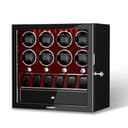
You rotate four or more automatics. Buy capacity. The XTELARY 6+6 at about $175 is the value answer and the DUKWIN six-position cabinet the nicer one; the eight-position DUKWIN exists for collections where a second winder plus a separate box would cost more and look worse. The Heiden quad is the pick when the four watches in it are worth protecting — its listing states a no-magnets construction, which answers the one genuine mechanical risk a winder carries. See the multi-watch winder roundup for the rest of that field.
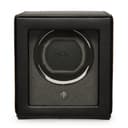
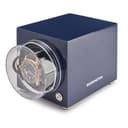
You rotate one or two. Buy build. The WOLF Cub counts turns rather than estimating them from a timer and uses WOLF’s patented lock-in cuff; the Barrington gives you exact TPD and direction plus battery power and modules that stack later. Both are singles, both cost more than boxes holding six watches, and both are defensible if the watch on the cuff is worth several thousand dollars. Our single winder page and winder brand rankings cover that argument in full.
You are somewhere in between. Three positions with published settings — the Rothwell — is the most broadly correct answer in this band, which is why it is the top pick. It costs half what the cabinets do, states what it is doing, and will take a fourth watch in storage elsewhere.
What $500 does not buy
A published maximum case size. Not one pick here states the largest watch it will hold. On a cabinet costing $360 that is remarkable, and it is the number most buyers actually want.
Security. A lock on a wooden lid is a deterrent. If the collection in it justifies a safe, buy a safe and put a battery-powered winder inside it.
A reason to wind watches you do not wear. A winder keeps a watch set, not healthy. Buying eight positions for a collection where four watches sit untouched for months is the classic overspend in this band — how many watch winders do I need is the arithmetic, and winder vs watch box is the cheaper conclusion a lot of people should reach.