What a Seiko 5 Sports actually is, in Seiko’s own words
Worth laying out plainly, because every comparison below is against this and not against a reputation. For the SRPK99 Seiko publishes: caliber 4R36, automatic with manual winding, roughly 41 hours of power reserve, a 42.5 mm case 14.2 mm thick with a 46.0 mm lug-to-lug, a curved Hardlex crystal, a day and date display, a see-through screw case back, a three-fold clasp and 10 bar water resistance. For the field-style SRPG37 it publishes the same caliber and reserve in a 39.4 mm case 13.2 mm thick, again with curved Hardlex and 10 bar, weighing 77 g.
Seiko publishes no daily accuracy figure for either reference. The 4R36 caliber sheet does, and it is wide: +45 to −35 seconds a day worn on the wrist, at 24 jewels and 21,600 vibrations an hour. That is a workhorse specification, not a regulated one — a certified chronometer must average −4 to +6 seconds a day under COSC testing — and it is the single number most often used to argue for an alternative.
Two of the 5 Sports’ real strengths are not on the sheet at all, and no watch below replaces them: Seiko made the movement, and Seiko will service it almost anywhere in the world. Three of the seven picks here are from brands with no service operation whatsoever.
The alternatives, by what you are actually after
“Like a Seiko 5, but with sapphire”
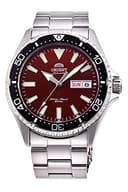
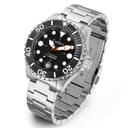
The clearest answer is the Orient Kamasu. Orient sits inside the same group as Seiko and still builds its own calibers, so this is not a step down in provenance: the F6922 hacks, hand-winds and drives a day and a date just like the 4R36, publishes about 40 hours of reserve, and sits under a sapphire crystal on a case Orient rates at 200 m with a screw-down crown and a 120-click unidirectional bezel. On our latest check it cost less than the SRPK99. The trade-offs are honest ones: Orient publishes a 47 mm lug-to-lug for the Kamasu — a millimeter longerthan the SRPK99 you may be leaving because it is too big — and no accuracy figure for the caliber either.
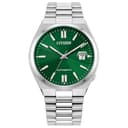
For something that is not a diver, the Citizen Tsuyosa is the other sapphire answer: Citizen’s own 8210 automatic, a 40 mm case, a 42-hour reserve and an integrated bracelet, which is a silhouette the 5 Sports simply does not offer. It costs more than a 5 Sports rather than less, and its 50 m rating is splash resistance rather than swimming. Our Seiko 5 versus Tsuyosa comparison runs that choice properly, and our sapphire-under-$200 page shows what the same crystal costs if you drop the brand name.
“Like a Seiko 5, but the numbers on paper are tighter”
The TOPHILL Miyota 9015 is the only pick here whose movement comes with a published accuracy band: Miyota states −10 to +30 seconds a day, 24 jewels, 28,800 vibrations an hour and about 42 hours of reserve for the 9015. The higher beat rate gives a visibly smoother seconds sweep than the 4R36’s 21,600, and the 9015 is a thinner movement, which is why it appears in slimmer watches. It also has sapphire and a stated 5 ATM, in a 40 mm dress case, for less than either Seiko.
Read the cost honestly: TOPHILL is a micro-brand with no service network, the 9015’s rotor is famously audible when it spins, and a published band is a factory specification rather than a promise about your individual watch. A well-behaved 4R36 and a well-behaved 9015 will both land within a handful of seconds a day in practice. Our NH35 versus Miyota 9015 comparison covers the two calibers in detail, and our accuracy guide explains what any of these numbers mean on a wrist.
“Like a Seiko 5, but smaller”
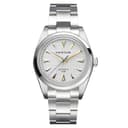
Seiko’s own in-family answer is the SRPG37 at 39.4 mm, and it is a good one. Below that, the Hestur Miyota 9015 Vintage is a 36 mm case with a domedsapphire crystal, BGW-9 luminous material and a solid steel bracelet rather than hollow links — a combination that is genuinely rare in a small watch. Its listing’s water-resistance wording is unclear enough that we have recorded no figure at all, which is a real gap rather than a quibble: assume splash resistance and nothing more.
Our small-wrist roundup and 38 mm page cover fit in full. The thing worth repeating is that the SRPK99’s 46.0 mm lug-to-lug matters more than its 42.5 mm diameter, and almost nothing at this price publishes lug-to-lug at all — Seiko is one of the few makers that does, which is a point in its favor even when the number is the problem.
“Like a Seiko 5, but cheaper”
Two answers, and they are different kinds of cheap.
The CADISEN NH35A is the closest thing on this page to a 5 Sports mechanically, for roughly half the money. The NH35 is Seiko Instruments’ unbranded workhorse — the same family as the 4R35 in Seiko’s own watches — so it hacks, hand-winds, and any independent watchmaker can service or swap it. In a 40 mm steel case that is a lot of watch for the price. What you are buying instead of brand: no resale value, fair rather than fine case finishing, and a listing that publishes neither a crystal nor a water-resistance figure, both of which we have left blank rather than guessed. Our NH35 roundup covers the caliber across the whole registry.
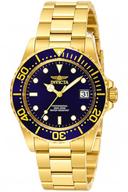
The Invicta Pro Diver 8930 is the cheapest route into a Japanese automatic movement full stop, at under $100. Its listing names the caliber — NH35A, 24 jewels — and publishes a 40 mm case 14 mm thick, an exhibition case back, a screw-down crown and a 200 m rating, which is more documentation than Invicta gives most of its range. The catch is the execution: this is the gold-tone version with a blue dial, the crystal is mineral, and gold-tone plating wears through at the edges over years. Our Seiko 5 versus Invicta Pro Diver page is the head-to-head, and our Invicta roundup covers which references publish what.
“Like a Seiko 5, but from a brand I have heard of”
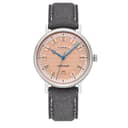
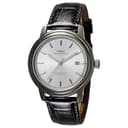
The Timex Waterbury Automatic is the one pick here from a mainstream high-street brand that still undercuts the Seiko, with a warranty and a returns channel behind it. Timex states a 50 m rating and self-winding, and the Waterbury styling is its own rather than borrowed from anybody. The honest limits: the crystal is mineral, 50 m means handwashing and not swimming, and Timex publishes neither a caliber nor an accuracy figure, so most of its spec rows above read “Not published.” If a documented movement is why you were looking at a Seiko in the first place, this is a step backwards on exactly that point.
What no alternative replaces
A movement made by the brand on the dial. Only two picks here manage it — the Orient Kamasu and the Citizen Tsuyosa — and both come from the two other Japanese houses that build their own calibers. Everything else on this page buys its movement in. Our Japanese-brand page is built on exactly that distinction.
Service and resale. Seiko’s service network is the reason a fifteen-year-old 5 is still a usable watch, and a 5 Sports holds a meaningful fraction of its price secondhand. A micro-brand automatic is worth what somebody will pay for a used micro-brand automatic. If you expect to trade up within a couple of years, that gap is a real cost and it does not appear on any spec sheet.
The day-of-week wheel, in most cases. The 4R36 is one of very few calibers at this price that drives a day and a date, and exactly one pick on this page matches it: Orient publishes day and date for the F6922 in the Kamasu. Everything else here is date-only or publishes no calendar detail for the reference. If the calendar is the reason you were buying, our day-date roundup is the page to read instead of this one.
And the specification sheet itself. Seiko publishes diameter, thickness, lug-to-lug, crystal, clasp, case back and magnetic resistance for individual references. Of the seven watches below, one publishes no case diameter, one publishes no crystal, and two publish no water-resistance figure at all. The ability to check a number before buying is worth something, and the 5 Sports is unusually good at giving it to you.
So should you just buy the Seiko?
Often, yes — and we would rather say that than pretend otherwise. If you want one dependable mechanical watch with a day-date, a brand that will service it and a published spec sheet, buy the SRPG37 at 39.4 mm or the SRPK99 if you have the wrist for 46 mm between the lugs, and stop reading.
Go elsewhere for one of four specific reasons: you want sapphire (Kamasu, Tsuyosa, TOPHILL, Hestur), you want a real diver’s case with a screw-down crown (Kamasu), you want a case under 38 mm (Hestur), or you want to spend half as much and accept the brand risk (CADISEN, Invicta). If you are deciding between the 5 Sports and Seiko’s own dive line instead, that is a different question and Seiko 5 versus Prospex answers it.